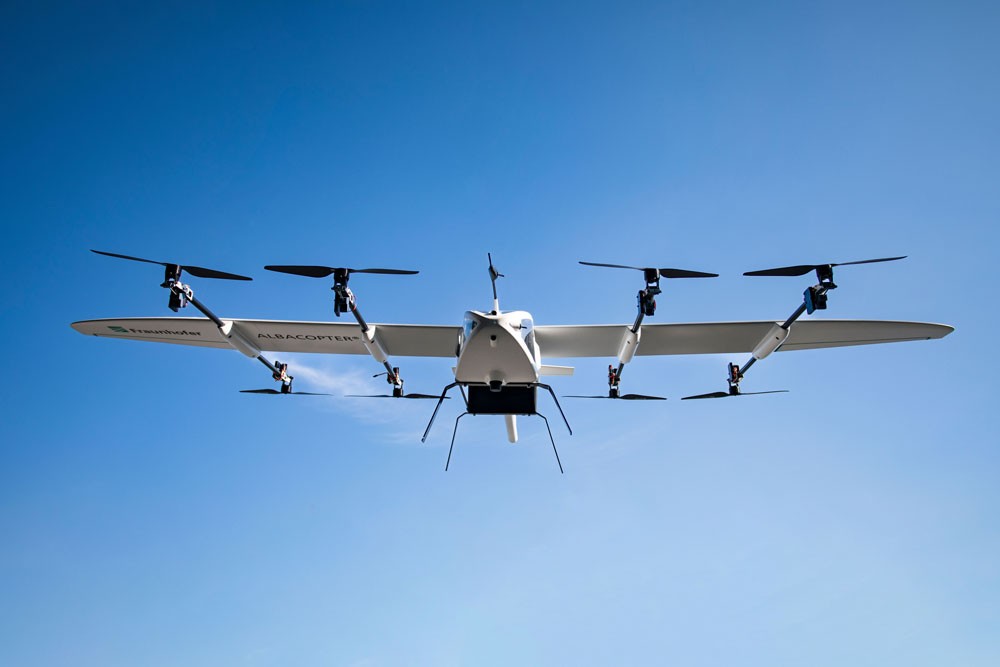

Urban Air Mobility (UAM) opens up new opportunities in freight transport. In addition, if part of urban traffic goes airborne, it offers completely new approaches with regard to sustainable mobility solutions. In the Fraunhofer Albacopter Lighthouse Project, six Fraunhofer institutes are working on the technical and social aspects of UAM. Led by the Fraunhofer Institute for Transportation and Infrastructure Systems IVI, researchers developed an aircraft that glides in a particularly efficient way - inspired by the albatross.
UAM has stringent requirements for aircraft and system technology, including safe, quiet VTOL (vertical take-off and landing/vertical take-off and landing) systems that can also deliver very powerful propulsion performance when hovering.
The challenges of urban air transport
Electric multicopters offer the benefits of vertical take-off and landing while also meeting safety and environmental criteria. However, their range and payload are extremely limited due to their low efficiency and low energy storage density. Larger wings could significantly improve the aircraft's energy balance by allowing them to hover for longer periods. On the other hand, these wings would make take-off and landing in urban areas more difficult. Moreover, to make UAM financially viable, aircraft that take off and land vertically are needed that can also fly autonomously. However, this would require AI-based control systems, which pose further safety risks.
It can be expected that UAM will have various applications in the future. Think of application scenarios in the field of logistics drones, aerial taxis, rescue and surveillance drones or in agricultural technology.
The Fraunhofer Albacopter project
In 2021, Fraunhofer launched a project aiming to build a flying platform that can combine the agility of a multicopter with the efficiency of a glider. "With the Albacopter, we want to develop an experimental aircraft that combines the agility of a multicopter with the ability of an albatross to hover long distances with minimal use of energy." So says Prof Matthias Klingner, project manager and director of Fraunhofer IVI. "Some exceptional features of this experimental glider include drone systems and cargo containers made of sustainable materials. In addition, it includes powerful coaxial propulsion systems, powerful multi-sensor systems for sensing the environment and monitoring functionalities, and safe electronic systems, including an AI-based autopilot," he continued. The consortium tackled the complexity of this drone design by combining the expertise of the participating institutes.
Materials
The Fraunhofer Institute for Structural Durability and System Reliability LBF designed the structure and aerodynamic components of the Albacopter. For the structure, the Fraunhofer Institute for Chemical Technology ICT developed pultrusion profiles. That is, fibre-reinforced thermoplastics that were integrated into the fuselage architecture of the space frame. Like the transport containers, which are made of biopolymer rigid foam, these system components can be easily recycled.
Propulsion Albacopter
"The efficient propulsion design of the Albacopter is based on fast synchronous motors with multi-stage gearing and high power density," explains Prof Frank Henning, director of Fraunhofer ICT. The institute not only supplies the new propulsion technology. It also provides a special propulsion test stand to facilitate testing of eVTOL propulsion systems in power classes up to 450 kW under realistic conditions.
Battery storage system
"The design of the battery storage system in Albacopter is based on cycle-resistant secondary cells that guarantee highly reversible charging and discharging processes. We have conducted detailed research on cell degradation and possible failure mechanisms," explains Prof Tobias Melz, director of Fraunhofer LBF.
Advanced sensors and artificial intelligence
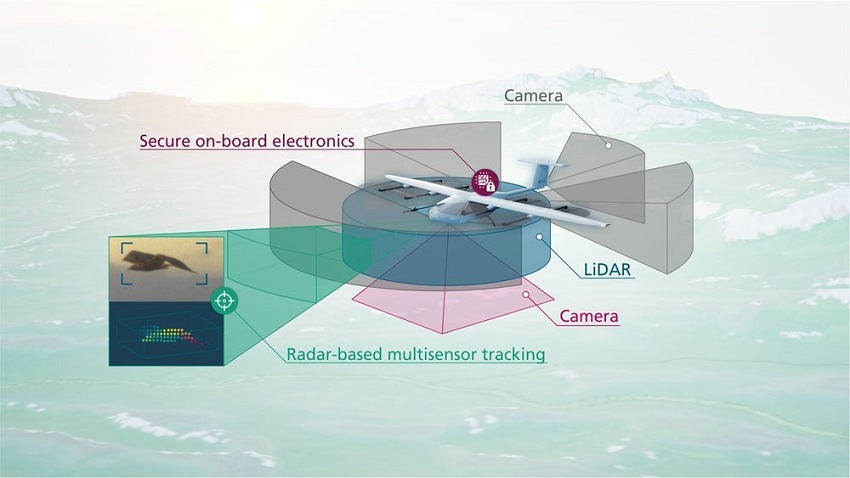
Robust, lightweight, high-performance multi-sensor systems are combined with sensitive single-photon LiDAR detectors. These detectors were developed by the Fraunhofer Institute for Microelectronic Circuits and Systems IMS. This enables 360-degree environmental monitoring. "The semantic 3D reconstruction of the environment is then performed based on reliable AI systems. Combined with intelligent trajectory planning, this enables innovative functions such as autonomous (emergency) landing, one of the Albacopter's key safety functions." So says Henri Meeß, manager of the Highly Automated Flying group at Fraunhofer IVI.
Total system
Together with a fail-safe RISC-V on-board network architecture, continuous monitoring, stable 5G communications and a redundant autopilot, this results in a total system. A system that meets the high reliability requirements of the UAM. Subordinate to the autopilot is the model-based flight attitude control system from the Fraunhofer Institute for Mechatronics Design IEM. This system exhibits stable control behaviour, especially in the critical transition phases between hovering and gliding.
Autonomous from the start
The Albacopter is intended as a demonstration model for Fraunhofer technologies. Demand for this is expected to rise sharply over the next five to eight years in the rapidly growing aviation and logistics sectors. As a VTOL glider, the Albacopter will be available for testing various technologies.
Validation
The researchers are validating their design in several stages using appropriate flight models, wind tunnel experiments, Iron Bird test stands and system simulations on a digital win developed by the Fraunhofer Institute for Optronics, System Technologies and Image Exploitation IOSB. A scale version of the drone with a wingspan of 7 metres and a payload of about 25 kilograms will be launched in autumn 2023, while extensive flight tests of the Albacopter are expected for early 2024.
Source and lead image: The Albacopter – a cross between a multicopter and a glider (photo: Fraunhofer IVI)