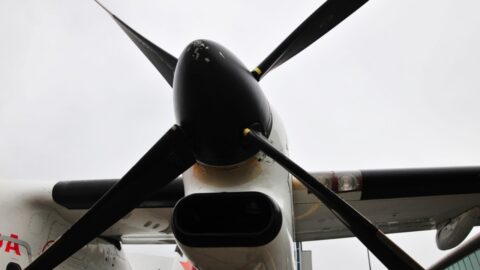
AI models can be deployed to make health predictions of aircraft systems. This allows the maintenance process to be tuned to these predictions, making maintenance more efficient.
This emerges from a major study by several universities and industries called ReMAP. TU Delft is the project leader. The Dutch university calls the research and the AI models developed an important step in the modernisation of aircraft maintenance.
Integrated Fleet Health Management
ReMAP is a Horizon 2020-funded project. The project started on 1 June 2018 and will end at the end of this month. ReMAP aims to contribute to Europe's leadership in aviation by developing an open source aircraft maintenance solution. This system is also known as the Integrated Fleet Health Management (IFHM) system. The system replaces maintenance at fixed periodic times with an adaptive maintenance model. In this model, maintenance is performed at the time it is actually needed.
The following parties are involved in ReMAP:
- Delft University of Technology (NL)
- ATOS Spain S.A. (SP)
- Cedrat Technologies (FR)
- Collins Aerospace (IE)
- École National Supérieure d'Arts et Métiers (FR)
- Embraer Portugal S.A. (PT)
- Instituto Pedro Nunes (PT)
- KLM Royal Dutch Airlines (NL)
- Office National D'Etudes et de Recherches Aerospatiales - ONERA (FR)
- Optimal Solutions (PT)
- Smartec SA (CH)
- University of Coimbra (PT)
- University of Patras (GR)
From fixed maintenance moments to continuous health monitoring
Project leader Bruno Santos, Assistant Professor of Airline Operations, says in a news release, "We have succeeded in modelling the complete maintenance process of several aircraft fleets. This will make it possible in the future to transform current aircraft maintenance based on fixed time intervals, and maintenance due to defects, into continuous health monitoring of systems. Systems will then be replaced exactly when needed, reducing waste. In addition, the team modelled the complex process of maintenance planning, something that is currently largely done by hand. This also takes changes and disruptions into account, so it approximates real-world conditions better than existing static models. As a result, maintenance can be planned further ahead."
The potential savings on aircraft maintenance are huge. In Europe alone, the savings are expected to reach €700 million annually, estimates the Advisory Council for Aeronautics Research in Europe (ACARE).
Planning months ahead
Paul Chün, Vice President Technology Hub KLM Engineering & Maintenance: "With this concept, we can consider replacing the current manual maintenance planning, of at most a few weeks ahead, with this automatic planning process that allows us to plan several months ahead. The benefit for travellers is clear: less unscheduled maintenance results in fewer flight delays and cancellations."
Santos: "With our integrated ReMAP approach, we have made an important contribution to optimise the application of condition-based maintenance in the commercial aviation industry. Furthermore, we have developed an open IT platform that allows AI developers to run their forecasts or planning algorithms with a few clicks based on actual operational data. This facilitates the development of innovative third-party solutions to move quickly from fixed-time interval maintenance to a truly adaptive, condition-based maintenance approach in the regulated aviation domain."
Detecting damage to composite aircraft structures
Besides research on AI models, other studies are also part of ReMAP. One of these studies focuses on possibilities for using diagnostic and prognostic models for composite aircraft structures. Manual inspections of these structures are time-consuming. For instance, damage to composite aircraft structures is often not visible on the surface. This complicates damage detection.
Diagnostic and forecasting systems were developed within the ReMAP project that use AI to map damage, localise damage and determine damage severity. This model was tested for two years by TU Delft's Faculty of Aerospace Engineering and the University of Patras (GR). Based on this test period, a public knowledge base was set up.
Author: Wouter Hoeffnagel
Photo: Free-Photos via Pixabay