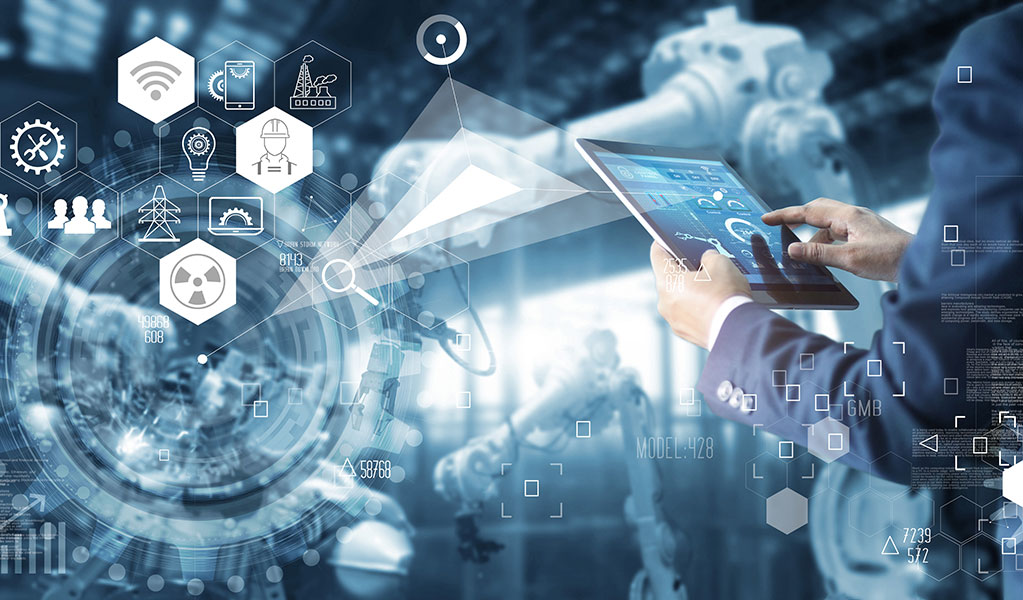

COVID-19 has a major impact on industry. The extent is determined by, among other things, the company profile, the chain position and the end market in which the entrepreneur operates. In consumer products, customers are already massively driving the chain digitally. In B2B markets, much has already been digitised, but the full potential of digitisation is far from being realised. The government and industry organisations are therefore fully committed to digitalisation through the Smart Industry Agenda.
Smart Industry is the far-reaching digitisation of devices, means of production, products, people and organisations using the latest production technologies. Here, IT and OT (operational technology) come together. To ensure future economic growth, employment and a sustainable industry, it is important to accelerate investments in digitalisation and production technology. They are the drivers for the development of a smart, flexible and competitive industrial sector.
Digitalisation: fast, flawless, new business models
Digitalisation within a company or organisation offers many advantages. It increases efficiency across the entire operation. But not only that! Besides shorter lead times, error reduction and quality improvement, digitisation and ICT offer the possibility of setting up new business models, introducing new service models and developing innovative products.
Digitalisation & Data
Once digitalisation takes serious shape within companies, sharing data with the chain becomes structurally valuable. Thus, digitalisation ensures:
- in the development phase to accelerate design, prototyping and testing,
- in the production phase by linking machines and production systems to reduce lead times,
- in the order phase, platforms and portals ensure that ambiguities in drawings disappear and information connects to the production process and
- in the user phase that, by exploiting usage data, optimises and expands customer services, introducing new business models.
In particular, a complete smart supply chain revolves around the following development blocks:
- Smart and error-free manufacturing
- Flexible (customised) production in small series
- Smart, digitally connected products
- Smart, additional (service) services to physical product
- Digital smart factory where departments and machines are connected and data drives
- Companies digitally connected in the chain (fast, error-free)
- Sustainable production (energy, material reuse)
- Working smarter through technology that supports human resources.
Cashing in on opportunities
There are various purposes for which data can be used. For example, with regard to process, business model or forms of phases a company can go through in the data transition to cash in on opportunities:
- Process optimisation: This is where a company puts the focus on the process. Process data provides a deep insight into where the strengths and bottlenecks are in the organisation and chain. This allows very targeted optimisation of processes, which is a prerequisite for the optimal use of new production technologies.
- Data-driven strategy and business model innovation. Data is used for specialisation and development of customised services for customers(as predictive maintenance - servitisation). Create a vision and innovation climate in the company.
- Digital chains with a shared data ecosystem: Prerequisite is the openness to share data. If data is not shared, no form of horizontal and vertical cooperation in chains is possible let alone platformisation. This requires management and market players to have a clear strategy and development path for digitalisation.
Source: ING, Industry Theme Update (October 2020)
Smart Industry Agenda









