
2.7 million industrial robots are active in factories worldwide. This is 12% more than a year ago. A total of 373,000 new industrial robots were shipped in 2019. This is 12% lower than in 2018, but still the third-highest sales ever.
This is according to data from the International Federation of Robotics (IFR). "The amount of industrial robots operating in factories worldwide is the highest ever," said Milton Guerry, President of the IFR. "Driven by the success of smart manufacturing and automation, this amounts to a global growth rate of 85% over a five-year period (2014-2019). The recent 12% contraction in sales reflects tough times in two key customer segments: automotive and electronics.
Impact of COVID-19 still unclear
Guerry also points out that the impact of the COVID-19 pandemic on the global economy is not yet fully understood. "The remaining months in 2020 will be shaped by embracing the 'new normal'. Robot manufacturers are adapting to demand for new applications and developing solutions. A big push for sizeable orders is likely to be missing this year.
China may be an exception, as the coronavirus was first identified in the Chinese city of Wuhan in December 2019 and the country has already begun recovery in the second quarter. Other economies currently report being at that tipping point. However, it will take several months for this to translate into automation projects and demand for robots. 2021 brings recovery, but it will take until 2022 or 2023 to reach pre-crisis levels."
Asia remains the important sales market
Asia continues to be the largest market for industrial robots this year. China is the biggest buyer; the country had about 783,000 industrial robots in use at the end of 2019. This is about 21% more than in 2018. Japan is the second largest market within Asia, with 355,000 units (+12%). India follows with 26,300 units, which is 15% more than in 2018. In five years, the amount of industrial robots in Indian factories has doubled.
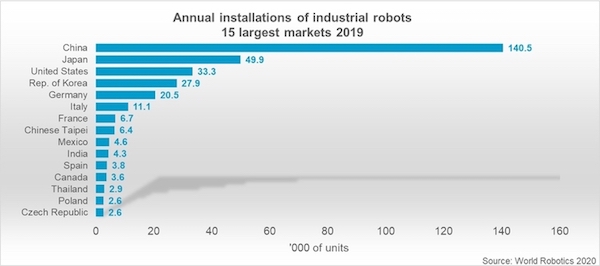
Asia accounts for about two-thirds of the total number of newly installed industrial robots worldwide. Almost 140,500 new robots were commissioned in China, which is less than in 2018 and 2017. Nonetheless, it is double that of five years ago. For instance, 57,000 industrial robots were commissioned in China in 2014.
71% of all industrial robots commissioned in China are from foreign manufacturers, while the remaining 29% are produced by Chinese companies. For now, Chinese manufacturers mainly focus on the Chinese market. Certain sectors rely on foreign parties more than others in this regard. For instance, foreign manufacturers supply about 29% of their robots to the Chinese automotive industry, while among Chinese manufacturers the percentage is 12%.
580,000 robots active in Europe
A total of 580,000 industrial robots were active in Europe in 2019, up 7% from 2018. Germany is the main European market; the country has around 221,500 units in operation. This is about three times as many as Italy (74,400 units), five times as many as France (42,000 units) and 10 times as many as the UK (21,700 units).
Looking specifically at the Netherlands, it appears that sales of industrial robots increased by 8% in 2019 compared to a year earlier. This increase was even higher in France (15%) and Italy (13%). In Germany, on the contrary, sales fell by 23% to 20,500 units. In the UK, sales declined by 16%.
US market
Looking at the US market, the United States (US) is the largest market with 293,200 units. This is an increase of 7%. Mexico follows with 40,300 units and an increase of 11%. In Canada, 28,600 industrial robots are in use, which is 2% more than in 2018.
The number of newly installed industrial robots fell 17% in 2019 compared to 2018. A total of 33,300 units were shipped, which is the second highest sales figure ever. Most robots in the US are imported from Japan or Europe. Mexican companies are also purchasing fewer industrial robots; sales here fell 20% to 4,600 units. On the contrary, Canadian sales rose 1% to 3,600 units.
South America
In South America, Brazil is the largest user of industrial robots with around 15,300 units installed. This is an 8% increase compared to 2018. Sales fell 17% to around 1,800 robots, which is still higher than the record set in 2018.
In addition to industrial robots, collaborative robots are also available. These robots are capable of collaborating safely with humans. For instance, many collaborative robots detect the presence of humans and adjust their behaviour accordingly to avoid injury. This makes a safety cage unnecessary in many cases. The use of collaborative robots increased by 11% in 2019 compared to a year earlier. More and more parties are offering collaborative robots on the market and wider and wider applications are available. Of the total 373,000 industrial robots sold in 2019, 4.8% were collaborative robots. Although the market is growing rapidly, the IFR does state that the market is still immature.
Modernising and digitising production
COVID-19 has a strong impact on market developments in 2020. It also offers an opportunity to modernise and digitise production in the repair process, according to the IFR. However, the benefits of the increasing use of robots remain the same: rapid production and delivering customised products at competitive prices are the main incentives. Automation allows manufacturers to develop products in developed countries without compromising on cost efficiency.
All IFR's figures are gathered in the World Robotics 2020 Industrial Robots report, which is available for purchase via IFR's website.
Author: Wouter Hoeffnagel









