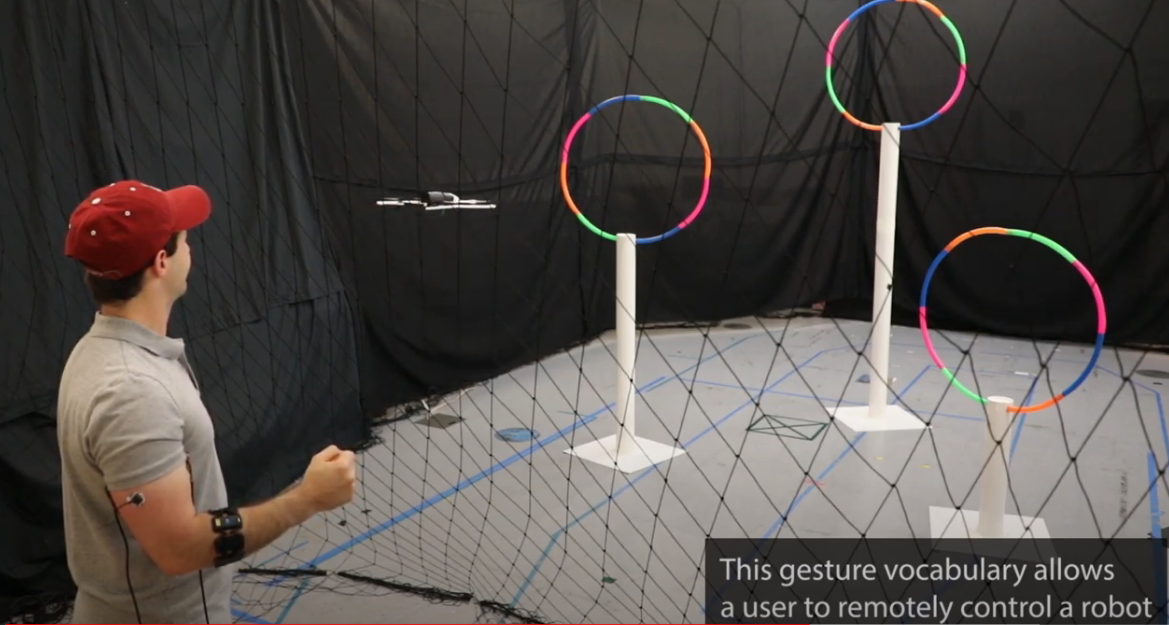

A new technology allows robots to be controlled using muscle signals. The system should thus simplify the control of robots and strengthen cooperation between humans and robots.
The system is called Conduct-a-Bot and was developed by Joseph DelPreto and Daniela Rus from MIT's Computer Science and Artificial Intelligence Laboratory (CSAIL). Interacting with robots is not new. However, many existing methods of controlling robots are clumsy, according to the researchers. As examples, they cite control using specific voice commands or the use of touchscreens.
Muscle and motion sensors
Conduct-a-Bot uses muscle and motion sensors to monitor people's movements. This makes it possible to control robots using muscle signals and movements. The system works using small sensors placed on the biceps, triceps and forearm.
The system is still under development. The current variant is capable of recognising eight pre-programmed movements. Training the system or calibrating it offline is not necessary; as soon as a new user places the sensors on his or her biceps, triceps and forearm, the system is immediately usable. Conduct-a-Bot's current setup was tested in combination with a Parrot Bebop 2 drone.
These pre-programmed movements are contained in a library, which is expandable. The researchers want to enrich this library with more movements so that more control options become available. The researchers also want to evaluate the database with more users and more robots.
Electromyography
Conduct-a-Bot, as mentioned earlier, uses muscle and motion sensors to register human movements. Specifically, this involves electromyography (EMG) sensors worn on the biceps and triceps. On the forearm, the user wears a wireless device that incorporates EMG and motion sensors.
The information collected using this system is analysed using machine learning technology. In doing so, the technology separates eight possible gestures from other user movements in real time. This makes it possible to control a robot in real time using hand gestures.
No manual calibration
The system calibrates itself to correctly interpret signals from different users. This process takes place while users are using the technology; calibration beforehand is therefore not necessary. The system learns each time from its previous user.
The current experiment used a combination of MyoWare sensors with electrodes from Medtronic Minimally Invasive Therapies (formerly known as Covidien) and a USB-6216 from National Instruments to read the data. The wireless device worn on the forearm is a Myo Gesture Control Bracelet. The researchers point out that other sensors and input/output readers may be used in the future.
Paper
In the paper 'Plug-and-Play Gesture Control Using Muscle and Motion Sensors', the researchers elaborate on their technology and findings. They explain their system in the presentation below.
Author: Wouter Hoeffnagel









