
Quality control is an important focus in additive manufacturing. 51% of respondents cite quality control as the key challenge. 62% state that the 3D printing industry especially needs more reliable technologies to grow.
This is according to the 2020 edition of The State of 3D Printing report by 3D printing company Sculpteo. 1,600 respondents took part in the survey. 22% of this group are CEOs, while 21% are engineers or product technicians. 62% have a technical background. Respondents operate in a wide range of sectors, ranging from automotive and aerospace to education, high-tech and consumer goods.
Embrace of additive manufacturing rises
More and more sectors are adopting manufacturing technology. The role of 3D printers within the production process of manufacturing companies is therefore becoming increasingly clear, while users are becoming more mature in their knowledge about and application of additive manufacturing. For instance, 80% of respondents say they have been using 3D printing for more than two years. 33% expect to increase their investment by 50% this year.
Cost is a major obstacle for companies to get started with additive manufacturing. Thus, 59% cite cost as a limiting factor for embracing the technology. Looking at the printing technique that companies deploy, most companies opt for Fused Deposit Modelling (FDM). Over 50% outsource 3D printing via Selective Laser Sintering (SLS), Jet Fusion, Selective Laser Melting (SLM)/Direct Metal Laser Sintering (DMLS) and Binder Jetting to external service providers. Not having to buy and maintain 3D printers is the main motivation for this.
31% 3D-print daily
Of the respondents, 31% say they use 3D printing on a daily basis. 24% do so several times a year, while an almost equally large group (23%) uses 3D printing several times a month. 16% do so several times a week. The majority have more than three years' experience with 3D printing. 12% even have more than 10 years of experience.
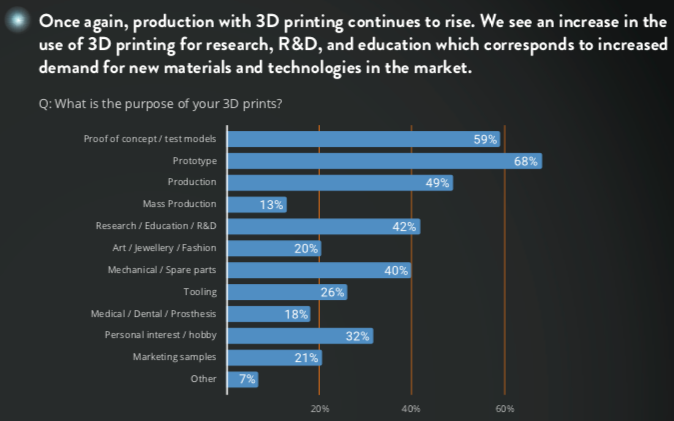
If we look at the applications for which additive manufacturing is used, most of them involve prototyping (68%). Producing a proof of concept or test models follows with 69%. 49% choose the technique for manufacturing, while 42% use additive manufacturing for research, education and research & development. 40% produce spare or mechanical parts using 3D printers. Only 13% deploy additive manufacturing for mass production. 68% expect to find new applications for 3D printing in the coming year.
Resin printing grows in popularity
The materials in which companies print vary. The largest group chooses plastic, followed by metal and resin. The use of resin in particular is growing rapidly, both among companies that 3D print themselves and parties that outsource.
Companies invest the most time in designing, testing and building prototypes. For instance, respondents say they spend most time on CAD design (54%) and prototype building (48%). Research (31%), testing prototypes (29%) and evaluating new technologies (24%) follow.
Consistent print quality and quality control
Achieving consistent print quality and quality control are the biggest challenges companies face (51%). Preparing print files (31%) and pricing (27%) are also mentioned. Other challenges include maintenance (25%), setting up 3D printers (24%) and preparing print jobs (24%).
Additive manufacturing is in many cases a production technique that companies deploy alongside other production techniques. Most companies also deploy CNC machines (53%) and/or laser cutting/engraving machines (49%). 25% also use injection moulding, 15% waterjet and 10% spark machining.
Benefits of additive manufacturing
When looking at the main benefits companies see in additive manufacturing, realisation of complex shapes (66%) leads the way. 45% point to rapid realisation of production, 43% point to shorter lead times and 37% to cost savings. Especially in the speed with which companies can innovate, additive manufacturing is a game-changer according to respondents. 60% see additive manufacturing as a key differentiator from competitors.
Factors limiting the embrace of 3D printing include entry costs (59%) and a knowledge gap (51%). Other commonly cited obstacles include operational costs (36%), available types of materials (34%) and the availability of these materials (30%). Not surprisingly, developing new materials (56%) is cited as the most important factor needed for the 3D printing industry to grow. 62% mention the development of more reliable printing techniques.
Power users
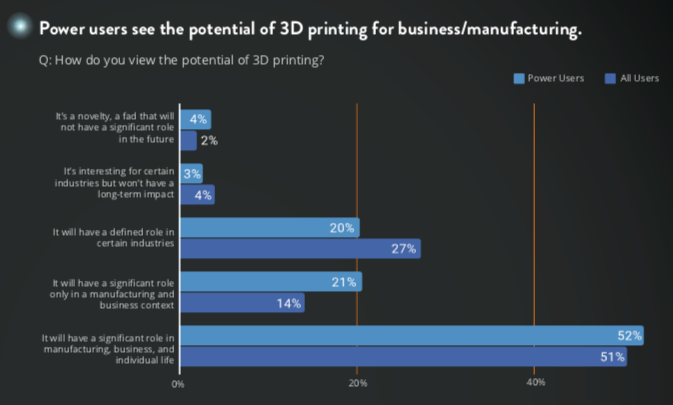
In the report, Sculpteo zooms in specifically on 'power users'. These are users who have more than two years' experience with 3D printing and also invested at least $10,000 in additive manufacturing last year. Strikingly, power users are above average in stating that additive manufacturing is a game changer, both in terms of speed of innovation, sales, cost per part and lead time. Also, 70% of power users see 3D printing as an important differentiator from competitors.
It is also notable that power users are significantly more likely to 3D print in plastic and ceramics. For instance, 64% of all users print in plastic, while this percentage among power users is 92%. A similar difference is visible with ceramics. 40% of all users print in ceramic, compared to 73% of power users.
Report
All the findings of the survey can be found in the 2020 edition of the report *The State of 3D Printing*, which is available on the Sculpteo website.
Author: Wouter Hoeffnagel









