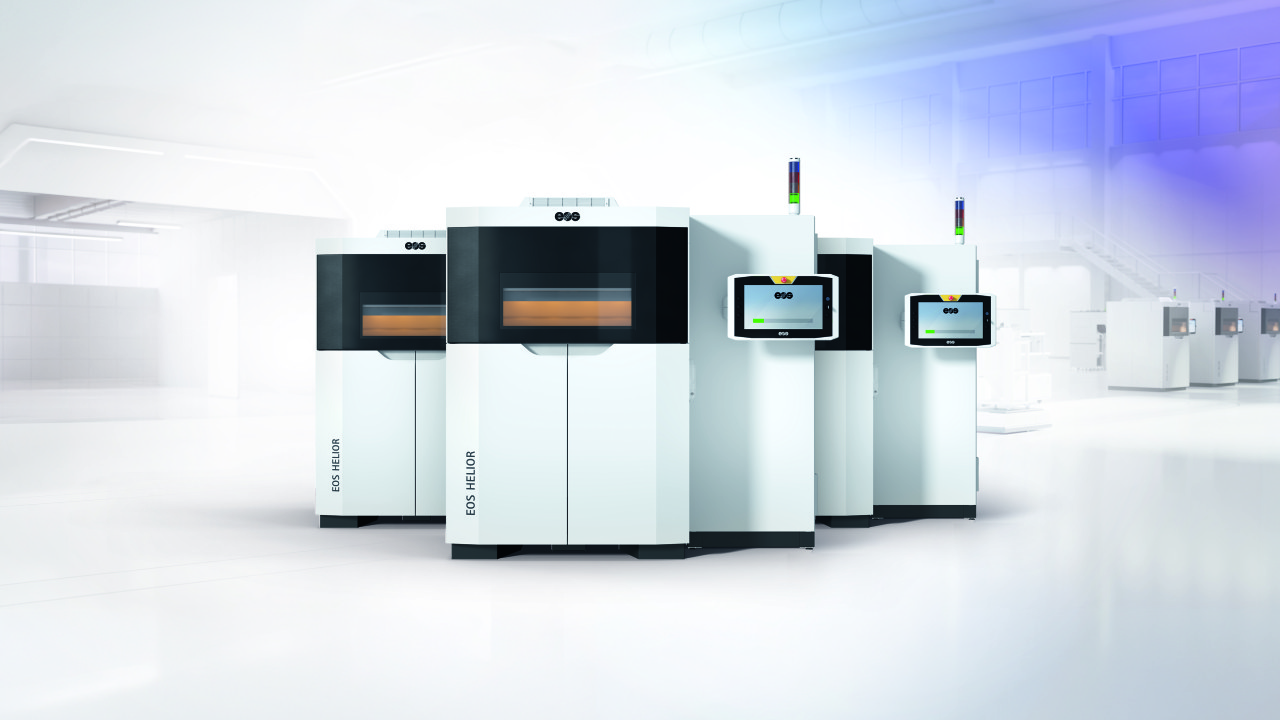

EOS is introducing the HELIOS platform for 3D printing with polymers. The printer combines a large build volume of 154 litres with three lasers and an adjustable roller recoater. With this, the manufacturer is targeting industrial-scale series production.
The EOS HELIOR can print parts with a maximum volume of 700 × 380 × 580 millimetres. The printer is equipped with three CO₂ lasers, each with a power output of 70 watts. The laser load is distributed dynamically, allowing the three lasers to be utilised simultaneously and efficiently. EOS states that, at a build rate of 10 per cent, the platform can produce up to 80 per cent more component volume per 24-hour period than previous systems.
The company reports that the printer is suitable, amongst other things, for production environments where continuity and high utilisation rates are crucial. With this platform, EOS is responding to the growing demand for efficient industrial production using additive manufacturing. By combining multiple lasers, a large build volume and optimised process control, the company aims to enable higher production volumes and reduce the cost per part produced.
Less post-processing and more efficient use of materials
Compared with previous EOS 3D printers, a key innovation is the independently adjustable roller recoater. This unit distributes the polymer powder across the build platform and can be adapted to the geometry of the parts to be produced. According to EOS, this, combined with precisely calibrated exposure parameters, results in a less compact powder layer, meaning prints require up to 80 per cent less post-processing.
Process control has also been further refined. For example, EOS uses 3D EOSAME to ensure consistent part quality throughout the build chamber. This is a technology developed by EOS to improve the uniformity of 3D-printed parts across the entire build chamber. The Smart Scaling software function ensures precise dimensional stability in the Z-direction.
To monitor production, the HELIOR is equipped with EOSTATE Thermal Insight. This system detects thermal anomalies during the printing process, enabling potential quality issues to be identified at an early stage. EOS reports a technical availability of 92 per cent and a process capability of Cp/Cpk ≥ 1.33 for dimensions smaller than 120 millimetres, with a tolerance of ±300 micrometres.
Developed in collaboration with pilot customers
According to EOS, various companies specialising in additive manufacturing were involved in the development. By collaborating with pilot customers, EOS aims to test performance under real production conditions.
The system has been tested in practice by FKM Additive Manufacturing, Prototal Group, Materialise, Shapeways and Formrise. The focus was, amongst other things, on machine utilisation, production planning, process quality and the efficiency of the entire production workflow.
Support for two polymer materials
At launch, validated process parameters will be available for the PA 2200 and PA 2220 HighReuse materials. Other materials can be qualified based on customer requirements, the manufacturer states.
The platform is integrated into the EOS ecosystem, which comprises software, materials and production solutions. These include, amongst other things, closed powder feeding systems and automated solutions for unpacking produced parts. A de-packing and sieving station is also available, as well as a mixing and qualification station, for processing and conditioning both new and reused powder.
The machine has a maximum power consumption of 17.5 kW and a typical power consumption of 4.0 kW. Its dimensions are 2,300 × 1,415 × 2,200 millimetres and it weighs approximately 2,070 kilograms. The system can carry out multiple consecutive production runs and process more than 1,000 litres of product volume without requiring any maintenance in between.