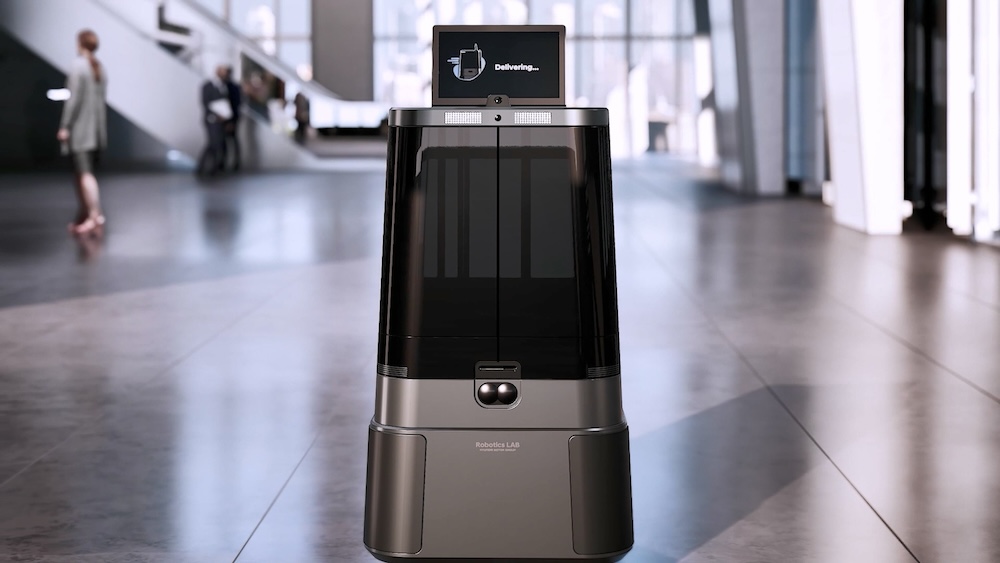

Hyundai Motors and KIA introduces an updated version DAL-e Delivery, a robot aimed at delivering products, goods and objects in indoor environments. Among other features, the robot is equipped with facial recognition, allowing it to identify individual workers.
DAL-e Delivery was introduced by the two South Korean companies in late 2022. At the time, it was a pilot project. The new version that the parties are now presenting builds on this earlier model. Among other things, the updated model should present better in complex environments such as office buildings and shopping malls.
Receiving goods quickly
"DAL-e Delivery provides efficient and reliable delivery services for food, beverages and packages to ensure customers receive goods quickly," said Dong Jin Hyun, Vice President and Head of Robotics Lab at Hyundai Motor and Kia. "Our vision extends to implementing infrastructure that communicates with each other in different spaces, including offices, restaurants and shopping malls."
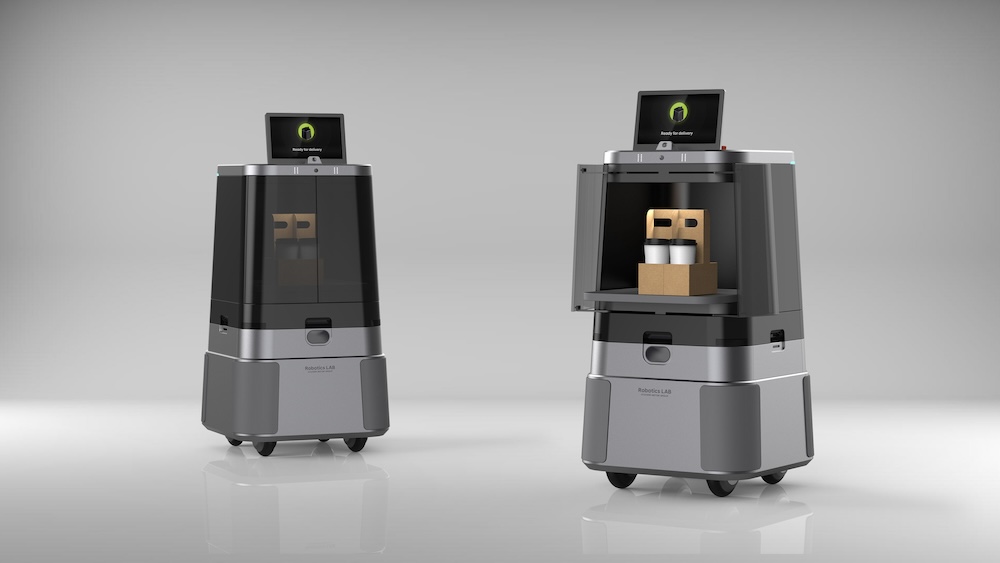
The updated version of DAL-e Delivery is a delivery robot specifically aimed at use in indoor environments, such as offices and shopping malls. The robot can propel itself at a speed of up to 1.2 metres per second, independently finding its way in tight environments and avoiding obstacles. DAL-e Delivery can carry loads of up to 10kg.
Based on Plug & Drive modules
Among other things, DAL-e Delivery features a new housing. It consists of a square column with rounded corners and a low centre of gravity. The robot is based on about four so-called 'Plug & Drive' modules, announced by Hyundai in early 2022. These are modules that combine a motor with steering, suspension, brakes and environmental sensors, among others, and can form the basis for a variety of robots.
Compared to its predecessor, DAL-e Delivery is smaller, which Hyundai and KIA say allows the robot to move more smoothly. At the same time, the robot's cargo area has actually increased in size. It can now accommodate up to 16 cups of coffee. Of course, users decide which objects they want to transport with the robot.
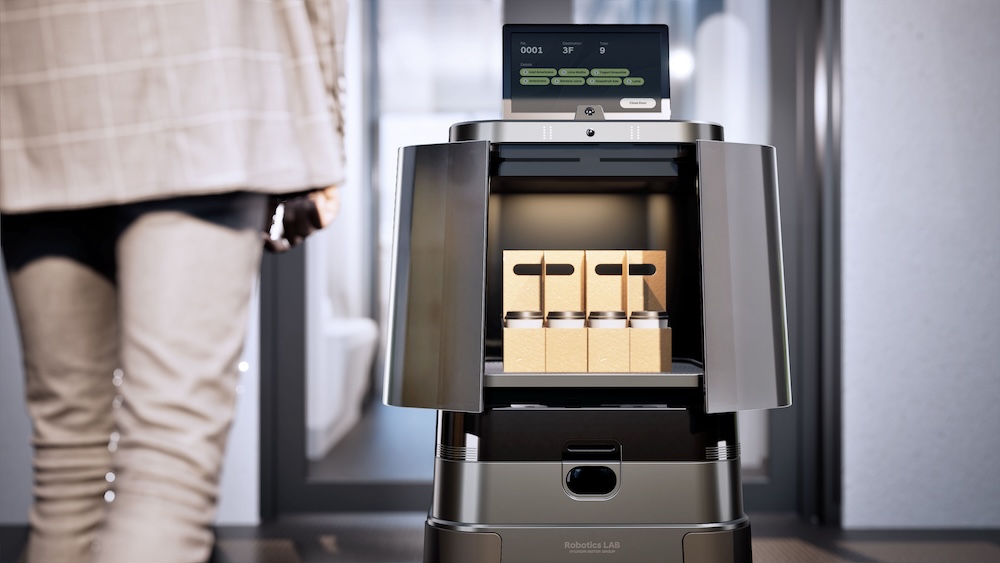
As soon as you open the cargo bay doors, the cargo automatically slides towards you. It also features a light that illuminates the load, which simplifies identifying the object or product needed.
Autonomous navigation in complex environments
DAL-e Delivery is capable of autonomously navigating its way through complex environments, which can span several floors. To do so, the robot can handle lifts and access doors, among other things. DAL-e Delivery also autonomously calculates the optimal route in real time, enabling it to reach its destination as quickly as possible.
Another notable feature of the robot is that you not only specify a location as the delivery point, but you can also specify a recipient. DAL-e Delivery can then use a camera and facial recognition technology to independently identify the recipient. This provides convenience in practice; it eliminates the need to enter a password or PIN to unlock the cargo bay. The technology used for this was developed in-house by Hyundai Motor and Kia's Robotics Lab. The facial recognition technology has been certified by the Korea Internet and Security Agency, rating it as 99.9% accurate.
Author: Wouter Hoeffnagel
Image: Hyundai Motors









