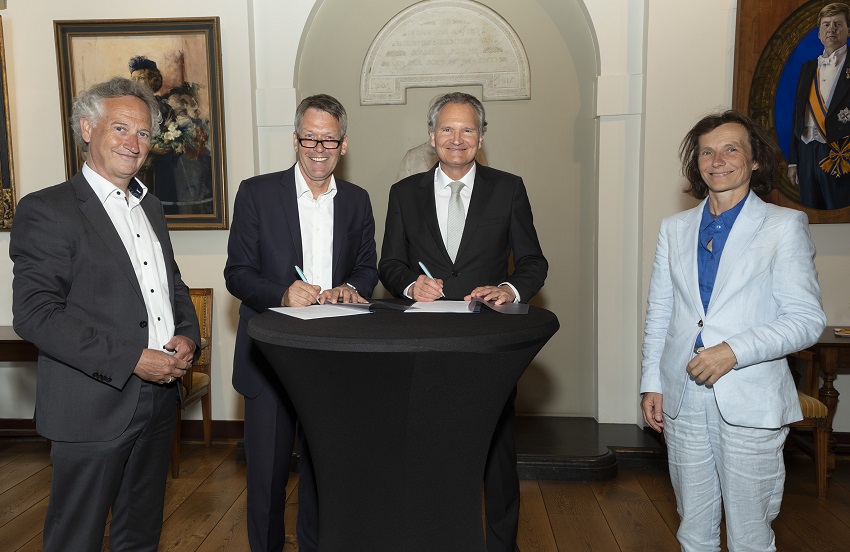

TU/e and NXP Semiconductors recently signed a letter of intent. With this, the parties have expressed their ambition to jointly develop a new, groundbreaking generation of technology for wireless communication. This will be done at frequencies above 300 GHz.
In the MoU (memorandum of understanding), both parties state that they will make available knowledge and data as well as the necessary employees and students via a new roadmap. This is necessary to take big steps forward in the future to improve the speed, efficiency and stability of information transfer. It is not the first partnership between TU/e and NXP. The two parties have been successfully working together for years on smarter, safer and cleaner mobility systems.
Communication at high frequencies
From TU/e, the Eindhoven Hendrik Casimir Institute (EHCI) is involved. Scientists from the institute, together with NXP specialists, will, among other things, conduct research into semiconductor technology that will enable significantly higher bandwidths than are currently common. The aim is to achieve communication at high frequencies, above 300 GHz. This is currently difficult. Why is this? Because the performance of current technologies for these frequencies is very limited.
More opportunities
New technology for wireless communication gives endless possibilities in a society that is increasingly focusing on 'plug-less' applications. Think of Internet of Things (IoT) devices and augmented and virtual reality (AR/VR). Applications in the medical or mobility sector, such as replacing wires in aircraft with wireless connections, are also possibilities.
Strengthening ties
It is the second time within the space of a month that TU/e has strengthened its ties with a major partner from the Brainport region by signing an MoU. In April, it was announced that ASML research will build a cleanroom on the TU/e campus. Among other things, in order to conduct research together with TU Eindhoven in the fields of plasma physics, artificial intelligence, mechatronics and semiconductor lithography.
NXP is important partner
Robert-Jan Smits, chairman of TU Eindhoven's Executive Board: "TU/e is known for its pioneering work in the field of wireless communications, a field that is essential for the strategic sovereignty of both the Netherlands and Europe. NXP has been a key partner in this for many years. The MoU will further intensify the cooperation between TU/e and NXP."
Advanced driving assistance systems
Lars Reger, executive vice president and CTO of NXP: "Collaboration with universities is an integral part of NXP's innovation strategy. And Eindhoven University of Technology's proven track record in collaboration with industry gives us full confidence to expand our collaboration into new research areas focused on communication and sensor systems. This will lead to innovations in communication technologies and advanced driver assistance systems, a field in which NXP is the world leader in semiconductors. With advanced driver assistance systems, we want to contribute to reducing the more than one million traffic fatalities worldwide every year."
Source: TU/e, Image: TU/e and NXP signing the MoU. From left to right: Maurice Geraets, executive director NXP Netherlands, Lars Reger, executive vice president NXP, college president Robert-Jan Smits and rector Silvia Lenaerts (photo: fotowerkt.nl)









