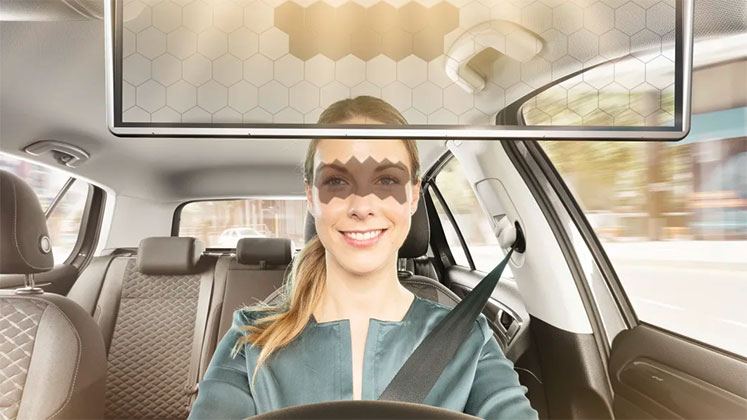

It remains irritating. You're driving home and the sun is shining straight into your face. Sunglasses don't really help and the sun visor in your car is not an optimal option in many cases. The visor blocks a significant part of the view, which does not exactly increase safety. Time for an intelligent solution.
It has been on the market for a few years now, but is only just starting to gain real traction amongst car manufacturers. The Bosch Virtual Visor. An intelligent sun visor that only covers the part of your face most affected by the sun.
How it works
Just like the sun visor we’ve had in cars since 1922, you flip it down. However, that’s where the similarities end. The Virtual Visor is a masterpiece of AI technology. It’s a transparent LCD screen with a camera that constantly scans the driver’s face. The AI then recognises the ears, the mouth and the nose, and uses that information to colour only the part of the visor where sunlight is shining into the driver’s eyes. The rest of the visor remains transparent.
The risk of an accident in bright sunlight is 16 per cent higher than in normal light. The old-fashioned sun visor helps, of course, but it covers a significant part of the driver’s field of vision. That doesn’t necessarily improve safety. Sunglasses help to a certain extent, but you either have them on or off. Not exactly a dynamic piece of technology. This is quite different.
Given all its advantages, it is quite strange that Bosch took a long time to convince car manufacturers. It now looks like the AI sun visor is going to find its way into high-end cars. At the same time, the world is not standing still and a number of company have developed similar solutions.










