
Drones are increasingly operating in areas beyond the line of sight of the person controlling them. However, conventional remote controls have a limited range, making them unsuitable for such flights. Yet simple systems based on mobile networks cannot always guarantee a reliable connection either. Researchers at the Fraunhofer Institute for Telecommunications, Heinrich-Hertz-Institut (HHI), have joined forces with partners in the SUCOM project. The aim is to develop a new mobile network system that can be used to control drones, even over long distances and across difficult terrain.
Autonomous drones that communicate via mobile networks often lack a stable connection. A lack of network coverage is one reason for disconnections. Experts also suspect that drones operating at high altitudes may be able to reach too many mobile phone masts at once. As a result, they may constantly switch between network cells, which can then lead to the connection being lost. Researchers at Fraunhofer HHI discovered that the communication protocols used by drones to regulate the data flow between the drone and the controller cause problems. If these are not robust enough to cope with fluctuating data rates, some data packets arrive more slowly. Some packets are lost entirely.
New communication protocols
Fraunhofer HHI researchers have therefore developed new communication protocols together with Wingcopter, the Hessian drone manufacturer, Emqopter GmbH and CiS GmbH. These are insensitive to jerky data streams. The drone remains connected even if the data rate fluctuates. Safety-critical information needed for aerial photography, such as position, altitude, flight direction, speed and other data, can be transmitted without interruption. This is an important prerequisite for high safety requirements in aviation.
Highest level of reliability
The researchers made a comparison. They equipped one drone with a commercially available LTE system. Another was fitted with the mobile network module SUCOM, which has the new communication protocols. Tom Piechotta, a scientist at Fraunhofer HHI explains the difference. "The connection to the conventional module kept dropping out. In contrast, the SUCOM module provided a stable connection. Thanks to our new protocols, the connection is very stable. As a result, there are no more interruptions." For the researcher, this is a clear indication that failures in drones do not only arise from a lack of network coverage.
Module
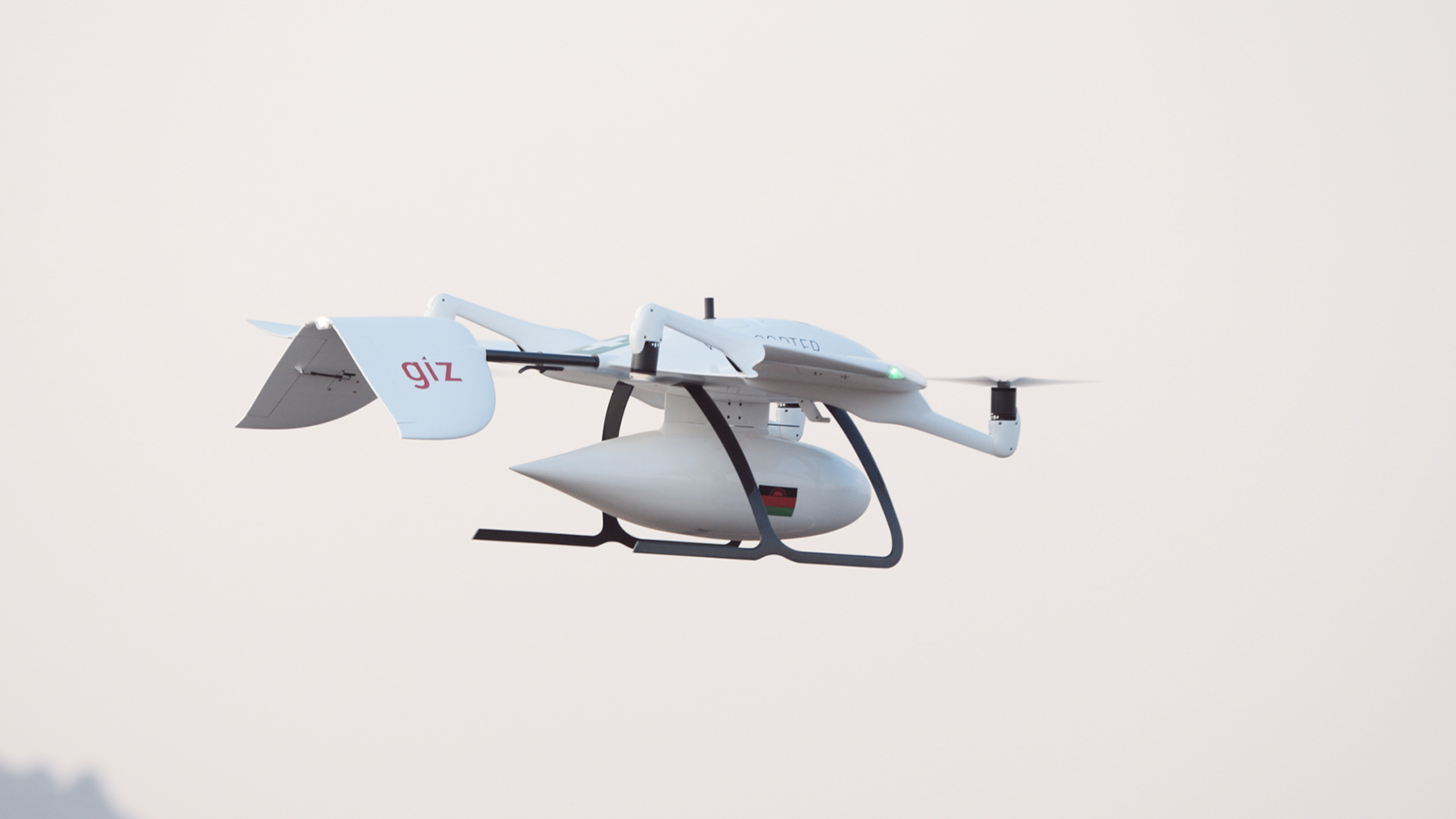
SUCOM's mobile network module can also be installed in drones already in use. In Malawi, for example, drones deliver medicine, blood supplies and other vital materials to the population during the rainy season. The drones are now equipped with this module. They cover distances of up to 40 kilometres.
Drone flight
The drones take off from four airports, each with a "remote pilot". This pilot enters the current route into the system. In addition, he determines the waypoints that will guide the drone. One click is enough to send the flight plan to the drone. The data required for this is sent to a server in Cape Town. From there, they are transmitted to the SUCOM module and to the flight controller on the drone. Along the way, the pilot continuously monitors the drone remotely in real time. The drone is also equipped with satellite technology. This can be used if the DSL connection fails. Control via a smartphone and VPN connection is also possible if necessary.
From Malawi to Berlin in 170 milliseconds
Fast transmission of data between the drone and the server in Cape Town is important. Therefore, adjustments have been made to the server's hardware and software. The connection is now so fast that the drones in Malawi can communicate in real time with Fraunhofer HHI in Germany. It takes only 170 milliseconds for a data packet to go from the drone to Berlin via a mobile communication network via the server in Cape Town.
Remote locations
The SUCOM system could also provide better coverage for other remote locations, for example in Germany. To demonstrate this, the project team flew over a large forest area in northern Brandenburg. This is one of the largest network dead spots in Germany. It has a diameter of 14 kilometres. The flight was a success. Thanks to the SUCOM module, the drones did not lose connection at any point during the flight.
Photo: Wingcopter in Malawi (Photo: Falco Seliger)
Also read: St Antonius tests transport of medical materials with drones











