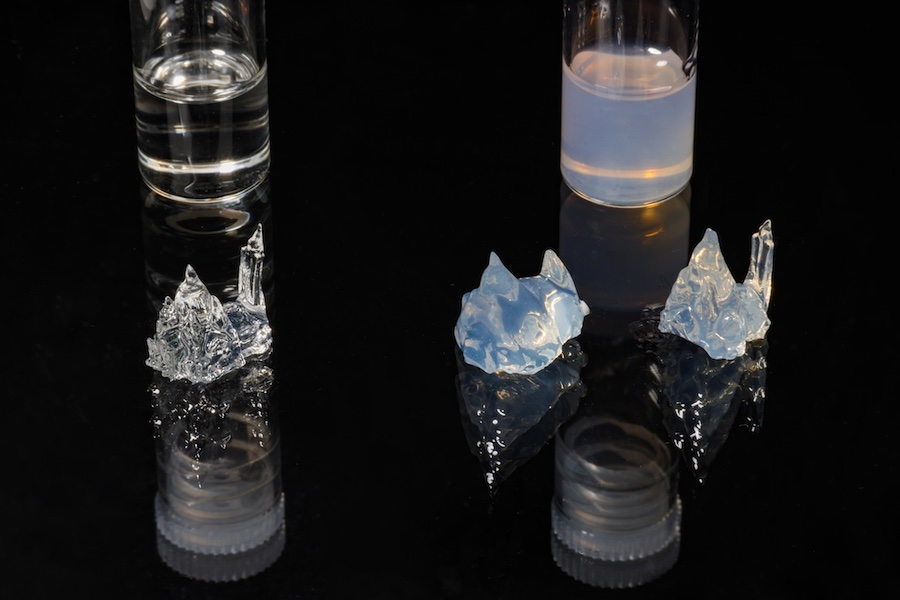

A new additive manufacturing system can 3D print objects in opaque resin, something previously impossible. In addition, the method is lightning fast and can produce an object in just a few seconds.
The printing method was developed by researchers at the Laboratory of Applied Photonic Devices (LAPD) of the Swiss Technical University of Lausanne (EPFL). 3D printers can use various printing techniques. Probably the best-known technique used by 3D printers is fused deposit modelling (FDM), in which a printer prints a thin layer of material each time. In this way, the printer builds up an object layer by layer.
Printing in resin
EPFL's 3D printer, however, uses resin, which is also a well-known printing method. In this, users place the resin in a container and illuminate the material with targeted light. This light causes the resin to harden and an object is created.
This method has its limitations. For instance, printing in resin was not suitable for printing in opaque resin until now. A new printing method now makes this possible anyway. "We pour the resin into a container and turn it," explains Christophe Moser, professor at LAPD. "Then we shine light on the container at different angles. This causes the resin to harden where the accumulated energy in the resin exceeds a certain level. It is a very precise method and can produce objects with the same resolution as existing 3D printing techniques."
Model printed in just 20 seconds
The method is also called a 'volumetric method'. The printing method is suitable for printing objects of almost any shape. The researchers tested the printing method by 3D printing a small model of Yoda, famous from Star Wars. The model was printed in just 20 seconds. By comparison, with conventional additive manufacturing, the process would have taken about 10 minutes.
"Our method only works if the light passes through the resin in a straight line, without being disturbed in the process," says Antoine Boniface, postdoc at LAPD. "Until now, we always used transparent resin. However, we wanted to see if we could print objects in the kind of opaque resin used in biopharmacy."
Path of light deforms
Light must be able to reach the resin for it to cure. However, light cannot normally penetrate the opaque resin properly. Mainly because the trajectory of the light is distorted. As a result, the energy required in the resin awkwardly exceeds the limits needed for curing the material. "We have therefore tried to arrive at a solution that lets us fabricate objects in this resin, without losing the advantages of our 3D printer."
The printing method is a further development of a 3D printer the researchers designed in 2017. It involves a printer that can 3D-print objects in a very short time. The researchers call the solution they found relatively simple. A video camera was used to observe the trajectory with which light travels through the resin. This involved unleashing computer calculations. This way, the researchers know how to compensate for distortions in the light's trajectory.
By optimising these calculations, the researchers were able to print highly accurate objects made of opaque resin. The accuracy here is almost equal to prints in transparent resin.
'Major breakthrough'
The researchers speak of a major breakthrough. They foresee various applications. These include the printing of biological materials, such as artificial blood vessels. In the future, the researchers hope to print multiple materials simultaneously. They also want to increase the resolution of their printers from a tenth of a millimetre to a micrometre.
Author: Wouter Hoeffnagel
Photo: © Alain Herzog 2022 EPFL









