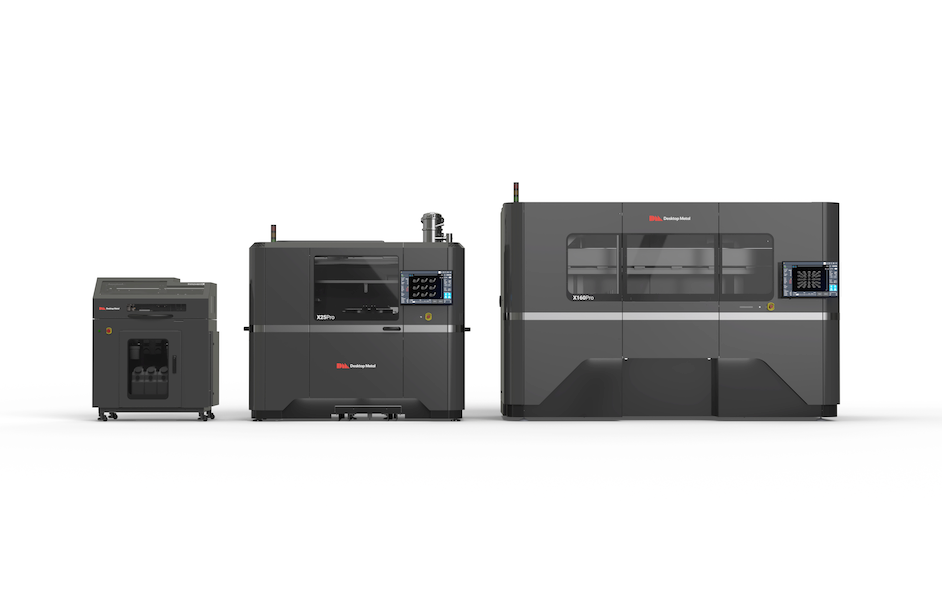

Desktop Metal launches the X-Series 3D printers for metal and ceramics. The printer series is suitable for metal and ceramic powders with a wide choice of powder thickness.
The X-Series is based on technology that Desktop Metal got its hands on with the acquisition of ExOne. This is a US company specialising in binder jet 3D printers for metal, sand and ceramics. Binder jet is a 3D printing technique in which an industrial print head selectively dispenses a liquid binder onto a thin layer of powdered material. This cures the powder, allowing an object to be built up layer by layer.
Exclusive licence
The binder jet technology was developed by the US Massachusetts Institute of Technology (MIT) in the early 1990s. ExOne was granted an exclusive licence to the technique in 1996. Two years later, the company launched its first commercial binder jet 3D printer: the RTS-300. The first 3D printer for sand followed in 2002: the S15. This printer can be used for 3D printing moulds for metal casting, among other things.
Desktop Metal acquired ExOne in 2021 for around $490 million. As part of Desktop Metal, ExOne focuses on supporting foundries with production systems for making moulds from sand. It is also focusing on further developing its printing technology for sand and ceramics into recycled concrete and upcycled sawdust.
Three models available
The X-series that Desktop Metal is now launching consists of three models:
- InnoventX: an affordable entry-level binder jet system aimed at scientists, R&D and low-volume production, among others.
- X25Pro: a mid-range solution already in use worldwide for higher-volume production with a print area of 400 by 250 by 250 mm.
- X160Pro: the largest binder jet printer for 3D printing in metal with a print area of 800 by 500 by 400 mm.
The X-Series uses a technology called Triple ACT. This is a technology for dispensing, spreading and compacting powders during the printing process. Desktop Metal reports that this technique can bind a wide range of powders with an average density (D50) of 3 to 100 microns.
Author: Wouter Hoeffnagel
Source photo: Desktop Metal









