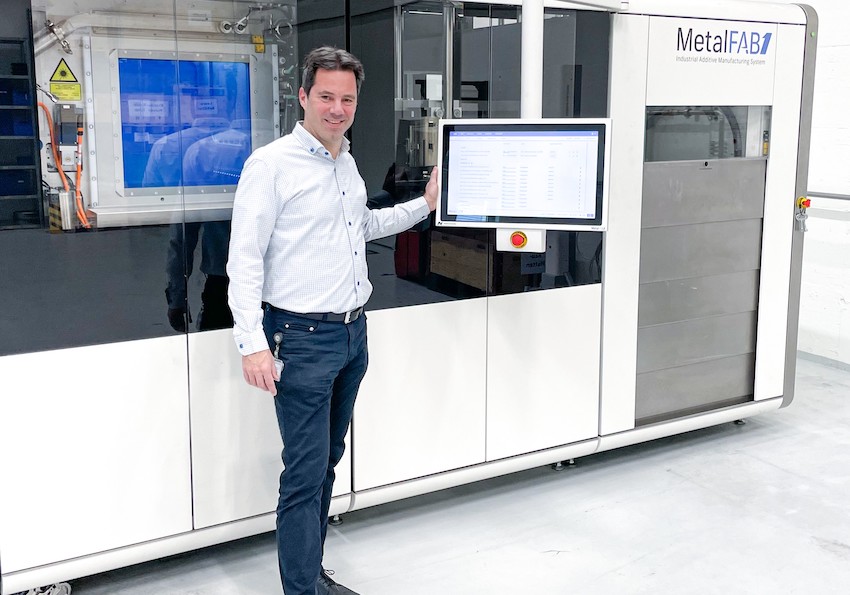

ABB Turbocharging, part of ABB, is going to deploy Additive Industries' MetalFAB1 platform. Using the additive manufacturing platform, the company will print spare parts for its turbochargers. The company can 3D-print parts on-demand with the platform. And need to hold less inventory.
What exactly does ABB Turbocharging do?
ABB Turbocharging supplies and maintains turbochargers for 500 kW to 80+ MW diesel and petrol engines. The company has more than 100 service stations worldwide. More than 180,000 ABB Turbocharging turbochargers are in operation worldwide.
The Swiss company supplies turbochargers for the marine sector and emergency power supplies, among others. The company has a wide product range. This requires the availability various spare parts . The company therefore kept a large number of spare parts in stock until now.
Print spare parts on-demand
ABB Turbocharging plans to produce these components on-demand from now on. This should significantly reduce production time. Whereas traditional casting of components can take up to nine weeks, a spare part should be able to be produced in just one week using the MetalFAB1 platform.
The process offers significant advantages. Not only can ABB Turbocharging produce spare parts faster, the company also needs to keep less stock without increasing delivery times. The company expects to significantly reduce the amount of spare parts it holds in stock.
What kind of printer is this?
MetalFAB1 is a platform for additive manufacturing based on powder bed fusion (PBF). This is a technique where powder material is deposited on a print bed and then cured using a laser. What is special about the MetalFAB1 platform is that the manual steps normally involved in this process have been automated. Additive Industries reports that this increases productivity and ensures a lower cost per printed part. The automation also reduces human errors and increases reproducibility.
The platform offers a printing area of 420 by 420 by 400 mm. The printer is equipped with four 500W lasers. Printing is possible with a layer thickness of 20 to 100 µm. The MetalFAB1 platform can carry out up to eight print jobs autonomously, after which human intervention is required. For larger production runs, it is possible to combine up to eleven MetalFAB1 units. In addition, an existing MetalFAB1 printer can be expanded with additional modules. This allows production capacity to be increased even after the printer has been commissioned. Full specifications of the MetalFAB1 platform are available here.
Improve customer service
"In Additive Industries, we have found a partner that not only understands what it takes to deploy 3D metal printing in an industrial environment, but also shares our passion for digital technologies for continuously improving our services to customers," says Egon Seegers, General Manager Service Parts at ABB Switzerland, Turbocharging.
Ian Howe, CEO of Additive Industries, added: "With ABB, we are adding another market leader to our highly focused customer list. They are committed to progress in digital spare parts manufacturing, which is highly relevant at a time when shortening delivery times and reducing logistics movements globally is key."
"ABB services over 200,000 turbochargers worldwide on ships, in power plants, generators, diesel locomotives and large off-highway vehicles. The potential for on-demand 3D printing of spare parts is immense," said Mark Massey, COO of Additive Industries. "We are delighted to be able to support ABB in improving their customer service and satisfaction by significantly optimising the production process of turbocharger parts."
Author: Wouter Hoeffnagel
Photo: Additive Industries









