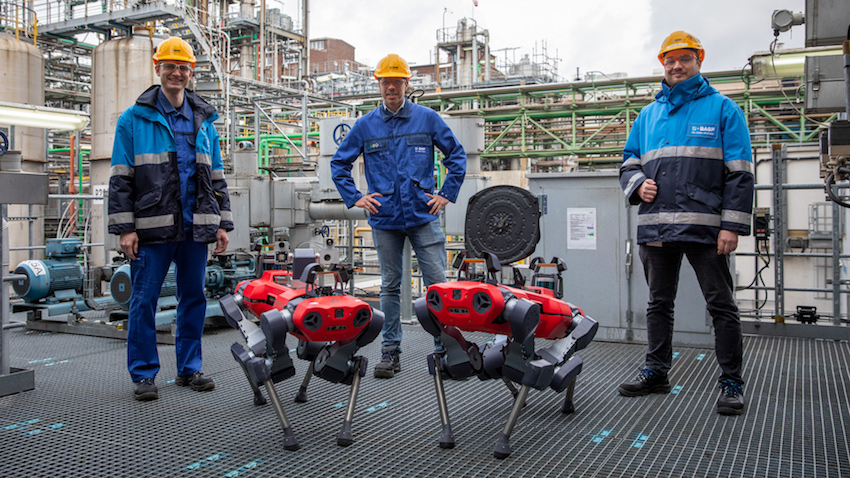

ANYbotics enters into a collaboration with chemical company BASF. The company's autonomous ANYmal C robots will be used by BASF for inspections in Germany's Ludwigshafen.
Robotics has long been used in manufacturing environments. However, many tasks in industrial environments are still performed manually. These include repetitive inspections and data collection for efficiency analysis. These manual processes not only have a financial impact, but can also affect process reliability and the quality of collected data.
Technology solutions have long been used to automate such tasks. These include sensors and Internet of Things (IoT) devices deployed to monitor critical processes. However, these have their limitations. For instance, according to ANYbotics, they are not scalable enough for inspection with multiple sensors or fully monitoring a large-scale production environment.
Fully autonomous
ANYbotics' ANYmal C robots should provide relief. ANYmal is a fully autonomous four-legged robot that can, among other things, climb stairs and obstacles. The robot can also move in very tight spaces. The legs are powered by actuators with adjustable traction, allowing ANYmal to adapt to different types of terrain.
We list some of the figures. ANYmal:
- Moves at a speed of 1 m/s
- is omnidirectional
- Climbs slopes of up to 20 degrees
- Runs up and down stairs of up to 45 degrees
- Put steps up to 35 centimetres high
- Steps over obstacles of up to 20 centimetres high
- Bridges gaps of up to 25 centimetres
- Wriggling through spaces just 60 centimetres wide
- crawls through a hole 50 centimetres high
Sensors
ANYmal is equipped with various sensors for mapping an environment. For instance, depth cameras are present for detecting obstacles. And the robot maps its surroundings using a 360-degree scan using LIDAR sensors. At the front and rear, it features a camera with wide-angle lens. Optional satellite-based navigation for indoor environments is available.
When configured, the robot is manually guided through an environment. On this familiarisation tour, ANYmal maps its environment. The robot can then find its way around independently from now on. During its operation, ANYmal thereby monitors any obstacles. The robot thus adapts itself to any changes in its path. There is thus no need to keep the route the robot travels completely clear. In the interest of safety, the robot continuously scans for the presence of people. Is this the case? Then the robot automatically maintains a safe distance.
Charging via docking station
The ANYmal features a battery with a battery life of 2 hours. The battery can be charged to 70% capacity in 100 minutes. Full charging takes three hours. Charging is done via a docking station, to which ANYmal automatically returns.
Controlling the robot manually is also possible, by the way. A remote control is available for this purpose. ANYmal's performance can be viewed via a workstation. Communication between this workstation and ANYmal's on the factory floor takes place via internet or WiFi.
Deployed in the Ludwigshafen
"Automation is definitely at the crossroads of the digitalisation strategy. We are at the end of the implementation process, and robotics has made a huge contribution," explains Peter Welter, Automation Manager at BASF. The ANYmal robots are deployed at BASF's site in Ludwigshafen, Germany. With an area of over 10 square kilometres, this is the largest chemical complex in the world. "We have a very heterogeneous environment here that has grown continuously over the past 150 years. A walking robot like ANYmal meets one of the key requirements for navigating these complex environments with long distances and steep stairs," Welter said.
At BASF, ANYmal performs inspection tasks, among other things. These include reading meters, taking acoustic measurements at pumps and compressors and checking the environment for hotspots using the built-in thermal camera. This data is collected daily and compiled into test reports.
Author: Wouter Hoeffnagel









