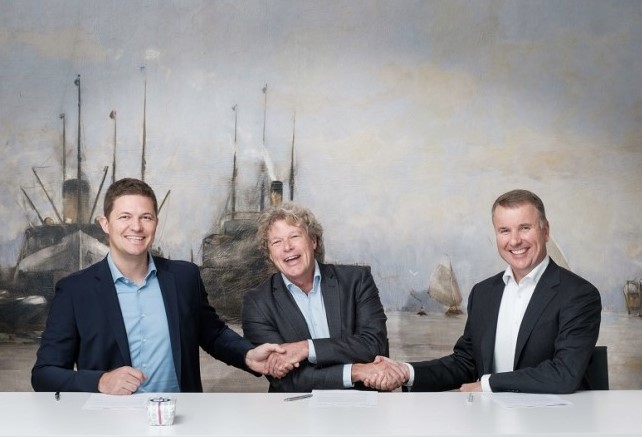

Hydrogenious is a pioneer in the field of liquid organic hydrogen (LOHC). The company has signed a Memorandum of Understanding (MoU) with tank storage firm Evos and the Port of Amsterdam. In it, they state their intention to jointly establish large-scale hydrogen import and storage facilities in the Port of Amsterdam. The facilities will consist of a large-scale LOHC separation plant (dehydrogenation process) and associated infrastructure. According to the plans, this will have a capacity of around 100–500 tonnes of hydrogen per day.
All three parties are co-founders of the H2A platform. This platform focuses on the import of green hydrogen, specifically on the development of the entire supply chain via the Port of Amsterdam. There are already many planned hydrogen activities in the port. These include the development of the regional and national hydrogen backbone, as well as various planned projects for hydrogen production in the North Sea Canal area. The construction of an LOHC import facility and a plant for the large-scale supply of hydrogen will be a significant addition to these plans. In the next phase, the parties involved will investigate the spatial, infrastructural and financial requirements. The aim is to have the terminal operational by 2028. The target is to import 1 million tonnes of LOHC per year.
LOHC technology
In the past, a feasibility study on different carriers of liquid hydrogen was carried out. Now Evos, Hydrogenious and Port of Amsterdam are taking the next step. The aim is to put Hydrogenious' unique LOHC technology into practice. Indeed, the study showed that LOHC technology is a promising solution for the Port of Amsterdam. This is because LOHC can be fitted into the existing infrastructure. Evos Amsterdam's terminals require minor modifications for the storage and distribution of LOHC.
Important step towards making European industries more sustainable
The hydrogen carrier used by Hydrogenious, benzyltoluene (LOHC-BT), is already widely used in industry as a heat transfer medium. It also has ideal properties for safe handling in ports. This is because it is a fire-retardant and non-explosive carrier with a high energy density. It can be handled in the same way as fossil liquid fuel within the existing infrastructure. After the dehydrogenation process, it is possible to reuse the carrier many hundreds of times for hydrogen bonding. This unique project is therefore an important step in the development of pan-European hydrogen value chains linked to the port of Amsterdam, accelerating the decarbonisation of European industries.
Image: Signing of MoU by Dr Daniel Teichmann (Hydrogenious, left), Koen Overtoom (Port of Amsterdam, centre) and Ramon Ernst (Evos, right).











