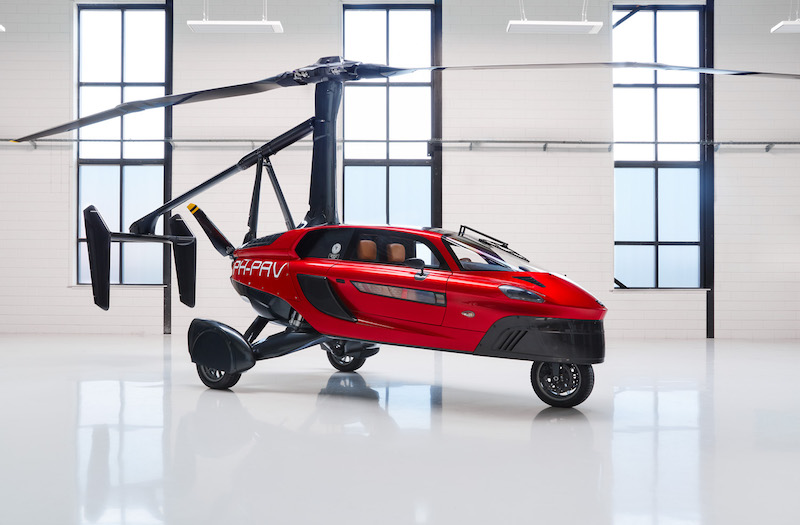

Dutch company PAL-V's flying car may carry a Dutch licence plate. This allows the vehicle to travel on public roads. Co-founder and CEO Robert Dingemans hopes the PAL-V will also be allowed to take to the skies next year.
PAL-V from Raamsdonksveer working on a vehicle that combines features of a car and an aircraft. The company showed its PAL-V Liberty for the first time at the 2019 Geneva Motor Show. This vehicle can drive on public roads but also take to the skies by unfolding its blades. Switching between driving and flying mode takes about five to 10 minutes. PAL-V was founded by CEO Robert Dingemans and shareholder John Bakker.
Driving and flying mode
The PAL-V Liberty offers space for two people and weighs 664 kg. The maximum load is 20 kg. To take off safely, a maximum weight of 910 kg is allowed, including passengers. The vehicle is equipped with two engines: one for driving and one for flying. In driving mode, the Liberty uses a 100 hp engine, which allows the vehicle to accelerate from 0 to 100 km/h in 9 seconds. Its top road speed is 160 km/h.
In flight mode, the vehicle switches to a 200 hp engine, which can reach a top speed of 180 km/h. The vehicle's range at maximum load is 400 km, while with one person on board at sea level, a range of 500 km is possible. The calculation of this range assumes a cruising speed of 140 km/h, which is the most efficient speed. At a speed of 160 km/h, 90% of the range is achievable.
The vehicle needs 300 metres from standstill to take off. With a rolling take-off, this amounts to 180 metres. This allows pilots to take off from small airfields, of which there are about 20 in the Netherlands.
Reach any location with own vehicle
The concept was born out of frustration with the fact that aircraft always have to take off from a fixed location. In practice, this means that the pilot has to leave his or her car at the airport and does not have this vehicle when arriving on location. Bakker therefore designed a car that can also fly, allowing users to reach any location using their own vehicle.
Liberty has been in development since 2007. The delivery of the vehicle has already been postponed several times. Dingemans reports to the FD that it is in the final stages of getting approval from the European Aviation Safety Agency (EASA). In 2021, Dingemans hopes the PAL-V will also be allowed to enter Dutch airspace.
The permission PAL-V now receives from the RDW is limited, by the way. It is a so-called individual approval, which applies to only one vehicle. With this approval, PAL-V can gain experience with the prototype on public roads, but cannot yet put the vehicle into production. "For that, we also need to look at the production site to make sure each vehicle can be produced to the same quality requirements," Ramon Gouweleeuw of RDW told the FD. "We have now only looked at the vehicle."
AeroMobil
PAL-V is not the only company working on a flying car. Slovakian AeroMobil is also working on such a concept. An AeroMobil prototype first took to the skies in 2013. Since then, four versions of the prototype have been developed: version 1.0, 2.0, 2.5 and 3.0.
The company has also been working for some time on the production model AeroMobil 4.0 STOL (short take-off and landing), which can be ordered as a pre-order. This vehicle features folding wings. The vehicle can switch from driving to flying mode, or vice versa, in three minutes. In the air, the AeroMobil 4.0 STOL is powered by an internal combustion turbocharged engine delivering 300 hp. On the road, it uses a hybrid system with two electric motors in the front wheels, delivering 110 hp of power.
The vehicle's top airborne speed is 360 km/h, while the cruising speed is 259 km/h. The range at 75% power is about 600 kilometres. On the road, the top speed is 160 km/h, while the AeroMobil 4.0 STOL accelerates from to 0 to 100 km/h in 10 seconds. The vehicle consumes 4.2 litres of fuel per 100 kilometres according to the NEDC test.
AeroMobil announced in late 2017 that the AeroMobil should go on sale in 2020 or 2021.
Author: Wouter Hoeffnagel