
In the Cyclometric project, researchers at the Fraunhofer Institute for Industrial Engineering IAO developed a solution related to promoting circularity. With this solution, companies can integrate sustainability assessments and circular economy concepts in early development phases. This is needed to accelerate sustainability.
To create sustainable technologies and products, it is essential to consider numerous factors across all development and life-cycle stages. The challenge: a classical life-cycle assessment (LCA) can currently only be performed in late stages of development. At these stages, many decisions cannot be reversed. Moreover, the sustainability of a product largely depends on its subsequent life cycle. That is, the use of individual components through to disposal. This is exactly where the experts at the Fraunhofer IAO and their partners in the Cyclometric project come in. Their solution moves sustainability evaluation into the development phase. That way, a course can already be set during conceptual design for sustainable products suitable for the circular economy.
Balance between innovation and standards
A key part of their solution is a software programme that fits seamlessly into existing development environments. Right from the very first product idea, it provides estimates of carbon emissions, expected lifecycle and other environmental aspects. As the product is designed in more detail, the predictions are refined. It is therefore possible to make targeted adjustments. "The software visualises potential weak points in the life cycle. Moreover, it provides specific recommendations for measures such as the selection of recyclable materials or modular designs. The solution is based on existing LCA standards to ensure compatibility with legal requirements." Speaking is Dr Lukas Block, head of the Mobility Transformation team at Fraunhofer IAO.
Parallel approach
The experts take a parallel approach. Besides software, they sought collaboration with a car manufacturer, a design agency and an engineering service provider. Together, they worked on the design of a car's centre console. They used this as an example to explore how design, materials and lifecycle requirements affect each other in a practical way.
Mutual learning
This approach stimulated and nurtured mutual learning. At the same time, it was also challenging. "We had to break with traditional approaches and develop a completely new methodological approach," explains Franziska Braun. She is an expert in innovation design and project manager for the development of the methodological approach and the cross-partner design of a cycle-oriented middle console based on it.
Revolution circular economy
This centre console combines innovative materials such as bio-based fibre composites with modular designs that allow easy repair and reuse. The researchers also developed a corresponding service concept that not only facilitates the replacement of individual parts, but also extends the product's lifespan.
Promoting tangibility
Another stated aim of the project was to make the subject of sustainability tangible for end customers and promote acceptance. Materials and design were deliberately chosen so that their recyclability is not only practical, but also a positive visual experience. "We want to foster a new mindset - both in industry and among consumers to promote circular economy," Braun explains.
Integration
The close integration of software development and component design ensures that the results can be transferred to industrial practice - also outside the automotive industry. Thanks to the software's compatible structure and evaluation logic, the project results can be easily transferred to other sectors and open up new avenues for promoting sustainable value creation and circular economy in different industries.
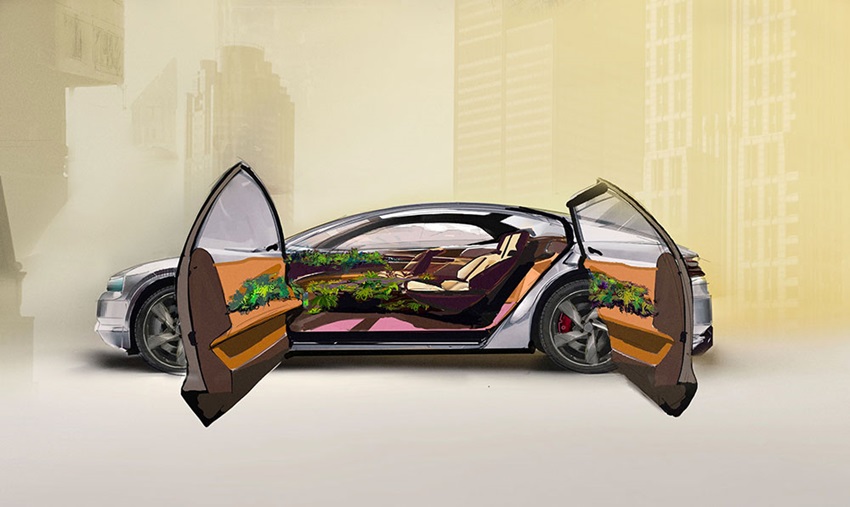
Opening image: Cyclometric demonstrates the importance of combining technical solutions, innovative methodological approaches and a shift in mindset. The project offers new perspectives on sustainability and the circular economy (Source and image: Fraunhofer IAO)
See also: Over 5.2 million euros in funding from SolarNL for circular solar panels











