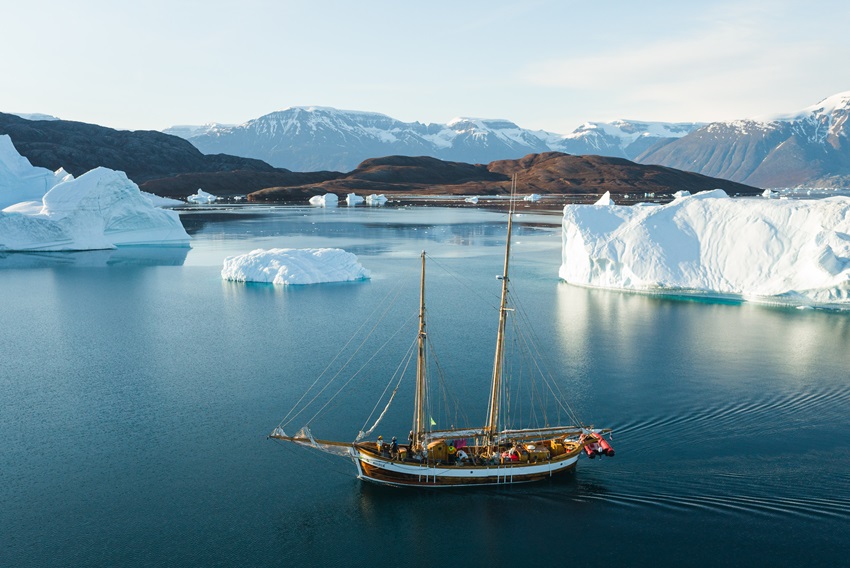

Icelandic company North Sailing, in collaboration with the University of Iceland, has shown impressive results in improving fuel consumption and CO2 emissions by retrofitting modern propeller systems to historic sailing vessels.
When overfishing, fishing quotas and the transition to large-scale industrial fishing consigned Iceland's characteristic wide-hulled oak fishing cutter to oblivion in exchange for modern fishing vessels, an important part of Iceland's history and folk spirit seemed to be disappearing.
For one family from Húsavík, this development was hard to watch. Indeed, fishing with oak boats was part of their life and culture. Two sons of fishermen, Hörður Sigurbjarnarson and Árni Sigurbjarnarson went their separate ways. They acquired the oak cutter Knörrinn in 1994 and started renovating it. They then founded the nature travel company North Sailing. Today, the company is still family-owned and Hörður's son, Heimir Harðarson, is active on the board of directors.
Ecological footprint
Parallel to their desire to preserve the historic boats, it was important to the brothers from the beginning that their company minimise their carbon footprint. However, the boats are between 50 and 100 years old. This makes it very complex. In fact, the shovels have old and polluting engines. Improved fuel utilisation and propulsion were therefore a major focus during the refurbishment.
Icelandic shipping
"By renovating North Sailing's boats, we have a unique opportunity to test different engine and fuel solutions. This with the aim that they can contribute to greener shipping. Therefore, we are always curious about solutions that can improve our carbon footprint and that of other boats," says Heimir Harðarson.
Innovative propeller systems
Recently, Heimir and his team turned their attention to the ships' propeller systems. This is to find the most optimal propulsion solution. When the team converted the schooner Hildur's old propeller with a new one from Denmark's Hundested Propeller, improvements were already to be expected. Still, the result came as a surprise.
University of Iceland
Before the propeller was installed, Heimir contacted Professor Rúnar Unnþórsson and Satish Kumar Bonthu from the Faculty of Industrial Engineering, Mechanical Engineering and Computer Science at the University of Iceland. They made plans to measure and evaluate the improvement in performance and fuel consumption compared to the original propeller.
Thirty per cent less emissions
The study showed a consistent 30 per cent reduction in fuel consumption and improved speed. CO2 emissions were also reduced by 30 per cent. "The result exceeded our expectations. Rúnar and Satish's study clearly shows that propeller retrofitting is not only a good financial investment for the boat owner. It is also good for the climate. We hope we can spread this message through our work at North Sailing," says Heimir Harðarson.
Systematic measurements
Systematic measurements were taken at different speeds. In the process, the researchers recorded fuel consumption, sailing speed, wind speed and other weather data. "The results of this study clearly show that shipping and fishing can drastically reduce their fuel costs and carbon footprint with existing technology. In short, there is no excuse to hesitate any longer, says Professor Rúnar Unnþórsson. He led the research.
Featured image: North Sailing
Read also: Outboard engine with hydrogen combustion











