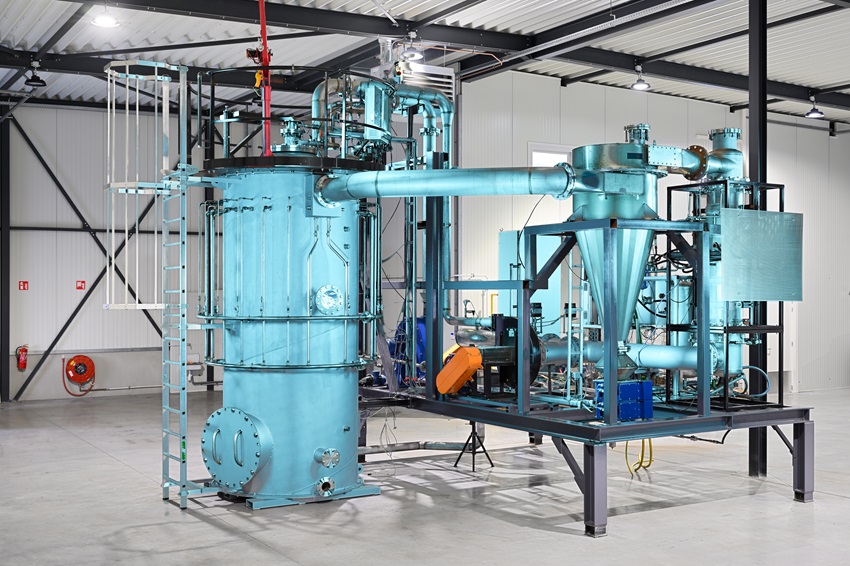

Iron powder can store energy in a very compact, cheap, safe, environmentally friendly and carbon-free way. This combination makes it a promising solution for greening energy-intensive industry and, for example, coal and power plants. Currently, a lot of research is still needed before industry can implement the new energy carrier. A feasibility study and its validation will bring implementation one step closer.
Iron powder has no direct CO₂ emissions, minimal NOx emissions and safe storage and transport is possible. Therefore, this new renewable energy carrier has the potential to be a realistic alternative for companies that cannot connect to the electricity grid due to congestion.
Technical design
Metalot is a network organisation where innovation, research, trade and education come together to form open innovation clusters. Metalot's aim is to prepare a feasibility study that promotes the development and implementation of this innovation. The cooperation takes the form of a government-funded feasibility study (technical, economic and legal) for a full end-to-end Metal Power pilot. In this study, SPIE, Metalot and other organisations are working together to flesh out in all these areas. Metalot is responsible for the technical design, economic business case and project management. Spie is responsible for validating the technical design, providing input regarding costing, maintenance and validating the economic business case.
Alternative energy carrier
Grid congestion has arisen due to a significant increase in electricity consumers in the Netherlands. To prevent the electricity grid from exceeding its capacity, not all companies get the desired connection and there is a waiting list for new electricity connection applications. This prevents companies from starting new operations, expanding or making them more sustainable. At the same time, companies are looking for more sustainable fuel sources to reduce CO₂ emissions from their production processes.
Operation
Stijn van Aken, Metal Fuels Project Lead at Metalot, explains how this innovation generates a new energy source. "The heat released from burning iron powder can be applied directly or converted into electricity. This is similar to how other fuel sources work. Iron powder can be burned on a large scale in a controlled environment, releasing large amounts of energy."
Advantages iron powder
Iron powder is not only an excellent energy source; it also has many advantages when it comes to safety and circularity. Van Aken: "Iron powder corrodes relatively slowly. Dispersion by wind hardly happens. Unlike many other fuel sources, such as hydrogen, iron powder is not prone to explosions, making it easy and safe to transport. Moreover, this energy source is fully circular."
Scaling up
Steef de Baat, Business Development and Innovation project lead at Spie, explains: "We capture the rust powder that remains after incineration and convert it into clean iron using renewable energy sources such as wind, solar and hydrogen-based energy. We burn the resulting clean product again in the combustion chamber. The heat produced is converted directly into electricity. And so we have come full circle." Currently, the pilot study is focusing on an industrial energy consumer with a small-scale heat process of 200 kW powered by iron fuel. If successful, SPIE plans to scale up implementation of the technology to a wider range of energy outputs and end users.
Low-carbon economy
The first iron powder applications are district heating, industrial processes and power generation. Companies are keen to reduce their carbon footprint, but at the same time need more energy to continue their operational activities. In the further development of iron powder as an energy carrier, Spie provides Metalot with knowledge and expertise in technical design, construction, installation, maintenance and service and validation of the economic business case. De Baat: "With this cooperation, we stimulate the development and implementation of this sustainable innovation and contribute to the transition to a low-carbon economy."
Source and photo: Spie
See also: €900,000 grant for iron powder as an energy source