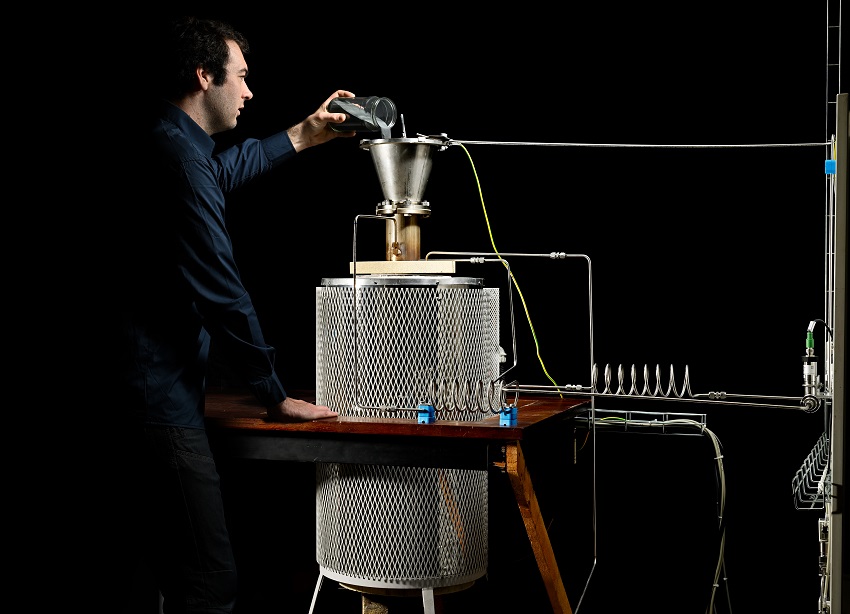

Iron powder can store energy in a very compact, cheap, safe, environmentally friendly and CO2-free way. This combination makes it a promising solution for greening energy-intensive industry and, for example, coal and power plants. Science financier NWO is therefore making 900,000 euros available with organisations involved. This for research into the potential of iron powder as an energy carrier on an industrial scale. The research - taking place under the name CIRCL, Closing the Iron Reduction-Combustion Loop - involves Metalot, RIFT, Shell and EIRES.
Niels Deen is professor of multiphase and reactive flows at the Faculty of Mechanical Engineering. He leads the research around iron powder as an energy carrier and is very happy with the award. "It was the second time we applied for this grant. So we have been eager to start this for over a year," explains Deen. He credits the entire team that shaped the grant application. Besides Deen, the team consists of Giulia Finotello (associate professor at Mechanical Engineering), Ivo Roghair (associate professor at Chemical Engineering & Chemistry) and Martin van Sint Annaland (professor at Chemical Engineering & Chemistry).
From rust to iron powder
The research focuses specifically on the regeneration of burnt iron powder. This is also known as iron oxide. The process works as follows: Burning iron powder releases energy in the form of heat. This heat can be used to heat houses in a green way, or it can be used in industry. The residual product released during combustion is iron oxide. It is possible to recapture this. Together with hydrogen derived from green electricity, it can be converted back into iron powder. That way, it can be reused. This creates a sustainable cycle, with iron as a green energy carrier.
Final process step
Deen and colleagues focus on the step from iron oxide back to iron powder. His team collaborates with TU/e spin-off RIFT. This team has built a production plant in Arnhem, containing a so-called fluidised bed furnace into which iron oxide is poured.
Computer models
Deen explains: "What we want to do is develop computer models. In doing so, we want to see if we can find the sweet spot in the regeneration of burnt iron. For example, high temperatures are favourable, because then you can convert more iron oxide. But at too high temperatures, for example, the particles become sticky and start sticking together. So there is an area of tension there. We will also investigate what the design of a fluidised bed should look like. High and narrow, or rather low and wide. It's a nice project."
NWO's Open Technology Programme
The NWO Applied and Technical Sciences domain awarded funding to a total of seven application-oriented research projects through the Open Technology Programme in September 2023. The total amount involved is EUR 5.8 million. In addition, companies and other organisations involved are investing around 950,000 euros in the projects.
Source: TU/e, Photo: Bart van Overbeeke
You can read more about the project in an earlier article on Maakindustrie.nl: Heating homes using iron powder











