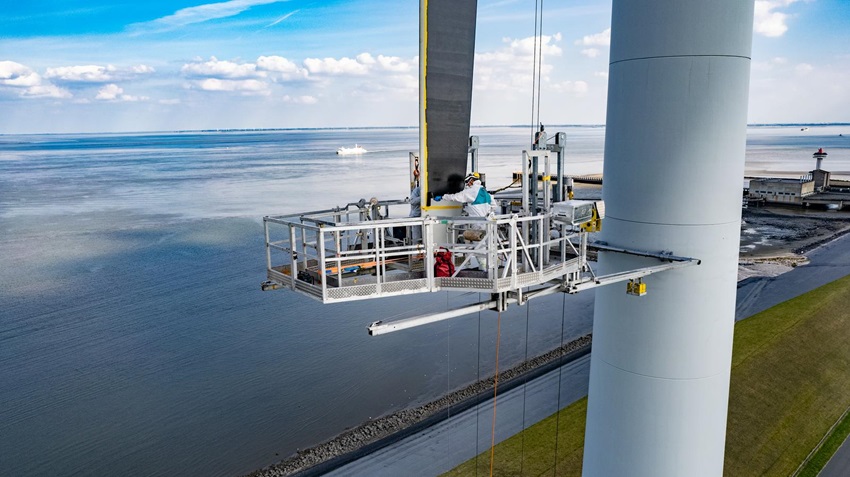

TNO, together with energy company RWE, province of Groningen and other public and private partners, is broadening the ongoing research into the effectiveness of a single black blade on wind turbines. This is done by placing sensors, cameras and a radar system in and around the turbines at Eemshaven wind farm.
TNO uses the various sensors to investigate under what conditions birds fly into a wind turbine. Researchers study whether painting one of the three turbine blades (one black blade) black has an effect on bird behaviour. Painting one of the three turbine blades of a wind turbine black could potentially improve the visibility of the blades for birds, making them more likely to avoid them.
Monitoring
The research with the additional sensors will run for just over a year. This is necessary to monitor different seasons. The study follows the first year in which the possible effects of a black turbine blade have already been studied in other ways.
Sensors in turbine blades
For about a year, sensors and (thermal) cameras will be installed in two turbines with TNO's so-called WT-Bird system. In the process, one turbine is equipped with a black blade and one is not. The sensors are inside each blade and use vibrations to record each collision. The cameras serve for verification and species recognition.
Bird behaviour
The images also map the behaviour of birds near the turbine. With the WT-Bird systems, TNO aims to gain more insight into when the bird comes into contact with a blade. The researchers also expect to get a more accurate picture of the number of collisions. This is because the area around the turbines is not universally accessible for manual searches.
Microphones
Microphones will be added to the system on the unpainted turbine as a complement to the WT-bird system. This will enable the team to acoustically detect birds as well. To map flight behaviour in the vicinity of the turbines, the research team is further installing a special 3D bird radar. All results will be compared with measurements from the Zwarte Wiek study, which has been running since the end of 2021. Interim results from that will be published in early 2024.
Results important for offshore wind turbines
Since the end of 2021, the province of Groningen and energy company RWE have been letting researchers study whether painting one blade black helps birds fly safely between wind turbines. Earlier research was done in Norway, on the island of Smøla. Here, researchers showed that painting one blade black results in 70 per cent fewer bird casualties among certain species of birds. It is being investigated whether this also applies to the situation in the Netherlands, with different bird species and a different landscape.
Black blade turbines Eemshaven
Meanwhile, one blade of seven of RWE's existing turbines in Eemshaven wind farm has been painted black. This one has a tip height of 140 metres. In this study, they are counting by hand how many birds may have flown into a turbine. This provides limited insight into when and how this happened. There is also no insight into any differences in bird behaviour around a turbine with a black blade and a turbine without such a black blade.
New research - more data
TNO's new research does aim to collect data on this. In this way, researchers will gain a better understanding of the effectiveness of the black blade. The results of the studies are also important for future offshore wind farms where manual measurement/counting is not possible.
Partners
Installation and monitoring of the systems is done by TNO with support from RWE. Part of the ecological evaluation has been outsourced to Waardenburg Ecology in collaboration with Altenburg & Wymenga. The project is supported by several parties. TKI Offshore Energy, the offshore wind energy ecological research programme Wozep of Rijkswaterstaat/Ministry of Economic Affairs and the Zwarte Wiek project group led by the province of Groningen.
Winter 2024/25
The Black Peak study is expected to run until the winter of 2024/25. It is a partnership between private parties in the wind industry, various public authorities and the nature sector. RWE, Vattenfall, StatKraft, Eneco, Pure Energie and Groningen.NL Energy, Ministry of EZK/LNV, Rijkswaterstaat and the provinces of Groningen, Flevoland, Overijssel, Gelderland, Noord-Brabant, Limburg, Zeeland, Zuid-Holland and Noord-Holland and Vogelbescherming.
Photo: Painting a black wick (photo: RWE)
Source: TNO
See also: Wind turbine inspections using autonomous drones and digital twin modelling











