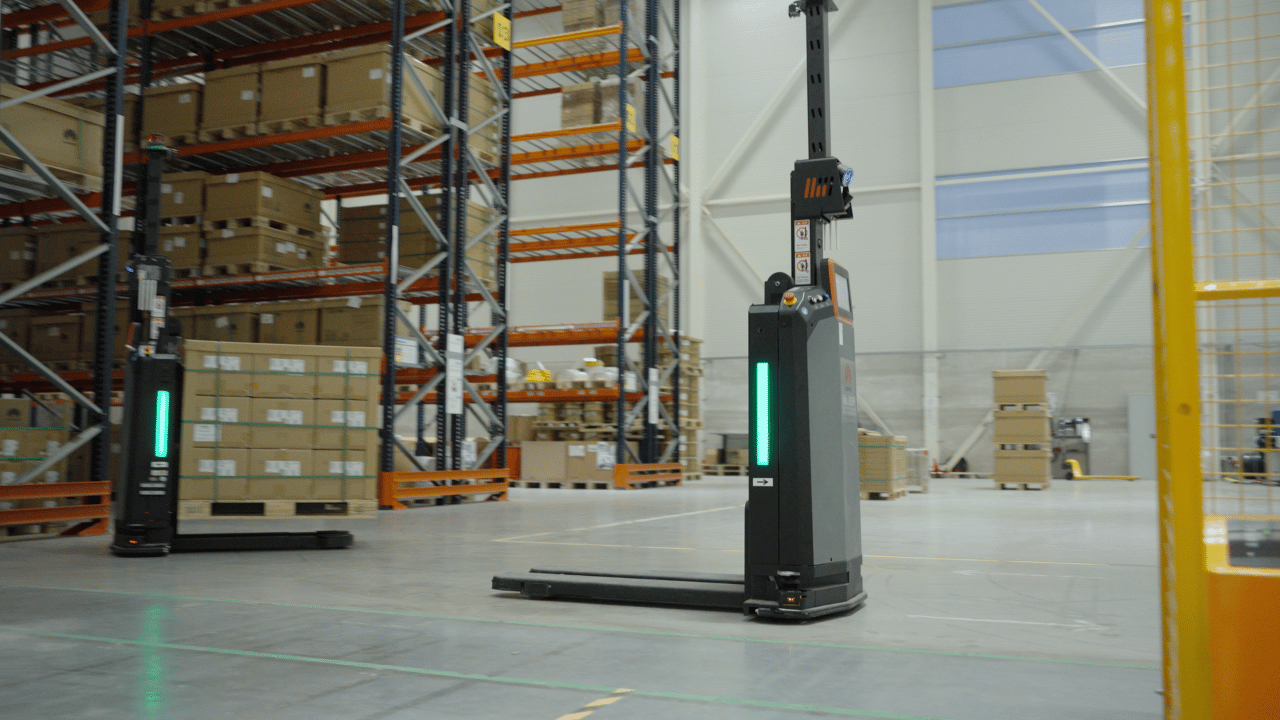
Autonomous driving vehicles (AGVs) need to be fully trusted. 'The large AGVs in our warehouse weigh tons,' explains Rianne Hoek of logistics service provider KLG Europe. 'You shouldn't think of losing control of such a forklift because of a hick-up in the connection. So for the safety of your employees, you want to be able to fully rely on the connection. That you can stop such an AGV à la minute if necessary.' With a hybrid 5G network, KPN offers KLG Europe that security.
KLG Europe is a large logistics service provider, operating worldwide. At the Waalwijk site, they handle logistics and distribution for a large international retailer. Forklift trucks and aerial platforms drive back and forth to put the goods on small trolleys, which bring the orders back to the order pickers. Efficiency and continuity are crucial for KLG Europe. Customers always expect to receive their orders on time, even at peak times like Black Friday. By deploying more and more AGVs, efficiency and continuity can go up. But then guaranteed network capacity and reliable indoor coverage are absolute musts.
Successful test phase
A year ago, KLG Europe launched a test in which they ran AGVs on a hybrid 5G network. A hybrid 5G network runs partly locally, so data stays on location. That test phase proved so successful that KLG decided to scale up immediately afterwards: from 5 to 10 AGVs. A large number of additional mini-AGVs are now also ready for implementation.
In a nutshell: the 7 benefits of AGVs and 5G for KLG Europe
- Increased operational continuity and reliability
- Fewer process disruptions due to technological issues
- Increased safety on the shop floor
- Greater security of supply for customers, even during major peaks
- More efficient use of vehicles and space
- Smarter use of employees
- Stronger reputation as a reliable and innovative partner
More efficient use of warehouse
'Besides more speed and reliability of picking processes, the safety of our employees is very important to us,' says Rianne Hoek, business unit manager at KLG Europe. She is responsible for logistics services at the Waalwijk site. 'Thanks to the hybrid 5G network, we can increase safety on the shop floor. With Wi-Fi, we still sometimes had failures and insufficient coverage. That posed security risks that we now face much less with 5G. Moreover, employees can now work much closer to the AGVs because they can drive much more accurately. Employees used to have to keep a distance of several dozen metres, now 5 or even 1 metre is sufficient. That means much more efficient use of our warehouse.'
Less downtime and sharper operational planning
Another big advantage: processes are much less disrupted by technological issues. 'Previously, AGVs more often came to a standstill due to hickups in the Wi-Fi network. Then a mechanic had to come, often travelling for up to half an hour. Meanwhile, the output stood still,' Rianne explains. 'To be able to continue anyway, we brought in people from other processes in the meantime. But this also disrupts those other processes. So preventing downtime - which is what 5G does - delivers a lot. The output becomes more predictable, work processes are interrupted much less.'
‘Incidentally, those interruptions in the Wi-Fi connection also led to gaps in the output data. Because 5G offers far greater coverage and reliability, the data is also much more reliable. Our operational planning is far more precise, and we’re better able to demonstrate to customers that we’re meeting the agreed KPIs.’
Reputation as an innovative company
Filiep Degryse, CTO at KLG Europe, looks back on the process with satisfaction. In addition to all the benefits Rianne mentions, 5G also enhances their reputation as an innovative partner, he explains. ‘Since we’ve had 5G, we’ve been taken more seriously and seen as a forward-thinking organisation.’ His advice to other companies? ‘Just get started. A proof of concept will show you what’s possible. New doors will open. You’ll discover where you can improve performance and boost output.’
As autonomous as possible
In the future, they want to move towards a warehouse that operates as autonomously as possible, Filiep continues. With, for example, hand scanners and access gates that also run on the 5G network. That they are working with 5G is now singing around fast, inside and outside the organisation. 'When suppliers, colleagues and customers hear that we are working with 5G, they immediately come up with questions and proposals. You can see that it is alive, that it sets a lot in motion.'
And Filiep is looking even further ahead. 'I don't see a 100% automated warehouse without any manual processes as realistic. However, I do expect the interaction between humans and technology to go much further than now. We can already do a lot more work with fewer people. And that is a big advantage in this labour market. But suppose you let the basic processes of order picking go fully automated and you only use people's knowledge and skills for special requests? Artificial intelligence (AI) makes it possible. Even the scenario that you enter the warehouse in the morning and ask, "System, where can I assist today?".'
Committed partner
About the cooperation with KPN to roll out the hybrid 5G network, Filiep and Rianne praise. 'Do you convey our compliments to your team? The interest in our processes, the availability in case of unexpected questions, the tips and tricks you brought - our technical people are very enthusiastic about the cooperation. And so are we.'
Accelerate your digital transformation on site
Do you always want robust and reliable connectivity and capacity at your location(s)? New technologies place new demands on IT infrastructure. Find out more about digital transformation on location in our eBook: Accelerate your digital transformation on location.