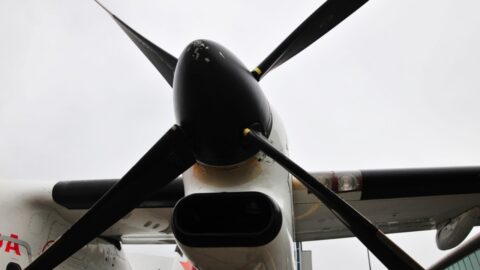
For the first time, a passenger flight has been operated with an aircraft that has flown largely on sustainably produced synthetic paraffin. This is a world first.
The synthetic paraffin was produced by Shell and used by KLM on a flight. The scoop was explained by the companies at a meeting held at the initiative of Minister Van Nieuwenhuizen (Infrastructure and Water Management). European politicians, policymakers, business and (aviation) industry representatives and civil society organisations participated in the meeting.
One of the fastest growing causes of CO2 emissions
Aviation accounts for 3.42 per cent of total greenhouse gas emissions in the European Union, according to figures from the European Parliament. According to the EU, aviation is one of the fastest-growing sources of CO₂ emissions contributing to climate change. This is partly due to the high volume of air traffic resulting from the growing transport of passengers and goods. For example, emissions from international aviation have risen by almost 130 per cent over the past two decades.
Synthetic paraffin could be the answer. This fuel allows existing aircraft engine technology to remain in use, while at the same time reducing the environmental impact of flights. Synthetic paraffin is produced from hydrogen, which is generated using renewable energy sources, water and CO2 captured at factories or from the air.
European plant for sustainable biokerosene
The Netherlands wants to encourage the development and use of sustainable aviation fuels such as biofuels and synthetic paraffin. This should lead to Europe being able to fly entirely on sustainable fuel by 2050. The government therefore supports several initiatives aimed at the production and application of such fuels. One of these initiatives is the first European plant for sustainable biokerosene, located in Delfzijl. This plant is a collaboration of SkyNRG with KLM, Schiphol and SHV Energy.
It was announced at the conference that KLM conducted the first commercial flight in which 500 litres of sustainable synthetic paraffin was blended at the end of January. This involved a flight from Schiphol Airport to Madrid, Spain. The synthetic paraffin was produced by Shell at a research centre in Amsterdam. The paraffin was produced using CO2, water and renewable energy from solar and wind from Dutch soil.
'New chapter of our aviation'
Minister Van Nieuwenhuizen: "Making aviation more sustainable is an international challenge we face together. Today, with this world first, we are taking a beautiful step in the new chapter of our aviation. This promising innovation will be of great importance in the coming decades to reduce CO2 emissions from aviation. It is great that we in the Netherlands have been the first to show that this is possible: a big compliment to all involved. I hope that, in these turbulent times for aviation, this inspires people in the sector to continue full steam ahead on this course."
Pieter Elbers, President and CEO of KLM: "I am proud that KLM has operated the world's first passenger flight with blended synthetic paraffin, produced from CO2, water and renewable energy. The transition from fossil fuels to sustainable alternatives is one of the biggest challenges in aviation. Fleet renewal has contributed significantly to reducing CO2 emissions, but scaling up the production and use of renewable fuel will make the biggest difference to the current generation of aircraft. This is why we have been working with various partners for some time to drive the development of sustainable synthetic paraffin. This first flight on synthetic paraffin shows that it is possible in practice and we can move forward."
President of Shell Netherlands Marjan van Loon: "Shell is an active player in the energy transition and our contribution to this world first is an example of that. I am extremely proud that we have succeeded in producing 500 litres of jet fuel from CO2, water and renewable energy for the first time. It is an important first step and together with our partners we now need to scale up, accelerate and make it commercially viable."
Blending requirement
Earlier, Infrastructure and Water Management Minister Cora van Nieuwenhuizen announced that the Netherlands wants to be a pioneer in reducing CO2 emissions from the European aviation industry. The minister is taking the lead in introducing the European admixture requirement of sustainable aviation fuels. This involves mixing sustainable fuel with paraffin to reduce environmental impact. Research commissioned by the minister shows that blending is a good way to make aviation more sustainable.
"With sustainable aviation fuel, we can make great strides for cleaner aviation. We need it to reduce emissions in the short term. With mandatory blending, we can drive the production of green fuels such as biokerosene and synthetic paraffin," Minister Van Nieuwenhuizen said when announcing this.
Factory in Amsterdam port
The conference organised recently also had room for startups in the field of renewable fuels. The startup Synkero, for instance, announced that it is working in collaboration with Port of Amsterdam, Schiphol, KLM and SkyNRG on a commercial synthetic sustainable paraffin plant in the Amsterdam port. In doing so, the project seeks to connect with sustainable initiatives in the North Sea Canal area. These include the establishment of a 100-megawatt hydrogen plant where up to 15,000 tonnes of green hydrogen can be produced using renewable electricity.
Another example is a demonstration plant in Rotterdam for sustainable paraffin using captured CO2 from the air. This plant is an initiative of Zenid, in which Uniper, Rotterdam The Hague Airport, Climeworks, SkyNRG and Rotterdam The Hague Innovation Airport are participating.
Author: Wouter Hoeffnagel