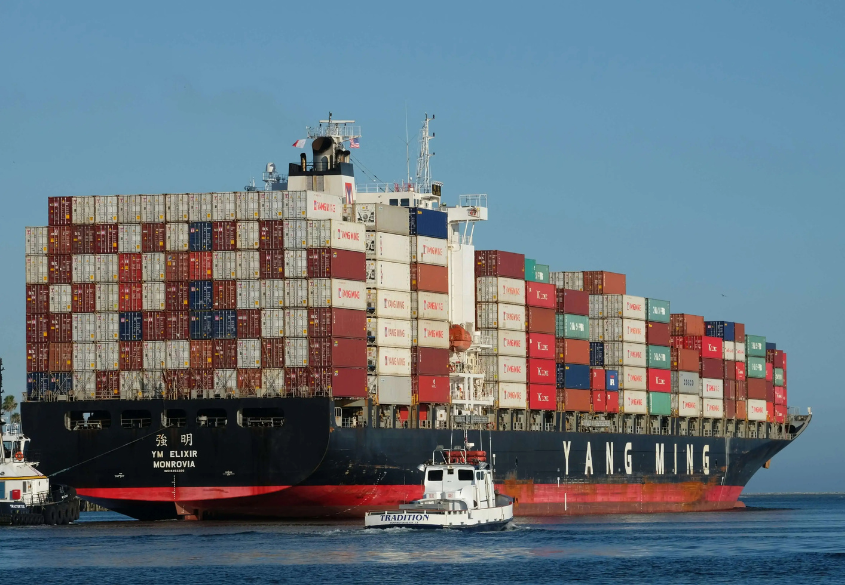
About 90% of all goods worldwide have been transported by ship at one time or another. This fact forces importers and manufacturing companies to think about the stability of their supply chains.
Since 2020, global shipping has been hit by a pandemic, the Suez Canal blockade, the war in Ukraine, attacks in the Red Sea, escalating tensions around Taiwan and now an escalating war in the Middle East. Each disruption had a direct impact on capacity, transit times and freight rates. Container prices that for years were between $1,000 and 2,000 per 40ft container peaked above $15,000 during COVID.
According to Maarten de Reij, CEO and founder of Cargoplot, it is a misconception to see this as exceptional. "What we have experienced in recent years is not a temporary anomaly, but a new reality," he said recently during Materials Week in Amsterdam. "Geopolitical tensions, climate disruptions and trade barriers have become structural. The question is not whether there will be another disruption, but whether companies are prepared for it."
Preparation as a differentiator
The difference between companies that continue to win during disruptions and those that get stuck lies in one thing: preparation before the crisis, rather than reaction during the crisis. Many manufacturing companies still operate with supply chains designed for a stable world. Just-in-time was efficient as long as ships arrived on time and trading relationships were predictable. One dominant supplier in one region made sense as long as geopolitical risks seemed limited.
Meanwhile, it appears that these very optimisations for efficiency increase vulnerability. Companies that weathered recent disruptions relatively well had identified risks earlier, had alternative suppliers and had visibility into their logistics dependencies.
"During a crisis, it is too late for fundamental choices," says De Reij. "Resilience arises in advance: knowing where you are vulnerable, organising options and making decisions based on actual data rather than assumptions."
Seven steps to a resilient supply chain
To make supply chains more future-proof, De Reij sees seven concrete steps that manufacturing companies can already take today:
- Map vulnerabilities Trace raw materials and components to their origins and identify dependencies on specific routes or regions.
- Actually diversify 'China plus one' is only effective if volumes are actually spread across different regions. We often see that ultimate dependencies on China, for example, remain even with suppliers from another region.
- Evaluate nearshoring & friendshoring Not every product can be produced closer to home, but for critical parts, a higher cost may be a defensible premium to avoid production downtime.
- Rethink 'just-in-time' Less stock reduces capital expenditure but increases vulnerability in the event of disruptions. Extra safety stock can in some cases be cheaper than an unexpected production stop.
- Prioritise real-time visibility Weekly Excel updates are insufficient in a volatile market. Real-time tracking, reliable ETAs and proactive notifications make it possible to organise timely alternatives in case of delays.
- Ensure logistics flexibility Choice between carriers, routes and modes increases flexibility when capacity is under pressure.
- Anticipate geopolitical developments Companies that respond early to rising tensions or trade restrictions limit their exposure to sudden tariff increases and capacity constraints.
Taking back control
In a volatile world, supply chain management is shifting from operational support to core strategic competence. Visibility and choice increasingly determine the difference between continuity and stagnation.
Digital platforms are playing a growing role in this regard. Cargoplot, a comparison, booking and freight management platform, is positioning itself as one that combines market transparency with operational coordination. The platform allows importers to compare freight options for FCL and LCL shipments, gain insight into carrier reliability and coordinate transport from port to warehouse. Users can track their freight in real time, manage documentation and see cost structures transparently.
According to De Reij, it is ultimately about getting a grip on the chain. "Technology will not solve geopolitical tensions, but companies that organise their logistics in a data-driven way can switch faster and make more informed choices. In an unpredictable world, this is not a luxury, but a prerequisite to remain competitive."
The message for the manufacturing industry is clear: do not hanker back for stability, but actively build resilience. Those who redesign their supply chains today will increase their strategic leeway tomorrow.