A real pop-up factory and a Pablo EscoBAR where you can pick up your sample while enjoying a beer. Parts on Demand will be making a big splash at ESEF Maakindustrie 2020. Their message?
With 3D printing, you can do much more than print a few prototypes; you can also use it to produce (series) very well.
Parts on Demand has been based in the modern Werkspoorfabriek in Utrecht since early 2019, surrounded by all sorts of trendy businesses. “It suits us quite well; we like to be a bit different,” says Neil van Es, owner of Parts on Demand. Their approach to the applications of 3D printing is also quite innovative. “3D printing has been around for thirty years; the technology itself isn’t that new. But it’s still often associated with small, run-of-the-mill home printers that produce clumsy little products that break easily. As you might sometimes see on Wereld Draait Door, so to speak. At Parts on Demand, we go much further: we focus on the industrial side and utilise all the latest developments in machinery, materials and processes to manufacture product ranges. The beauty of 3D printing is that you go straight from the computer to production. All the steps that used to be involved – such as making moulds and dies for injection moulding, or writing machine code for milling and turning – are skipped.”
ESEF MAAKINDUSTRIE 2020
At ESEF MAAKINDUSTRIE 2020, Parts on Demand will show through a 'pop-up factory' how the industrial printing process works and what benefits can be gained from it.
Get to work yourself
“The only way to really let visitors experience what we do is by showing them. Visitors can upload a file on the spot or in advance, or select a sample from our digital library for us to produce. They’ll be given the part to install and test on their production line. For more information, click this link.”
Or register directly
At our Pablo EscoBAR - because our raw material is always plastic powder, we are sometimes jokingly called one of the largest powder dealers in Utrecht - you can chat about your sample while enjoying a beer brewed especially for us. We also show many cases from our existing customers." Simplifying complexity, that's what Parts on Demand does every day and shows at ESEF MAAKINDUSTRIE 2020. "We are all kind of 'Willie Roots' who like to think of new and smarter ways to produce products. However, we often talk about complexity, which is abstract. At ESEF MAAKINDUSTRIE, we like to show what you can do with our techniques and how it works in practice. We also show our own developed materials, such as carbon 11: a carbon fibre-filled plastic that is six times stronger than we have been able to produce so far and creeps close to metal. The applications are incredibly broad, visitors at ESEF MAAKINDUSTRIE will experience this for themselves."
The technology
At Parts on Demand, they use the SLS 3D printing technique, or Selective Laser Sintering. It works as follows: complex parts are simplified into a huge stack of cross-sections. These are sent to the machines at Parts on Demand . Inside the machine, a layer of plastic powder is deposited, which is heated to just below its melting point. A laser then traces the first cross-section of the part. They lower that cross-section slightly. The machine deposits a new layer of powder and the whole process is repeated, sometimes as many as 6,000 times. At the end of the process, the machine contains a mixture of loose powder and solid parts. The loose powder is removed, after which the parts are finished to achieve the desired end result . “With this 3D printing technique, we can scale seamlessly from one to 100,000 units,” says Neil. “Because you’re simplifying parts into cross-sections the whole time, it’s easier to incorporate complexity into products. Products that couldn’t be made before, such as parts with complex structures or hinges, can now be produced in one piece and assembled. Because you skip so many steps, you can also produce parts that are highly tailored to the customer and the project. It doesn’t matter to us if that part is slightly different from the one in the previous production line or machine. We simply load a new file and slice it into layers again. We deliver within seven working days on average, which is quite unheard of in the manufacturing industry. As a result, our customers are much more flexible and agile in what they produce.”
Parts on Demand uses 3D printing to produce manufacturing tools, moulds and machine parts. “For the automotive sector, for example, we make production tools for applying stickers, fitting doors, aligning windows and installing locks. These are steps in the car manufacturing process that are often carried out by hand and for which staff have a set cycle time. For instance, they have to apply six logos in thirty seconds. These must always be positioned in the same place and pressed down with the correct force. We create smart templates and tools that allow fitters to apply the stickers in much less time and with less effort. For mechanical engineering, we print lots of brackets and housings, as well as grippers, which are often fitted to the end of a robot arm and are used to move objects. Every gram counts here, because the lighter the weight, the faster it can move. We redesign these grippers and integrate all the components. Previously, a vacuum head like this consisted of around 180 parts and weighed 12 kilos. We’ve reduced this head to 35 parts and a weight of 750 grams. As a result, the production line runs 20 per cent faster: pure profit, simply by replacing a single component. The Netherlands is conventional when it comes to engineering, and many companies are afraid to change something they’ve been doing the same way for thirty years. But you’re only hurting yourself if you don’t do it.”
Use of plastic
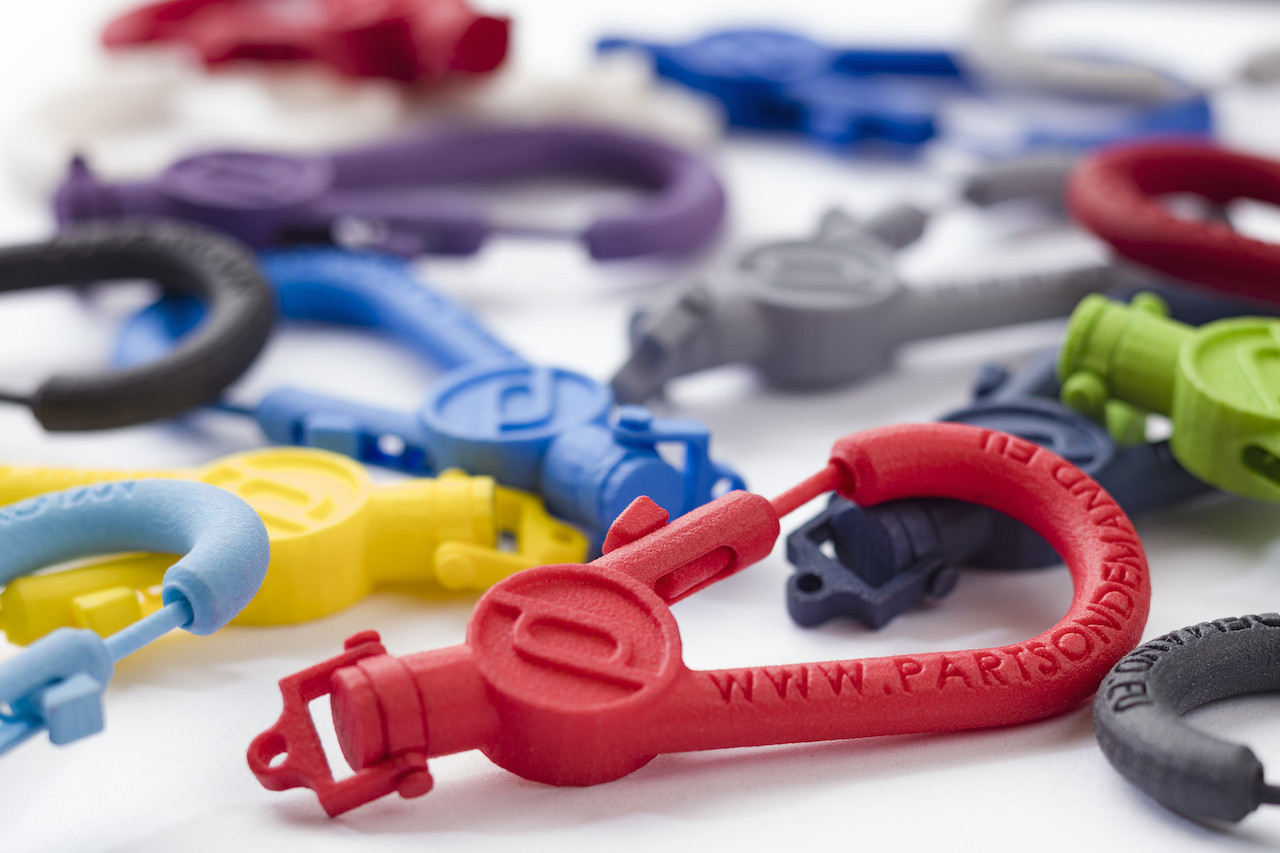
At Parts on Demand, many of the parts produced by the machines can withstand a fair bit of wear and tear. “The SLS technique is really quite different from the FDM technique, which is mostly used to make small prototypes. There’s not only a difference in how the parts look, but also in how much stress they can withstand. We use high-quality materials that are perfectly suitable for end-use applications. Every week in our factory, we produce thousands of parts that go into production lines, are used in assemblies, and are fitted in cars and rollercoaster trains. These are parts that are subjected to immense stress and must perform reliably. We have never had a product returned because it failed in the field. In fact, we have even printed drive wheels for a customer as a temporary solution. The part wasn’t in stock and it would have taken about eight weeks to source it in aluminium or steel. We produced a 3D-printed version, modified and reinforced it, so that the production line could at least keep running. It’s now been four years and the part is still in use.”
Text: Text lover: Kelly Bakker











