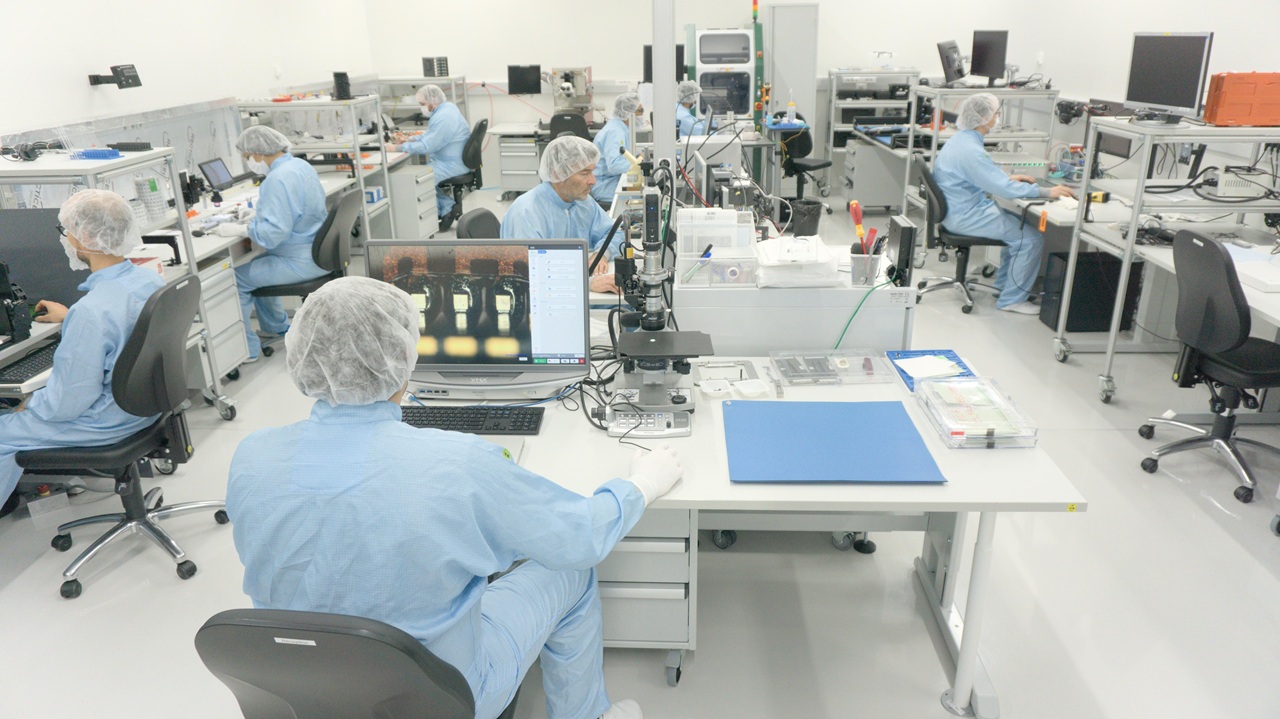

One of the most advanced parts of CERN's future particle detector is being built at the Free University of Brussels (VUB). In a cleanroom on the Etterbeek campus, production recently started on 1,600 modules that will soon form the heart of the new detector in the CMS experiment. The CMS or Compact Muon Solenoid Detector is, one of the showpieces of the European research centre in Geneva. VUB Prof Michael Tytgat, director of the Inter-University Institute for High Energy (VUB and ULB) explains.
Construction of the modules is taking place at the Interuniversity Institute for High Energy (IIHE), a collaboration between physicists from the VUB and ULB. The new modules are part of the so-called "tracker" of the experiment. This is a central component of the large CMS detector that minutely records the trajectories of thousands of particles created in collisions at CERN's particle accelerator, the LHC. There are 40 million collisions per second. With the experiment, physicists are trying to push the boundaries of our knowledge.
Replacement of current tracker detector
The current tracker detector is due for replacement. In 2026, the accelerator will close for four years. Time for a large-scale upgrade that will make the system many times more powerful. With the new tracker - and thus the modules being built in Brussels - the CMS experiment should be able to handle that explosion of data from 2030 onwards.
Finding answers
"We are not just building technology here," says Prof Michael Tytgat (VUB), director of the IIHE. "We are helping to build an instrument that helps us find answers to the biggest questions about the universe. That something like this is happening in Brussels alongside a select number of other leading institutes in the world, with students, researchers and technicians from five Belgian universities, is unique."
We are helping to build an instrument that will help us find answers to the biggest questions about the universe.Prof Michael Tytgat (VUB), director of the IIHE
Collaboration universities
The VUB is collaborating with four other Belgian universities in the project: ULB, UCLouvain, UGent and UAntwerp. For two years, researchers, engineers and technicians from all over Belgium will work together on the complex structure in the IIHE at the VUB. The overall project is supported by EWI, the FWO and the FNRS, which together are investing more than 12 million euros in this unique scientific collaboration.
Involvement in current detector
Belgium has played a prominent role in the CMS experiment for decades. The country has been involved from the start-up phase in the 1990s and made several contributions to the construction of the current detector in the past. Belgian scientists were also involved in the discovery of the Brout-Englert-Higgs particle in 2012, leading to a Nobel Prize for our compatriot François Englert. Today, the Belgian CMS group still includes about a hundred scientists.
Specially equipped cleanroom
The production of the new CMS tracker modules is done at the IIHE. The cleanroom there has been specially equipped for the job over the past few years. The first modules are now ready. "Our cleanroom in the IIHE at the VUB is currently a crucial part of an international experiment," says Tytgat. "We are showing here that fundamental research does not have to be a far-off show. What we are building here is literally part of a global search for new physics."
New discoveries
Since the discovery of the Brout-Englert-Higgs particle, the CMS experiment continues to yield new data that puts further pressure on the standard model of particle physics. In March, for instance, the detector noticed another strange phenomenon: an unexpected overproduction of top-quark pairs, a kind of short-lived ''molecules'' of two heavy quarks that, according to theory, should not actually exist. The results reportedly show the importance of continuing to invest in fundamental research.
Source: VUB
Opening photo: The IIHE cleanroom where the modules are made (Photo Tytgat/VUB)
Read also: Toyota invests millions in aerospace company Interstellar Technologies










