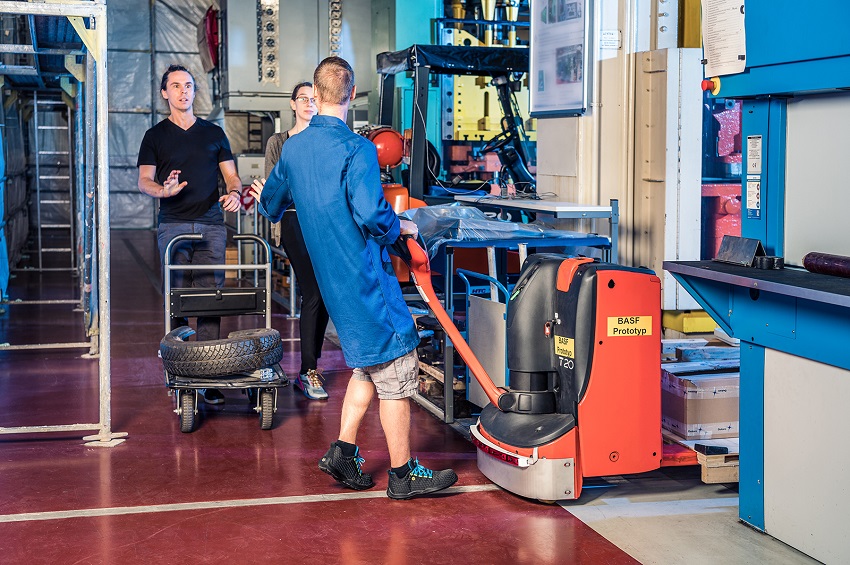

Warehouses are often very busy. The number of industrial vehicles such as pallet trucks or forklift trucks is growing in the aisles of increasingly large warehouses. Despite safety measures taken, accidents still happen. One solution to this is a safety technology with optical sensors attached to industrial transport vehicles. Fraunhofer Application Centre for Optical Metrology and Surface Technologies AZOM developed a number of prototypes together with BASF and Kinotex Sensor GmbH.
The Fraunhofer Application Centre is located in Zwickau, Germany. It is a department of the Fraunhofer Institute for Materials and Beam Technology IWS. The research centre developed customised optical sensors. By doing so, it hopes to reduce the number of transport accidents involving industrial transport vehicles. BASF is very enthusiastic about the research and therefore provided two pallet trucks.
Protect against bruising
"Every day, hundreds of industrial vehicles drive around our factories and warehouses. By cooperating with the Fraunhofer Application Centre, we want to integrate safety technology into our vehicles. This is necessary because we want to protect our workers even better." So says Dr Christian Fischmann. He is in charge of vehicle technology at BASF SE in Ludwigshafen. Together with Kinotex Sensor GmbH, he fulfilled an advisory role in the project as the client . "Our system is designed to protect the user from bruising, especially in the foot area. To achieve this, our research team developed a special proximity sensor. This detects when a driver is too close to the danger zone in front of a vehicle. It then brakes the vehicle," explains Prof Peter Hartmann, director of Fraunhofer AZOM.
Laser pulses
The system emits laser pulses of a certain length and distance from each other. With these, it generates distance information when they reflect against obstacles. As a special innovation, the developed system combines information from different spatial directions. In doing so, it continuously monitors a fan-shaped area around the pallet trucks supplied by BASF.
Sensor technology
In cooperation with the company Kinotex, the signal from a second optical sensor is processed with the distance information. This second sensor responds to pressure. The touch sensor can stop the vehicle. It can then automatically drive back a short distance. In this way, it protects the driver from collision and entrapment. This ability to drive pallet trucks backwards in response to a proximity sensor is a unique selling point of the new safety technology.
Testing
BASF employees have been testing too technology. Researchers will then incorporate their feedback into the further optimisation of the technology. The Employers' Liability Insurance Association is also advising the researchers.
Manufacturers are already showing interest
BASF has already presented the prototypes at a number of trade fairs. This revealed that manufacturers have a keen interest in the solution. “The technology can be applied to almost all transport vehicles. It is particularly interesting for AGVs,” says Dr Christopher Taudt. He is group leader for surface measurement technology at Fraunhofer AZOM. That is why he and his team are continuing to work on the technical optimisation of the safety technology. “We are currently working on the idea of integrating the sensors into a kind of retrofittable sensor strip rather than installing them permanently in the vehicle. This makes it possible to retrofit the system into any type of vehicle from different manufacturers.”
New system closes safety gap
Bruises, contusions or broken bones are the most common injuries caused by pallet trucks or forklifts. This is according to statistics from the German Social Accident Insurance Unit (DGVU). The vehicles travel six to seven kilometres per hour and sometimes weigh more than 500 kilograms without loads. Until now, there was no safety technology for these vehicles to protect against accidents around the feet. The system therefore closes a safety gap.
Source: Fraunhofer; Photo: A specially developed proximity sensor is used to protect the operator from entrapment, especially in the area around the feet. It detects when the driver gets too close to the danger zone in front of the vehicle and stops the vehicle (Photo: Daniel Viol/Fraunhofer IWS)











