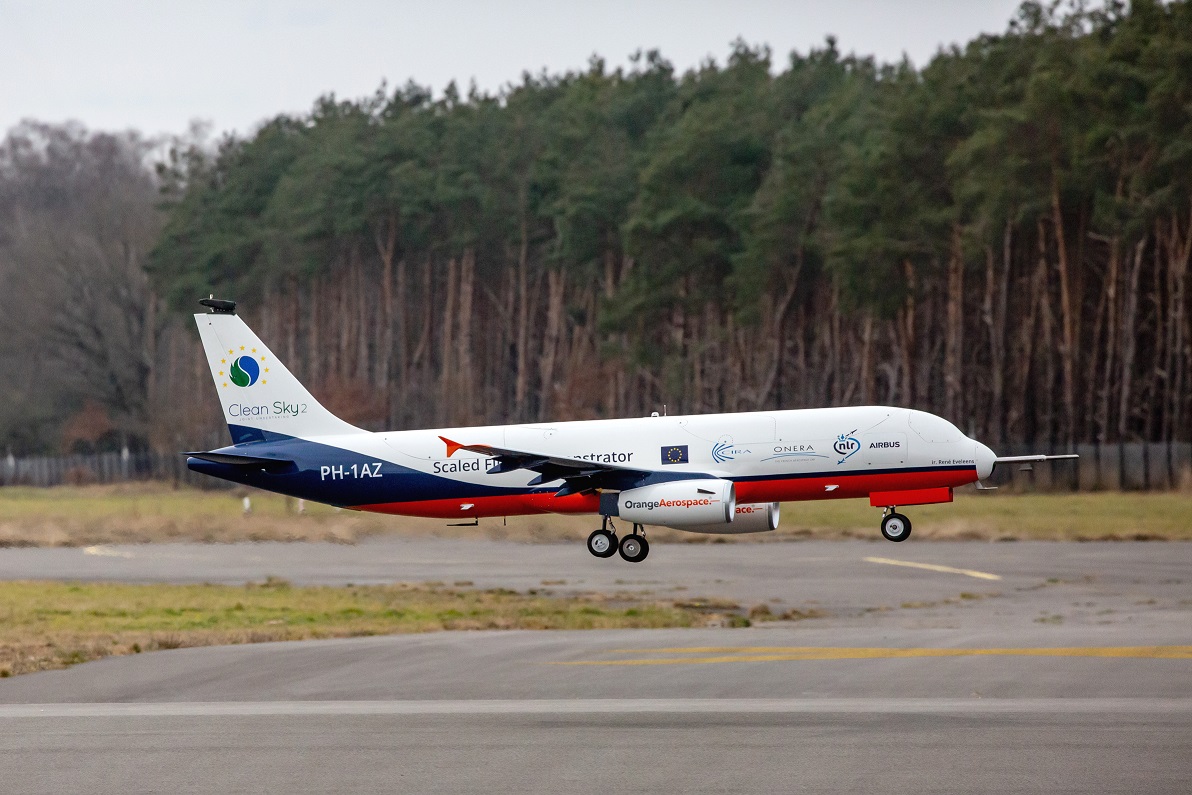

Test and develop disruptive technologies to enable significant reductions in aircraft energy consumption. That is one of the goals of the Scaled Flight Demonstrator (SFD)of the European Clean Sky 2 research programme. SFD is a scale model of a medium-sized passenger aircraft. A team of European research centres and industry developed the model. They have now started test flights.
Achieving a climate-neutral air transport system by 2050. That's quite a challenge. That's why European research centres and industrial parties have developed the Scaled Flight Demonstrator (SFD). This offers new research opportunities into sustainable flying. It can be seen as complementary to applying numerical simulations, conducting wind tunnel tests and using other regular testing tools for experimental research. The SFD will be particularly important in the field of aircraft dynamics. In addition, it is useful in the validation of so-called flight control laws. These are algorithms that convert a pilot's hand control into matching movements of aircraft control surfaces.
Features Scaled Flight Demonstrator
The SFD has a wingspan of 4 metres, a take-off weight of 140 kg and a cruising speed of 85 knots (160 km/h). In the study, the parties involved will determine the flight mechanical characteristics of the SFD through wind tunnel tests and test flights. They will then compare the data with that of a real passenger aircraft. That way, they can assess whether the characteristics match as realistically as possible.
Launch of Qualification Flight Tests campaign
The first flight of the SFD took place at the end of March 2022. It marked the start of the Qualification Flight Tests campaign. After an initial series of tests, the SFD will be transferred to Italy. Mission Flight Tests will then begin at Puglia airport later this year. During that second campaign, specialists will then carry out specific manoeuvres to build the required database. This is for the purpose of in-depth validation of the Scaled Flight Testing approach.
Dynamic aircraft behaviour
Following an earlier assessment of market players' needs and available research capabilities, the Large Passenger Aircraft Innovative Aircraft Demonstration Platform assesses going through a validation process. This will be done through Scaled Flight Testing as a suitable and competitive option to investigate dynamic aircraft behaviour. Following this, the SFD will be deployed to efficiently enable research into future distributed electric propulsion.
ONERA
An international team brings expertise to this validation of the Scaled Flight Testing approach. This team consists of four different parties, each with their own specific expertise. The French research centre ONERA, for instance, coordinates the entire validation activity. It also investigates the impact of scaling. Finally, the research centre defines the consistency of the control laws between the scaled vehicle and its full-scale scale reference.
NLR
Royal NLR is SFD operator. As such, it is responsible for design, manufacturing, integration, ground tests and flight operations. The entire Flight Test Instrumentation (FTI) also falls under NLR's remit. The FTI makes it possible to collect accurate data on flight behaviour.
CIRA
Italian research centre CIRA are also deploying specific expertise. For instance, by designing, producing and testing the navigation and control system for controlling the SFD and the Remote Pilot Ground Station. In addition, they are responsible for the Mission Flight Tests.
Airbus
Airbus finally, gave the objectives of the demonstrator at the beginning of the project. The company supports the various stages of SFD development throughout the project.
Source and image: NLR











