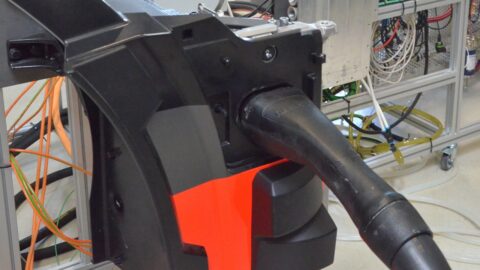
Swiss university EPFL recently boasts its own hyperloop test track. The track was built on EPFL's Lausanne campus and is intended for testing a linear induction motor. The site was realised in collaboration with Swisspod, a spin-off from the university.
Hyperloop is a form of transport that has been in the news with some regularity for years. The transport method aims to simplify and innovate distance travel. Among other things, by offering a cleaner alternative to transport by plane and train. Several hyperloop projects worldwide are currently underway, including in Hamburg, Germany, the US Nevada desert and China.
However, the Netherlands is also worth considering. In September 2018, for example, ProRail and Delft University of Technology signed an agreement to convert an unused second tube of a railway tunnel in Delft into a test tube for the Hyperloop. In late 2019, a three-kilometre-long test track near the city of Groningen was also announced, which is due to be completed in 2022.
'First operational model in Europe'
EPFL has also recently had its own test track. This is a circular test track on the Lausanne campus. EPFL talks about the first operational model of the hyperloop in Europe. The site is intended for studying new ideas about the structure and pod of the hyperloop, as well as researching the feasibility of such ideas for mass transport.
The test track is circular, 120 metres long and 40 metres in diameter. The site was developed by EPFL's Distributed Electrical Systems Laboratory, headed by Mario Paolone. The test track is made of an aluminium alloy. It is designed to encourage a final hyperloop, with pods of different sizes depending on test objectives and results.
1:12
Performance in terms of propulsion, levitation and kinematics is tested in a vacuum at a scale of 1:12. In time, this should become 1:6. The presence of a variety of sensors gives researchers insight into the properties of tested designs.
"With this smaller-scale test track, we are able to test the fundamental aspects of our pod's electromagnetic drive and levitation system," Paolone explains. "We will use the results to improve the pod's design and make the loop more efficient."

Linear induction motors
Among other things, the researchers want to experiment with linear induction motors, which play a major role in the pods. To reduce the cost of a hyperloop trajectory, the energy needed for propulsion is stored by the pods themselves. This is in contrast to, say, an electrically powered train, which typically uses an overhead line for this purpose.
The use of efficient linear induction motor should significantly reduce energy consumption per passenger compared to alternative means of transport. For example, the energy cost for an electric car is 97 to 100 Wh per km per passenger, while for an aeroplane it rises to 515 to 600 Wh per km. The use of linear induction motors should reduce this to 10 to 50 Wh per km.
Author: Wouter Hoeffnagel