
COVID-19 continues to disrupt our economy. A year after the first lockdown, it appears that the manufacturing industry in particular needs a different way of running their business. So that they can adapt better and faster to market dynamics. In a modern production forecast, you need to take more account of what customers are going through today. This encourages sales and operational processes to evolve. This explains why more and more business leaders are investing in digitalisation today.
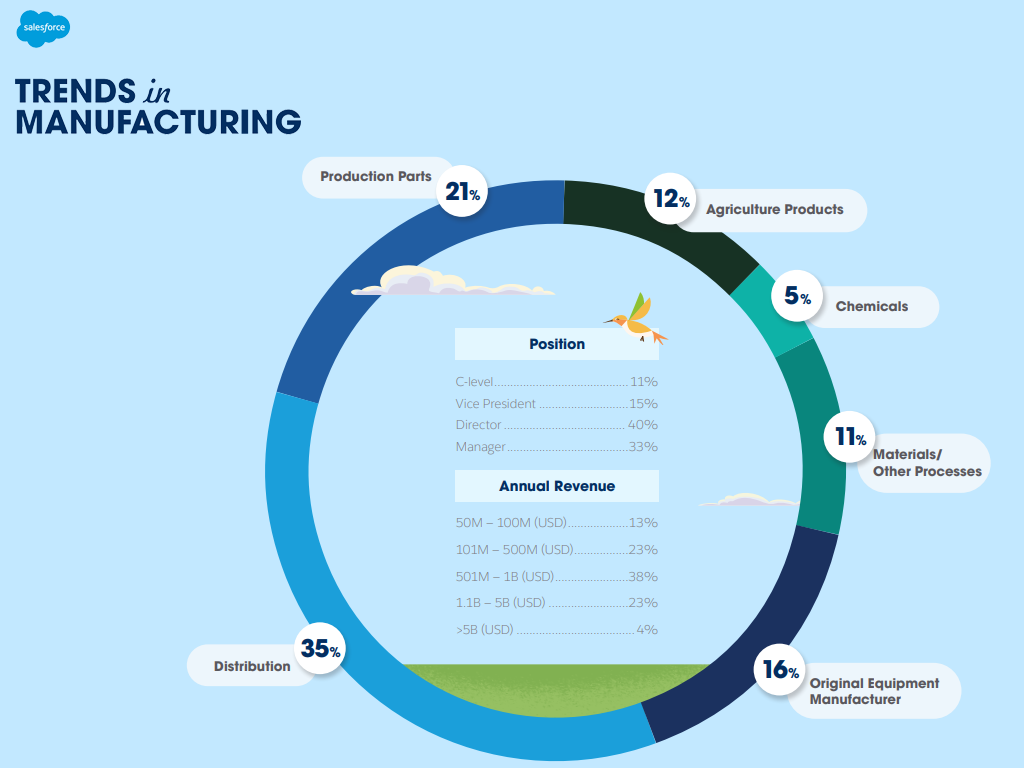
Digital transformation is one thing. In addition, a business leader or management has some other priorities in the next 24 months. Among them are making processes more efficient, forecasts and offering new services. This is already evident from Salesforce's Trends in Manufacturing Report. For this, the CRM specialist surveyed some 750 executives at manufacturing companies worldwide. The results for our region show that 95% of respondents expect some changes to be permanent during the COVID-19 pandemic. But 81% of manufacturers say they need both new approaches and new tools for more accurate planning and forecasting.
The report also points to business agility as a key difference between manufacturing companies that are future-ready and manufacturers that are not yet. That is, business agility matters in digitising sales and operational processes. In building strong relationships with channel partners, and in implementing a 'service-as-revenue' mentality.
To prepare manufacturing companies for the future and the new way of working, Salesforce provides four key lessons.
1. The role of the customer has changed forever
While suppliers and production units initially suffered the most from the pandemic, we should expect lasting changes most in customer-related functions. Because the need for better marketing actions and communication with customers has also changed significantly over the past year. We see classic manual operations, such as planning and forecasting on paper or collaborating via spreadsheets, disappearing from the scene to improve transparency for customers and channel and to make more accurate forecasts. Almost 8 in 10 manufacturers see the shift of planning to the cloud as an important piece of the puzzle.
2. Cloud is a key ally
Cloud can therefore be an important link for planning. But cloud technologies also indicate to what extent manufacturers are future-ready. Those that are future-proof are up to 2.2 times more likely to have already moved their sales and operational systems to the cloud as well. And 2.5 times more likely to have fully migrated specific business-critical systems - such as financial planning or forecasting systems - to the cloud. Benefits include the ability to respond quickly to new product applications. Optimisation of overall inventory and a shorter period between launch and effective revenue.
3. Better insights make for successful partnerships
Why do companies work together? This is mainly based on mutual trust, with ease of doing business being a crucial indicator of the success of both partners. An important part of this is partnerships and collaborations with channel partners. More than eight in 10 manufacturers admit that inaccessible data, outdated tools and teams working side by side severely hamper their forecasting process. Respondents thinking forward have therefore redoubled their efforts to digitise sales and operational activities. So that they collaborate more efficiently with channel partners and build stronger relationships around data transparency, co-selling and co-marketing. In the near future, we expect secure sharing of insights across ecosystems - from manufacturers and resellers to end customers - to be part of successful channel partnerships.
4. Consider extended after-sales services for greater resilience
The sales process obviously does not end with the purchase of a product. The importance of after-sales services - such as spare parts, diagnostics and support - is growing all the time. Especially for future-ready manufacturers. In the report, this group is also more optimistic about bundling product, service, software and other services through a single revenue model - also called servitisation. Overall, 86% of forward-looking manufacturers already currently offer servitisation, indicating a healthy 'service-as-revenue' mentality. These new business models, combined with their migration path from service systems to the cloud, have given these forward-looking manufacturers a clear edge over their competitors.
A post-corona period is coming. As manufacturers seek to prepare for this, flexibility will be fundamental to their business. Automation will increasingly replace manual forecasting. Digitalisation of sales and operational activities is a key factor in the readiness of manufacturing companies for the future. Thereby, business models are a key component for integrating adaptability into manufacturers' strategies.
Copyright: Michiel van Vlimmeren, general manager at Salesforce in the Netherlands











