
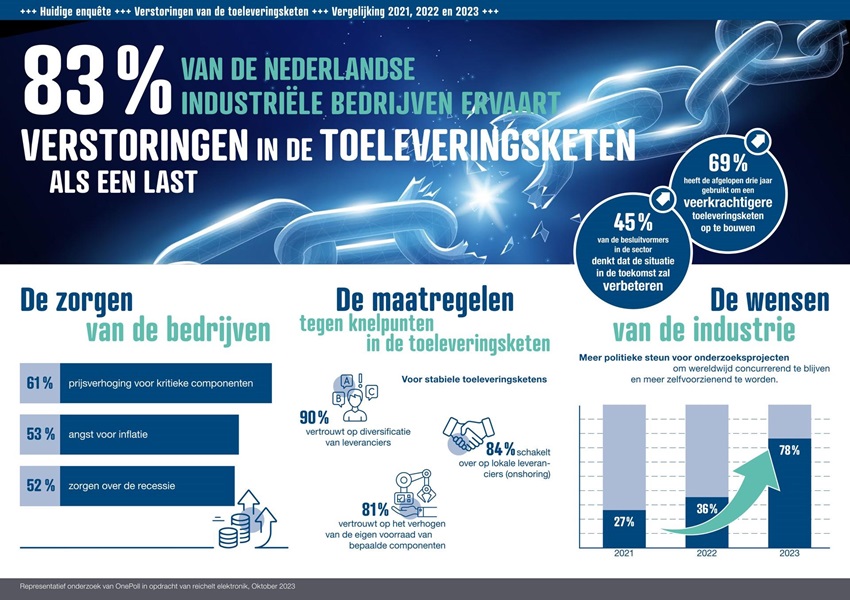
Parts shortages and supply chain chaos have long been part of everyday life in Dutch manufacturing. Hopes that markets and supply chains will soon ease up have been greatly reduced. Supply chain disruptions still keep 83 per cent of Dutch industrial companies in suspense.
Component shortages and chaos in the supply chain have long ceased to be the exception. Almost half (45 per cent) of decision-makers in Dutch industry believe that the situation will improve in the future. That is a lower figure than in previous years. In 2021, just over two-thirds were still optimistic about the future, and the year before that the figure was 48 per cent. This is according to the Supply Chain Report commissioned by reichelt elektronik. For the third year running, 250 Dutch decision-makers from various industrial sectors were surveyed.
Resilience
However, survey respondents do have confidence in their own company's resilience (88%). And that while the majority (52%) agree that their company has suffered significant losses over the past three years. Also, 59% fear the economic risk their company faces if there are major shortages of certain components. Implementing a reliable system is necessary. Respondents are convinced that this will help them overcome supply chain problems (69%).
Measures are bearing fruit
Supplies of materials are becoming scarce, deliveries are delayed or cancelled altogether. As a result, production in the Netherlands often comes to a standstill. Nevertheless, the results of this year's survey show an improvement compared to previous years. In 2021, the average production downtime was 38 days. In 2022, the average was 47 days. And this year, companies could not produce for only 30 days. Even 19 per cent of those surveyed did not have to stop work at all despite the hurdles. This result shows the success of the measures taken in the past 12 months.
Spreading opportunities
There is a new and popular trend to deal with supply chain bottlenecks. And to build or maintain resilience. A majority of companies (90%) see supplier diversification as a core strategy. More and more companies are working with multiple suppliers for certain components and raw materials. Onshoring, i.e. working with local suppliers, is also an important strategy (84%) to become independent from global trade and political turmoil. Switching to cheaper suppliers is also high on the list (80%).
Stock replenishment
Increasing inventories remains a popular countermeasure. It is taken to counter supply bottlenecks. In 2021, 49 per cent of companies followed this strategy. In 2022, it was 64 per cent. This year, some 39 per cent are still doing so to increase inventories of critical components. Another 42 per cent plan to increase this further in the next 12 months. In detail, this includes hardware component and electronic component manufacturing, construction, automotive and utilities, where about a third of companies rely on this measure.
Just-in-time
Over a third of those surveyed returned to the just-in-time concept in the past 12 months. Yet they also continue to stock their warehouses with key components. In particular, the automotive, electronics and hardware industries, and utilities rely on this combination. The return to just-in-time confirms the results of the 2022 survey. In it, 70% of companies could imagine relying on this strategy again.
Price increases, persistent inflation and recession
Despite the persistently unstable supply chain, sourcing of components and materials has improved significantly over the past two years. Price increases for critical components in the future are especially feared and have risen sharply: from 30% of companies in 2022 to 61% this year. Concern about inflation (53 per cent) is strong. General recession (52%) is also seen as a risk factor.
World Trade
In 2021, there was still hope for the light at the end of the tunnel. At that time, we were facing the end of the corona pandemic. Meanwhile, there are conflicts in the East and the Middle East. There is a general recession and inflation. There is also increased workload due to environmental regulations and the new supply chain law. Such events pose a major potential threat to Dutch industrial companies. In particular, 52 per cent of respondents from Dutch industry attribute a major impact on global trade to the war between Ukraine and Russia.
Desire for independence
The desire for independence is pervasive in 2023. The majority of companies (78%) hope for more official political support for Dutch research projects such as the production of semiconductors or other essential components. This is necessary to remain competitive and become more self-sufficient. In 2022, only 36% were in favour. And in 2021 it was only 27 per cent. 69 per cent would like to specialise more in new technology branches in the future, as they see better opportunities to expand technology leadership there, for example in quantum technology (60 per cent).
Featured image by MustangJoe via Pixabay and infographic: reichelt elektronik
See also the May 2023 study: Energy saving: Dutch industry balances between success and frustration











