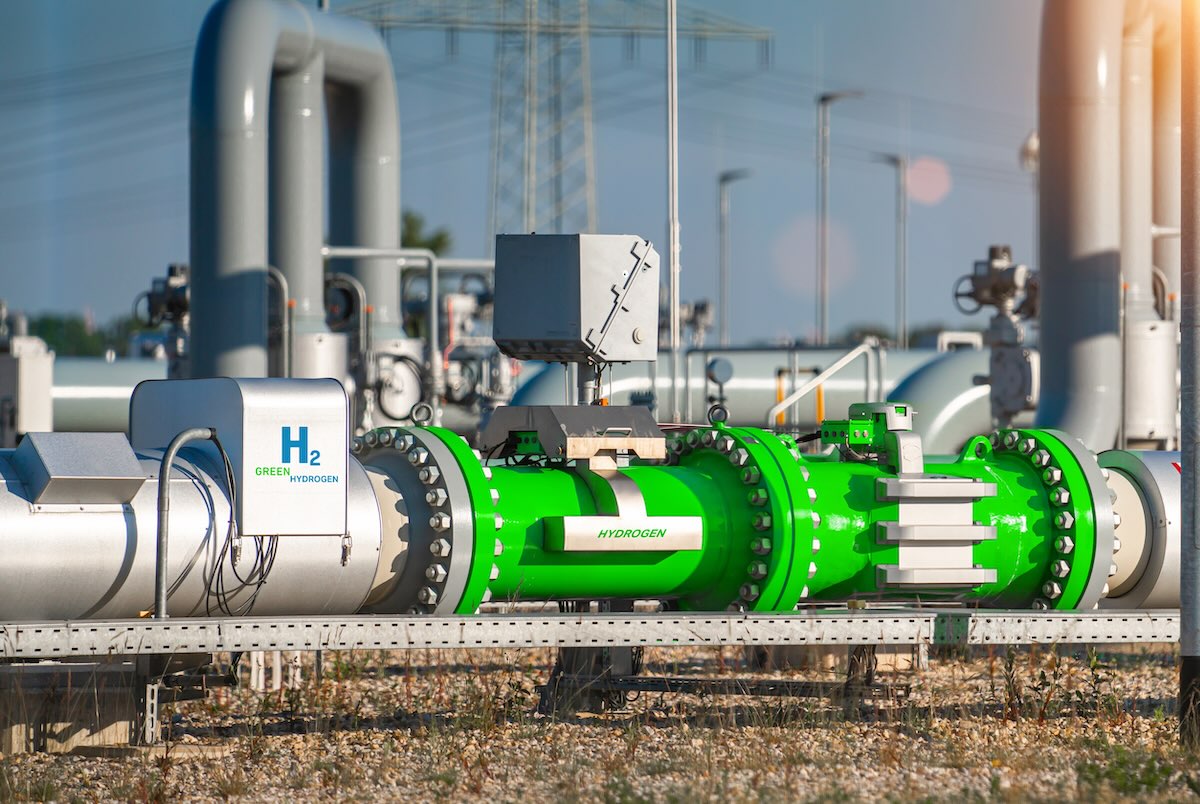

The fourth edition of the public-private research programme HyDelta will start this month. The research focuses on using the existing Dutch gas transport and distribution system for hydrogen gas.
Renewable gases are an important part of the energy transition in the Netherlands. Sustainable hydrogen in particular has an important role to play in industry. Sustainable hydrogen - also known as green hydrogen - is hydrogen produced using energy from renewable energy sources, with no CO2 emissions. This production takes place via electrolysis, a process in which water is split into hydrogen and oxygen. It can be used as fuel for fuel cells, vehicles and industrial processes, among other things.
Reusing gas transport and distribution pipelines
Network operators want to transport hydrogen through existing gas transport and distribution pipelines to locations where there is demand for the gas. This requires knowledge, which will be gained through the HyDelta research programme. HyDelta consists of several studies, so now the fourth one is starting. It focuses on questions raised by previous studies, such as preventing and measuring hydrogen emissions from a pipeline network as well as balancing and making the network safer.
HyDelta is a public-private consortium founded in 2020 on the initiative of Gasunie and Netbeheer Nederland. Several partners are involved, including Gasunie, Netbeheer Nederland, KIWA Technology, Netherlands Organisation for Applied-Natural Science Research (TNO), DNV, New Energy Coalition (NEC) and Hanse University of Applied Sciences (Hanze).
Integrated approach to transport and use of hydrogen
The research programme focuses specifically on developing an integrated approach to the transport and use of hydrogen in the Netherlands. Directly applicable research is central to this. HyDelta focuses on answering various questions:
- What standards and regulations are required for hydrogen?
- What could the hydrogen value chain look like?
- Can existing safety measures and equipment work with hydrogen?
- What are the key safety issues for hydrogen?
The programme consists of several studies, the first of which started in January 2021. HyDelta 1 focused on the introduction of clean hydrogen as an energy carrier and feedstock, and the role of infrastructure in this. HyDelta 2 focused on removing barriers to scaling up hydrogen. HyDelta 3 focused on the economic and technical integration of hydrogen gas into the national gas transport and distribution system in the Netherlands. So now HyDelta 4 is starting, focusing on the reuse of the existing Dutch gas transport and distribution system.
Quantitative insight into risks
One of the spearheads of the HyDelta 4 research is to identify the risks associated with a hydrogen transport and distribution network. This insight should help make the right choices surrounding the establishment and operation of hydrogen infrastructure in the Netherlands. Among other things, the parties involved are conducting research into static and permeation, and carrying out a quantitative risk analysis. This should lead to a safety framework.
Several projects are ongoing in the field of hydrogen distribution. These show that a distribution network designed for pressures up to 16 bar is a good option for the transport and distribution of hydrogen. However, the network is new in terms of pressure, medium, size, customer types and interpretation. Within HyDelta 4, those involved are gathering knowledge to make socially optimal choices in these areas.
Preconditions determine
When designing a safe hydrogen network, pressure and quality, among other things, play an important role. However, conflicting interests may come into play when designing the network. Therefore (technical) boundary conditions are needed to guide the design. In HyDelta 4, the stakeholders define these preconditions.
Balance on the electricity grid has been the focus of much attention for some time. This balance is also crucial for hydrogen networks. For hydrogen networks, however, it is not yet clear what the technical conditions are for keeping the grid in balance. As a result, it is also unclear what market incentives or regulation are needed for this. The HyDelta 4 study should provide more clarity on this.
Safety
Safety is also given a lot of attention in the research. For instance, safety is central to the operation of a gas infrastructure. This means, among other things, preventing fuel from entering the atmosphere during maintenance and measuring gas quality. In HyDelta 4, those involved gather knowledge and recommendations on gas analysis, emission reporting, recompression and flaring of gas mixtures.
More information about HyDelta is available here.











