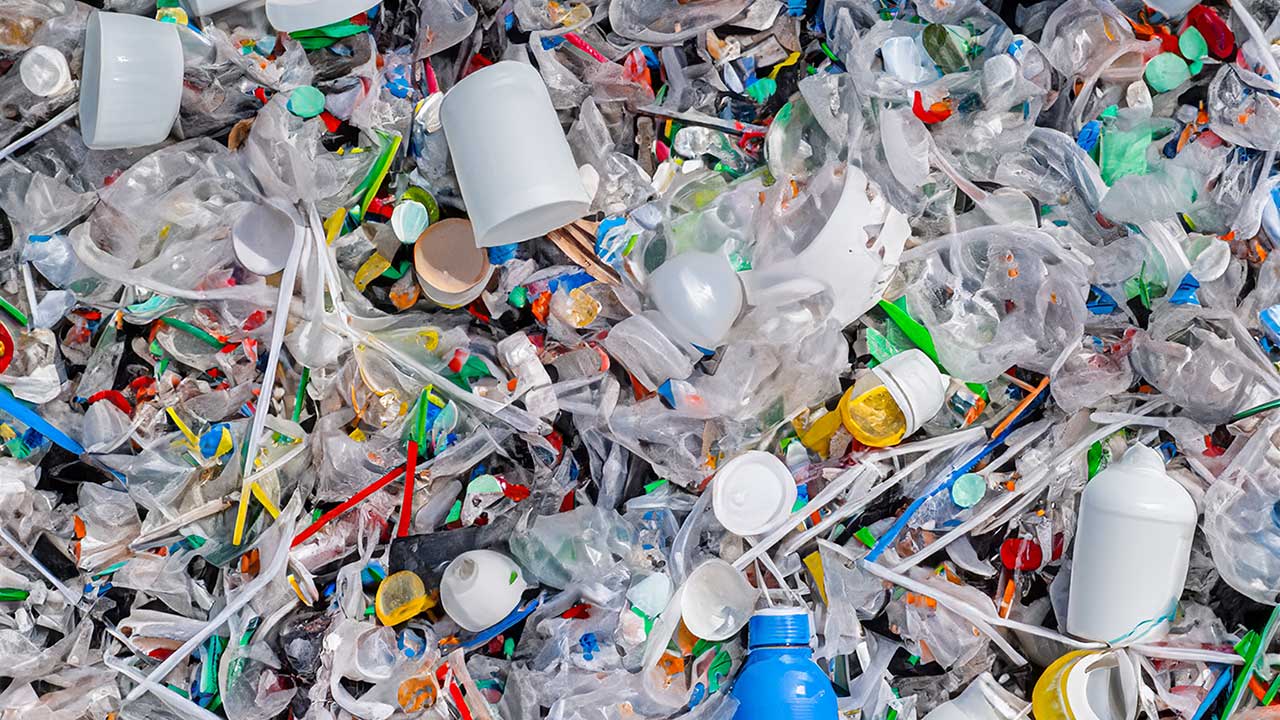

TNO is working on a method for recycling high-performance plastics without compromising on quality. It involves dissolution, a recycling technology that dissolves plastics, purifies them and recovers polymer. TNO is now working on scaling up this method from test labs to industrial application.
Alternative to mechanical and chemical recycling
Mechanical recycling in many cases does not meet the requirements for high-value applications. At the same time, chemical recycling is both costly and energy-intensive. Dissolution should offer an alternative. It produces a high-quality recyclate, where it is possible to remove unwanted or banned additives. In addition, valuable substances such as flame retardants can be recovered.
The energy consumption of the method is lower than for chemical recycling. The method is suitable for various polymers and effective for difficult-to-recycle plastic waste consisting of multiple materials. Dissolution also allows selective separation of a desired polymer from mixed streams.
Bringing dissolution to practice
With the TNO Möbius programme, TNO is developing a route to take dissolution from lab testing towards industrial application. In doing so, a new setup has been realised - the TNO Möbius LETO - to scale up and demonstrate dissolution in an industrial environment together with market parties. This is a semi-continuous installation that processes plastic waste on a kilogram scale and produces purified polymer powder. With the setup, TNO aims to analyse for which applications the recyclate is suitable.
The TNO Möbius LETO uses technology born out of the need to recover high-value polymers from difficult to recycle waste streams. As the market changes, the research institute is also looking at recovering valuable additives to plastics. As an example, it cites an antimony-based compound used as a flame retardant. It thus aims to strengthen the business case for the recycling method on the one hand, while at the same time increasing its impact.
Various partners involved
TNO is working with various partners to accelerate circular plastic recycling via dissolution technology. For instance, within the European project ABSolEU, the institute is working with LEGO, Volvo and BIC, among others, on circular applications for ABS plastics. Among other things, the parties aim to conduct TRL 5-level tests using the Möbius LETO facility to process ABS waste from end-of-life vehicles and electronic products.
In addition, the parties are investigating whether the recovered material meets the quality requirements of the intended applications. For this purpose, the setup will be tested in practice at a customer's site, for which TNO is joining forces with Royal Dahlman. In doing so, an advanced filtration technology from Royal Dahlman will be applied in the TNO Möbius process, and specifically in the filter module of the TNO Möbius LETO. In this way, TNO aims to accelerate the move towards the successful application of dissolution in the high-grade recycled plastic market.
Recovering polyolefins from mixed plastic streams
TNO is also working with Braskem to recover polyolefins from mixed plastic streams. Within this collaboration, the parties are investigating the feasibility and scale-up of the TNO Möbius technology. The aim is to produce near-virgin polymers. The focus is on the purification and separation of polymers and additives.
With Elix Polymers, TNO is focusing on recycling ABS polymers from discarded electronics. The parties are jointly investigating how to use dissolution to recover polymers and flame retardants from these devices. The focus of this collaboration is on high-value applications of recycled ABS, with a focus on preserving material quality and energy efficiency.