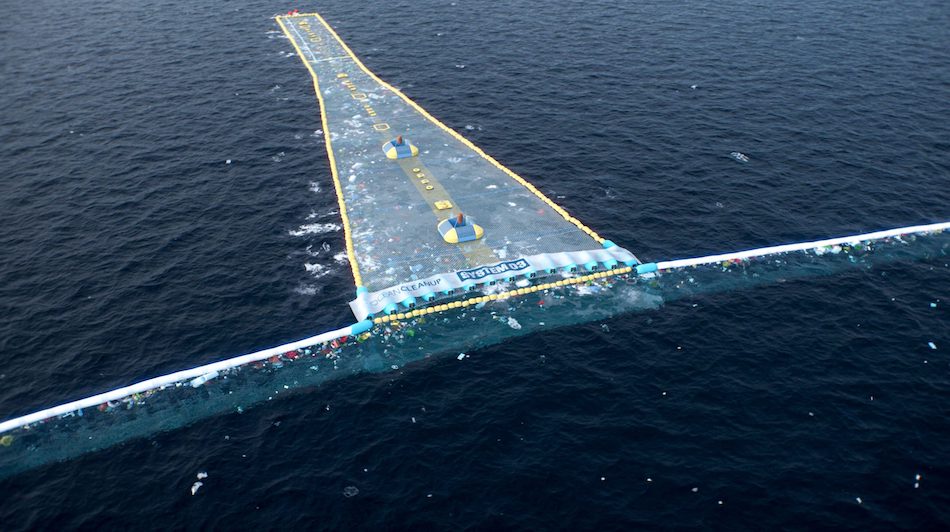

The Ocean Cleanup scales up. After previous test campaigns with System 002 were successfully completed in 2021 and 2022, the Dutch non-profit organisation now wants to clean up substantially more waste with System 03. System 03 is as much as three times the size of System 002.
Dutch inventor and entrepreneur Boyan Slat founded The Ocean Cleanup in 2013. This non-profit organisation based in Rotterdam focuses on tackling plastic pollution in oceans worldwide. Here, the organisation focuses on two factors: tackling existing pollution in oceans and stopping new plastic from reaching the oceans by cleaning up rivers. Previous research by The Ocean Cleanup shows that 80% of pollution in oceans comes from some 1,000 rivers.
System 002 successfully tested
Previously, The Ocean Cleanup conducted trials with System 002. This is the first large-scale system deployed by the non-profit to clean up oceans. The trial took place at the Great Pacific Garbage Patch (GPGP). This is an area in the northern Pacific Ocean between California and Hawaii where a large amount of plastic and other waste floats. The area is estimated to be about the size of Spain and France combined.
With System 002, The Ocean Cleanup conducted a 12-week test campaign, which was successfully completed. Following this success, Boyan Slat now wants to scale up the system. "Our ocean cleaning technology has now been validated and consistent removal of plastic from the GPGP is now a reality. The next step in our mission is to move from this successful pilot system to a system large and efficient enough to clean up the entire GPGP," writes The Ocean Cleanup in an update on its website.
Lower cost per kilogram of waste
System 03 is three times the size of System 002 and can remove much larger amounts of plastic from the ocean, at a lower cost per kilogram of waste removed. This on a continuous basis, with the system remaining active throughout the year. Thanks to its larger size and longer system uptime, The Ocean Cleanup expects the system to be 10 times more effective than its predecessor.
Although System 03 is substantially larger in size than System 002, the system is not capable of cleaning up the entire GPGP. System 03 should lead to a blueprint with which The Ocean Cleanup eventually wants to scale up to a fleet of systems. This fleet should completely clean up the GPGP. In optimising System 03, the focus is on minimising the cost per kilogram of waste cleaned up.
Ten System 03s needed to clean up GPGP
The Ocean Cleanup points out that cleaning up the entire GPGP is theoretically possible using System 002. However, this would be "impossibly expensive", reports the non-profit organisation. For example, it is estimated that a fleet of 50 System 002s would be needed for this project. Due to the larger scale of System 03, The Ocean Cleanup expects that 'only' ten systems of this variant would be needed for the same purpose.
Further information on The Ocean Cleanup’s System 03 is available here.
Author: Wouter Hoeffnagel
Image: The Ocean Cleanup











