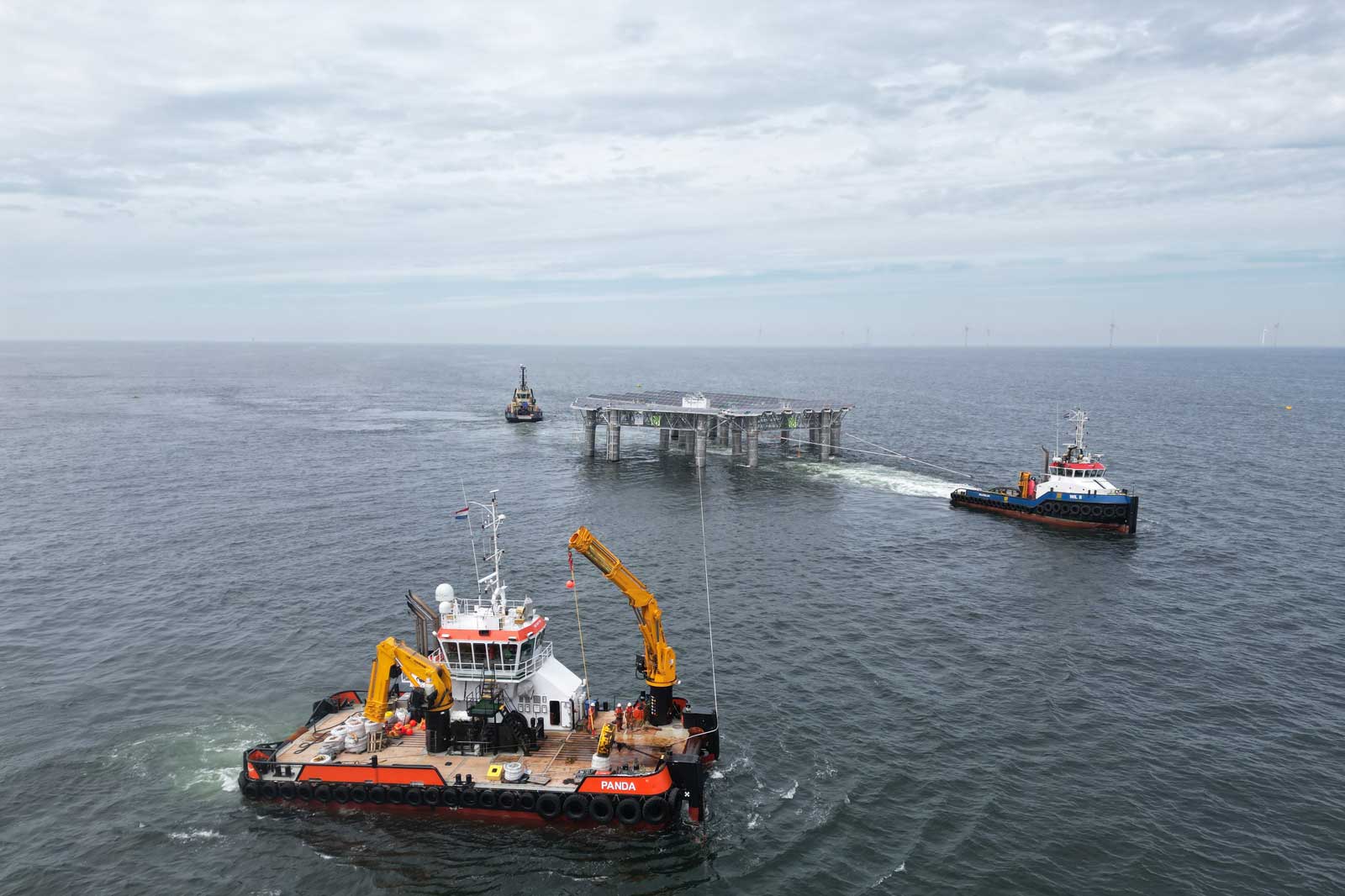

The offshore floating solar farm Merganser has been successfully installed by the Dutch-Norwegian company SolarDuck in collaboration with RWE. The project aims to test the structural design, anchoring and electrical designs. The project should also provide more knowledge on manufacturing, assembly, offshore installation and maintenance for the large-scale rollout of offshore floating solar (OFPV) project.
SolarDuck sets itself a mission to accelerate the growth of offshore floating solar parks and aims to roll out 1GW of capacity annually from 2030. It sees offshore solar parks as the future, citing the need to reduce CO2 emissions to zero. Solar energy offers a solution to this, but the installation of solar panels is not easy in all regions due to scarce land availability. Offshore solar parks can offer a solution.
Pilot project
Merganser is a pilot project with which the company wants to test its technology on the one hand, and at the same time gain knowledge for a large-scale roll-out of the technology. The project has a capacity of 0.5 megawatt peak. The solar farm is located in the Dutch North Sea, about 12 kilometres off the coast of Scheveningen.
This is a scalable concept in which six different platforms are connected. They are anchored to the seabed at a depth of 20 metres and must be able to withstand extreme weather conditions. This is possible partly because of the design of the platforms deployed by SolarDuck. These platforms are triangular in shape and float several metres above the water, moving with the waves like a carpet. Among other things, the concept helps keep critical components dry, clean and stable.
Over 180 sensors
The offshore solar farm is equipped with over 180 sensors, which are remotely readable. These sensors monitor, among other things, the structural load on the platforms, load on the interconnections between the platforms and anchoring, as well as the electrical performance.
"On its own or in combination with offshore wind farms, floating solar energy at sea can offer further opportunities for offshore renewable energy - especially for countries with lower average wind speeds but lots of sunlight. With Merganser, we gain unique insights and experience in one of the most challenging offshore environments in the world," said Sven Utermöhlen, CEO of RWE Offshore Wind.

Various partners involved
SolarDuck is carrying out the project together with RWE, which has long been committed to offshore wind farms. Together, the parties want to accelerate the rollout of OFPV. Other partners are also involved. For instance, Deltares is monitoring the ecological impact of the project.
Koen Burgers, CEO SolarDuck, commented, "The successful installation of Merganser is proof of the SolarDuck team's dedication to electrify the world with floating solar energy at sea. However, we are not doing this alone. Our project partner RWE is supportive of our technology and vision, alongside other partners such as TNO, TU Delft, MARIN and Deltares. Together with numerous supply chain partners, including Damen Shipyards, TMA and Norsk Hydro, we have turned hard work into positive change for the energy sector."
SolarDuck had previously announced plans to build a 780kW offshore floating solar power station off the coast of the Malaysian island of Tioman. With this project, SolarDuck aims to assess the technical and economic feasibility of so-called offshore solar farms.
Author: Wouter Hoeffnagel
Image: RWE











