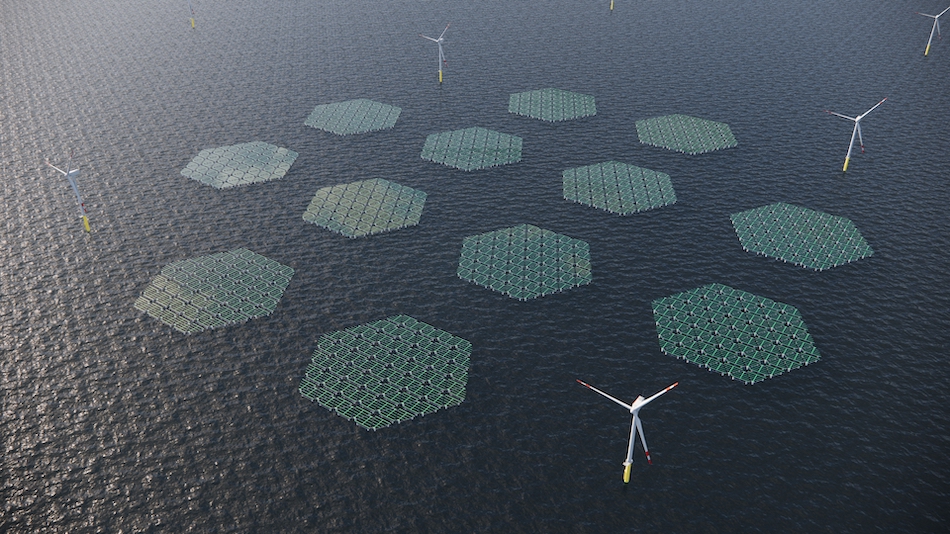

Energy company RWE and Dutch-Norwegian SolarDuck are entering into a cooperation agreement. The parties want to jointly develop the use of floating solar parks at sea. To accelerate knowledge acquisition for this purpose, RWE is investing in the first offshore pilot project with a floating solar park in the North Sea. In time, the pilot should lay the foundation for a larger demonstration project in the Dutch offshore wind farm Hollandse Kust West (HKW).
SolarDuck is a company focused on the development of floating solar parks. It involves a modular solution suitable for harsh conditions at sea. By installing solar parks at sea, SolarDuck aims to provide competitively priced solar energy, among other things.
We currently generate a lot of solar energy on land. On its website, SolarDuck points out the limitations of this. For instance, the amount of land on earth is limited, so choices have to be made on how to use it. Many cities have solar panels installed on rooftops. However, the amount of available roof space is also limited.
There is plenty of space at sea
Floating solar parks can offer a solution, according to SolarDuck. However, the company points out that the location where these solar parks are placed is of great importance. For instance, the amount of inland waterways is very limited. Only 0.2% of the earth's surface consists of inland waters. In addition, many rivers are relatively full, including with boats.
However, there is plenty of space at sea. For instance, 71% of the earth's surface consists of oceans. The company argues that partly because of this, floating offshore solar parks are the future.
RWE reports that SolarDuck can help use sea surface more efficiently to generate renewable energy. For instance, floating solar parks can be placed between wind turbines at sea. The company also sees opportunities for synergies regarding the construction and maintenance of the multi-purpose renewable energy source. RWE thus aims to achieve balanced energy production. Here, it points to the complementary nature of sources of wind and solar energy.
Resistant to harsh conditions
Solar farms at sea sometimes operate in harsh conditions including high waves and strong winds. Solar farms also operate in salt water. SolarDuck responds to this with a triangular platform. It floats several metres above the water and follows the waves. Among other things, the approach ensures that important electrical components remain dry, clean and stable. This increases the lifespan of the structure.
SolarDuck reports on its website that the platform consists of triangles connected in a flexible way. The company claims that this is the most cost-effective structural topology. The structure also offers advantages in situations where the platform is subjected to waves from multiple angles. In that case, the construction reduces the load. In addition, the construction ensures high stability. Because the platform floats several metres above the water, it can (partially) avoid the impact of waves. The platform previously received the world's first certification for floating offshore solar installations from Bureau Veritas.
As mentioned earlier, the platform is modular. This means, among other things, that several platforms can be connected and combined. The platforms can be linked together at sea for this purpose.
Pilot
The pilot that RWE and SolarDuck will implement is called Merganser. The project will have a nominal capacity of 0.5 MWp. The pilot plant is expected to be installed off the coast of Ostend in the Belgian North Sea. This is SolarDuck's first pilot at sea. Last year ago, SolarDuck did successfully carry out a pilot inland in the Netherlands.
Sven Utermöhlen, CEO Offshore Wind RWE Renewables says: "RWE is constantly looking for innovative ways to further improve offshore renewable energy production. We are very excited to further explore the potential of floating solar farms at sea together with our partner SolarDuck. For countries with lower average wind speeds but high solar irradiation, this offers attractive opportunities. With SolarDuck's pilot, we are gaining experience with a highly innovative technique of floating solar panels at sea. We want to contribute to accelerating the energy transition, have a positive impact on marine ecology and help integrate energy systems. Together, we can really make a difference by using tomorrow's technology for today's projects."
Koen Burgers, CEO of SolarDuck, says: "The need for safe, sustainable and affordable energy requires new and immediate answers from the industry in Europe and also worldwide. SolarDuck is part of that answer, bringing solar energy to the oceans. By demonstrating SolarDuck's robust technology in the harsh conditions of the North Sea, we can deploy the technology almost anywhere in the world. We are happy to have found a strong partner in RWE who shares our vision of electrifying the world through floating solar power at sea. I look forward to our companies working together to achieve exactly that."
The parties want to explore new opportunities after the Merganser and Hollandse Kust West projects. The aim here is to develop commercial offshore floating solar parks, both stand-alone and hybrid.
Author: Wouter Hoeffnagel
Photo: RWE











