Despite increasing awareness of the importance and necessity of a circular economy, most residual plastic semi-finished products are still incinerated. This is a missed opportunity, as the residual materials of many plastic types, such as Polyethylene and Polypropylene are highly recyclable. Result: less environmental impact and resources are depleted less quickly.
In 2021, Vink Kunststoffen from Didam fired the starting gun for the ReVink recycling programme. Meanwhile, many plastics processing companies are already participating in this chain cooperation. The aim is to reuse valuable raw materials in the production of 'new' semi-finished products.
What are the principles of the Vink recycling programme?
Within the frameworks of the ReVink programme, Vink aims to realise a circular process where preservation of material value is the main starting point. The following principles apply here:
- Creating a clean residual stream;
- Focus on value retention of plastic residues;
- Offering semi-finished products consisting partly/completely of residual material.
Retaining the value of plastic waste materials is crucial to the programme. The basic principle is that A-grade residual material is reused for the production of A-grade semi-finished products. To achieve this, Vink is collaborating with a select group of manufacturers and partners, with the aim of implementing this circular process as effectively as possible.
How does the Vink recycling programme work?
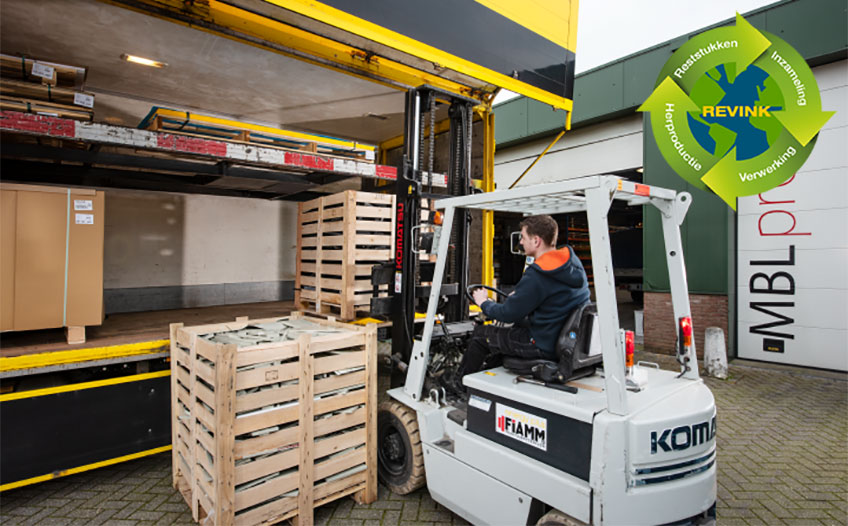
When recycling plastic residues, separate collection of the plastics is important. To this end, participants are offered 1m3 recycling crates. The participating company has to deposit each type of plastic in a separate crate. Once the crates are filled, Vink's logistics service picks them up again and leaves empty crates behind.
Only plastic that is free of chemical contamination and film may be deposited in the recycling crates. Original protective film may remain on the plastic. As soon as the crates are collected by Vink, the contents are checked for purity. This is done using special plastic recognition machines. After approval, the crates are transported to the relevant producer and/or partner. There, the remaining pieces are processed into raw materials. They serve as the basis for the production of new plastic semi-finished products.
Which plastics are eligible for recycling?
Partly due to technological developments, the number of recyclable plastics has grown significantly in recent years. Within Vink plastics' product range, the following plastics are now eligible for recycling:
- PMMA (Acrylate);
- Polypropylene;
- Polyethylene;
- PVC;
- Polyamide;
- PEEK;
- POM;
- Polystyrene;
- Polycarbonate.
A comprehensive overview of these plastics, including details of which types are suitable for recycling, can be found on the ReVink page at vinkkunststoffen.nl.
What are the possibilities of recycle plastics?
Meanwhile, Vink supplies a number of recycled plastic semi-finished products resulting from recycling processes. For example, Vinkboard recycle board is produced entirely from recycled consumer waste and is both technically and constructively a good substitute for wood and concrete plywood. Recycle plastics, which are also used in the manufacturing industry, include Vikugreen acrylate and recycled Polyethylene and Polypropylene.
The recycled Polyethylene and Polypropylene sheets are produced entirely from plastic residual waste collected by Vink from its customers. These are smooth black sheets in the size and thickness of 3000 x 1500 x 10 mm. The properties of these circular sheets can be compared to virgin material. In addition, these sheets are also easy to process in various ways.











