
Products are often shipped in oversized boxes. The overall packaging is often much larger than the contents. For example, a perfume bottle is shipped in packaging the size of a shoebox. This box is then filled with padding material to fill the empty space. This is not sustainable. A solution has now been devised for this.
Online retail is constantly changing - the latest trends and seasonal fluctuations influence the structure of items and orders. With increasing product diversity and variable order structure, the range of shipping boxes also grows. Although the types of packaging available are becoming more diverse, in many cases the degree of volume usage is decreasing. Items that require little packaging, such as perfumes, cosmetics and jewellery, end up in oversized boxes. This is largely because packaging is not selected based on changing product and order requirements, such as dimensions and weight. Researchers at Fraunhofer IML are addressing this problem with the software CASTN (Carton Set Optimisation).
Optimal carton set
CASTN puts together the optimal carton set for the individual item and order structure for shipping companies. "If a retailer wants to use a set of ten different cartons at its packing stations, they must be adapted to the order and article structure to achieve the best possible volume utilisation. The products should fill as much of the box's volume as possible, minimising the need for padding such as bubble wrap," explains Lukas Lehmann, scientist at Fraunhofer IML.
Software algorithms
To achieve this, Fraunhofer IML's development team enters customer data (order, item master and packaging specification data) into CASTN. To reflect a representative time period, including seasonal variations, the data generally cover a full year. Using these input parameters, two interconnected software algorithms together calculate the optimal set of boxes. These take into account customer requirements, such as minimum or maximum packaging sizes, as well as the needs of the logistics service provider.
Minimising packaging volume
CASTN works with two algorithms: The first uses an evolutionary approach to create different sets of boxes based on parameters such as the number of boxes allowed or the maximum and minimum dimensions. The second algorithm - a bin-packing algorithm - ensures that orders are efficiently packed into the selected boxes. Its aim is to minimise the packing volume and achieve the smallest possible overall volume.
30% article, 70% air
At the end of this process, the software assesses each box in a set and checks how well its internal capacity is filled by the order it contains. This information is fed back to the evolutionary algorithm, which uses the score of each box to create new, better sets. This continues until better volume utilisation cannot be achieved. "Customers are often unaware of the volume usage of their packaging, which is often only around 30%. They have no idea how much air they are sending. This is what our software calculates," says the researcher. Once the optimisation is complete, the results are analysed together with the customer so that they can choose the right carton set.
Several industry partners, each with their own online retail business, have already benefited from carton set optimisation and increased their volume usage by 35 to 45%, while also reducing the number of carton types used.
Making e-commerce more environmentally conscious
In the next phase, Lehmann and his team want to expand the functionality of the software to include complex item forms and additional item features. "We want CASTN to increase sustainability in logistics. Packaging and padding material can be reduced by using optimally matched carton sets. This results in better truck loading and reduced CO2 emissions and can also prevent space wastage," says Lehmann. By using CASTN, companies shipping products can make a difference to the planet while saving on packaging and transport costs.
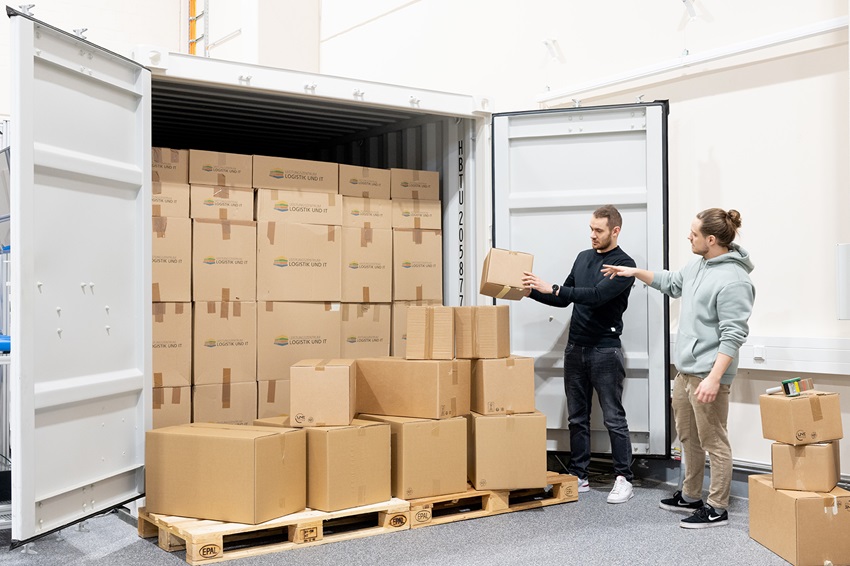
Featured image: Using the CASTN optimisation software, dispatch companies can select the optimal set of boxes for each item and each order structure (photo: Fraunhofer IML)
See also: Albert Heijn uses robots to pack customers’ orders











