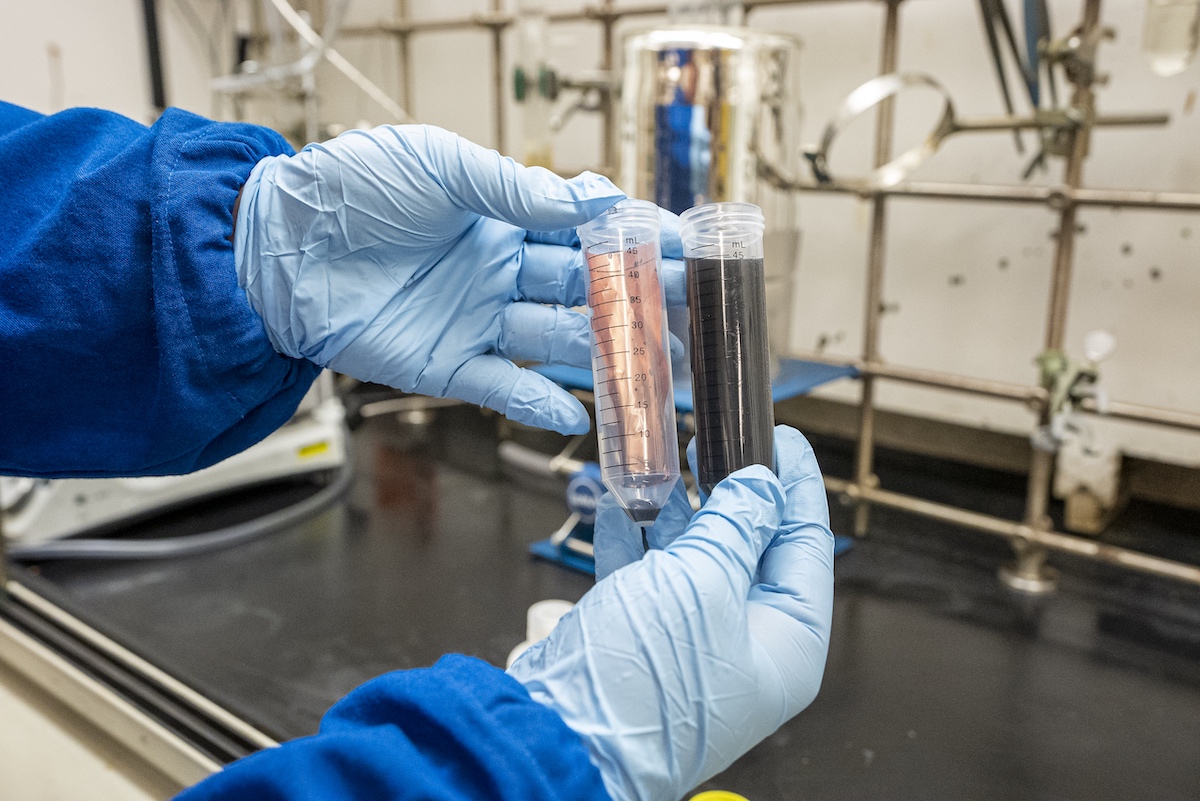

A new material makes recycling a wide range of batteries possible and economically attractive. It involves new binder that can replace current binder materials present in many batteries. It is characterised by the relative ease with which components can be separated again, making them recyclable.
A new material makes recycling a wide range of batteries including Li-ion and alkaline batteries possible and economically attractive. It involves new binder that can replace the current binders present in many batteries. It is characterised by the relative simplicity with which components can be separated again to make them recyclable.
The material - called Quick-Release Binder - was developed by researchers at the US Berkeley Lab. Batteries have become an integral part of our society. We use batteries in a wide variety of devices and applications. Think smartphones and tablets, but also sensors, electric bicycles and electric cars.
Raw materials are scarce
The role of batteries is only expected to increase with the electrification of the world. At the same time, raw materials needed to produce batteries are scarce. Consequently, there is a risk that we will not have enough raw materials available for battery production as early as 2050.
This specifically involves materials such as lithium, nickel, cobalt and graphite. The demand for these materials is very high due to the extensive demand for batteries. Lithium, nickel, cobalt and graphite are therefore increasingly scarce, driving up the price. The researchers also point to the lack of adequate monitoring of environmental impact and working conditions when mining such materials.
'Recycling batteries is a requirement'
"We are getting to the point where recycling batteries is a requirement," explains project leader Gao Liu, senior scientist in Berkeley Lab's Energy Technologies Area and member of the Berkely Lab Energy Storage Centre. "If we don't stop burning them and throwing them in the trash, we will run out of resources in the next decade. Otherwise, it will be impossible to keep up with the number of batteries demanded by the market. There is simply not enough cobalt and not enough nickel - we have to recycle."
Researchers are capitalising on this with the Quick-Release Binder. This is a binder made from two commercially available polymers: Polyacrylic acid (PAA) and polyethyleneimine (PEI). The two materials can be bonded together thanks to the presence of positively charged nitrogen atoms in PEI and negatively charged oxygen atoms in PAA.
Easily removable
Important about the binder is the simplicity with which it can be removed. If the binder is placed in alkaline water containing sodium hydroxide, the sodium ions penetrate the bond and the two polymers break apart. In the process, the separated polymers dissolve in the liquid, releasing the components trapped in it.
The researchers report that the binder material is suitable for manufacturing both anodes and cathodes. The material costs about a tenth of the price of the two most commonly used commercial binders.
Suitable for batteries of any size
The material has only been tested in a lab for now. "We have demonstrated that the entire process is very simple at laboratory scale and we see no reason why this would not work equally well at industrial scale, explains postdoctoral researcher Chen Fang. The research team also expects Quick-Release Binder to be suitable for batteries of any size, ranging from small batteries in smartphones to large-scale batteries in energy storage systems that are part of the power grid.
The researchers are working to commercialise their development. To do this, they are working with Steven Sloop, founder of OnTo Technologies. This company specialises in battery technology. Together with Sloop, the team is testing the product and eventually aims to bring it to market. Among other things, the team wants to produce prototype Li-ion batteries using the binder. With this, they want to analyse the performance in this application and demonstrate the capabilities of the Quick-Release Binder.
'Paradigm shift in battery design'
Demolition sees great potential in Berkeley Lab's development. He speaks of a "paradigm shift in battery design". "The binder has the amazing feature that it can be 'unzipped' with low-cost, environmentally friendly processing, benefiting us all by improving the economic and environmental sustainability of advanced battery systems," Sloop says. The OnTo Technologies founder points out that the binder does not contain poly- and perfluoroalkyl substances (PFAS). Sloop is referring to the growing opposition to the use of PFAS. He expects regulators to come up with measures against PFAS in the near future.
In time, the researchers and Demolition hope to license the Quick-Release Binder technology so that it can be used in all major brands of Li-ion batteries.
Author: Wouter Hoeffnagel
Photo: Marilyn Sargent/Berkeley Lab











