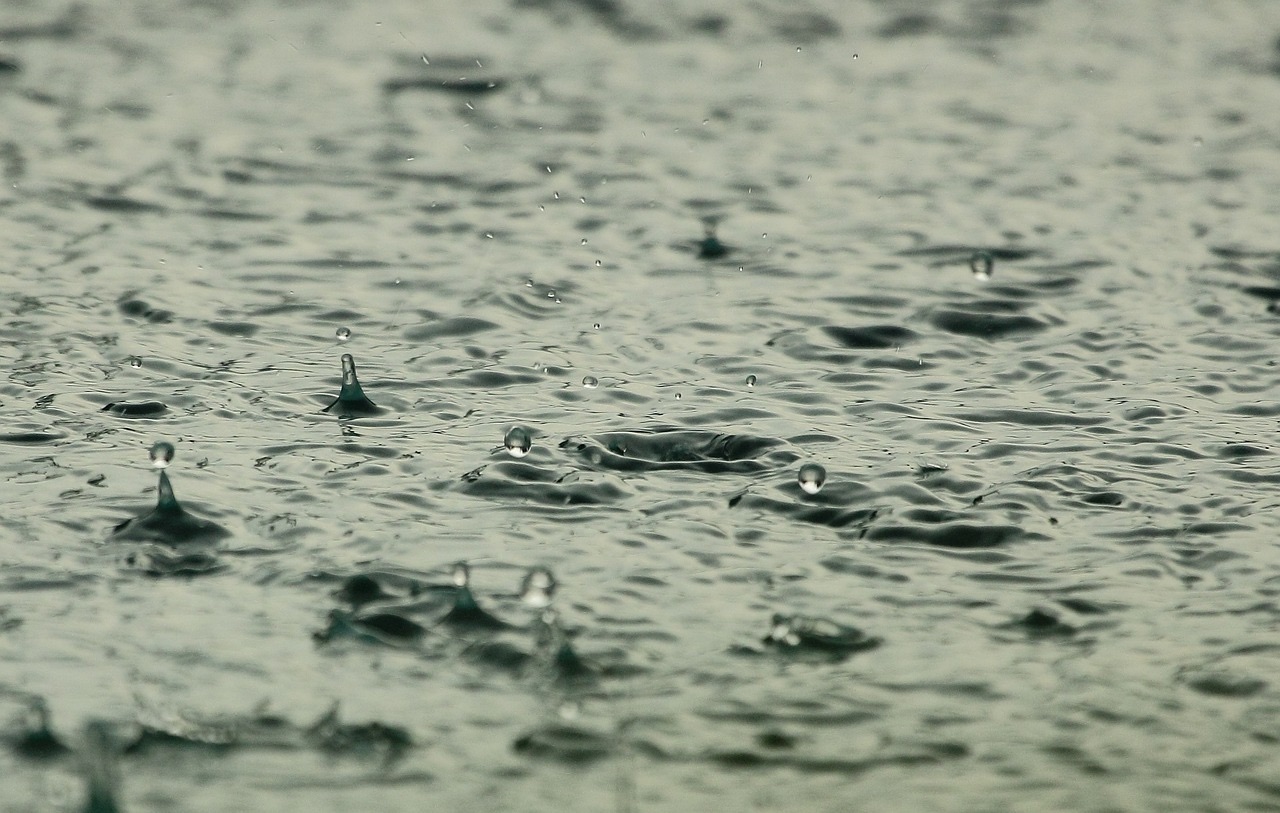

Researchers at China's Tsinghua University want to start extracting energy from raindrops. Such technology has existed for some time, but has its limitations in terms of yield, among other things. The new approach should enable five times higher peak power than is possible with conventional raindrop energy technology.
Raindrops falling from the sky generate a small amount of energy. Capturing this energy is not new and has long been possible using a droplet-based triboelectric nanogenerator (D-TENG). The technical performance of this method has previously been demonstrated. A D-TENG uses liquid-solid contact electrification. The same technology is also applicable for wave energy generation, among other things.
'Each drop generates a small charge'
The energy generation method is similar to hydropower, but on a (very) small scale. If a control droplet falls on the surface of a D-TENG panel - which is also called the FEP surface - the droplet receives a positive charge. At the same time, the FEP surface actually receives a negative charge.
"The charge generated by each drop is small and the surface charge on the FEP gradually disappears. After a long time on the surface, the charges on the FEP surface gradually cause saturation," Li explains. "At this point, the dissipation rate is balanced with the charge generated by each impact of the droplet."
Limited scalability poses major limitation
A major limitation in deploying the technology so far has been its limited scalability. For instance, connecting several D-TENGS together proved to be quite a challenge in practice. This limited the maximum amount of energy that can be generated with such a system. In practice, this is a major limitation to the adoption of the technology.
"Although D-TENGs have very high direct energy output, it is still difficult for a single D-TENG to continuously provide energy for megawatt-level electrical equipment. This makes it very important to realise the simultaneous deployment of multiple D-TENGs," explains Zong Li, a professor at Tsinghua Shenzhen International Graduate School of Tsinghua University in Shenzhen, China. "Referring to the design of solar panels in which multiple solar power-generating units are connected in series to deliver the charge, we propose a simple and effective method for extracting energy from raindrops."
Unintended capacitance
One of the challenges of connecting multiple D-TENGs is the unintended capacitance created between the top and bottom electrodes of the panels. This capacitance limits the maximum energy output of D-TENG systems. As a solution, the researcher bet on bridge-array generators, which uses a series of lower electrodes to limit the impact of capacitance.
The researchers are also experimenting with making the D-TENG panels thicker. In fact, a thicker surface has been found during experiments to lead to lower capacitance while maintaining the energy density of the panel. This could further improve the performance of the bridge array generator.
Up to 200 watts per square metre
The peak power of the bridge array generators is almost 5 times higher than that of conventional raindrop energy technologies of the same size, up to 200 watts per square metre. The researchers hope their findings will bring large-scale energy extraction from raindrops closer.
Further information is available in a paper recently published by the researchers in iEnergy, a journal published by Tsinghua University.
Author: Wouter Hoeffnagel
Image: Roman Grac via Pixabay











