
Petrogas and Gasunie want to jointly investigate whether an existing Petrogas pipeline in the North Sea can be reused for green hydrogen transport. The joint study focuses on the feasibility of reusing and potentially deploying the pipeline for the offshore hydrogen project Demo 1. This is a demonstration project initiated by the Ministry of Climate and Green Growth. It focuses on the realisation of a 20-50 MW electrolysis plant for the production of green hydrogen in the North Sea and its landfall in the North Sea Canal area.
The Netherlands has big ambitions for scaling up and rolling out Wind at Sea. It is uniquely positioned for this. Offshore wind energy contributes to a sustainable and affordable energy supply and will grow strongly and rapidly. It also makes the Netherlands and Europe less dependent on energy from other countries. And it contributes to the competitive position of the Netherlands. To get all this sustainable energy on land, offshore hydrogen transport networks are needed.
Hydrogen network at sea
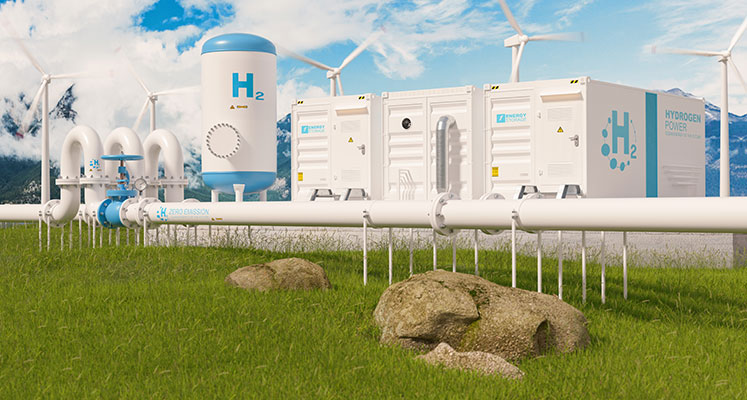
What does a hydrogen network at sea look like? The wind energy produced at sea is immediately turned into hydrogen, which goes to shore via offshore pipelines. This is attractive because of the high transport capacity of gas pipelines and because hydrogen can then be stored well. This also allows harvesting the wind energy that would be lost if only power cables were used for this purpose.
Less space needed on land
In addition to the energy system benefits, hydrogen at sea requires less space for cables and electrolysers on land. Moreover, hydrogen transport is very (cost-)efficient, making the total cost of energy infrastructure much lower. An additional advantage is that hydrogen can also be imported from other North Sea countries via these North Sea pipelines.
Good preparation for hydrogen transport
Gasunie has been preparing for some time for its future role of developing and realising a hydrogen network in the North Sea that is well connected to our national hydrogen network. In doing so, it is looking at whether and how the existing gas infrastructure in the North Sea can be reused. With various organisations, including the Ministry of Climate and Green Growth, Gasunie is investigating the various aspects of reuse. Besides technical feasibility, this also concerns legal frameworks, economic feasibility and effects on nature and the environment. Petrogas is investigating various possibilities to reuse their infrastructure, including transporting green hydrogen through existing pipelines.
Safe reuse
Gasunie has years of experience in the safe and reliable transport of hydrogen through reused and new pipelines on land. Reuse of pipelines at sea for hydrogen transport is a relatively new development, which requires additional research. Gasunie is working in several international research projects with other network operators (TSOs), knowledge institutes and standards committees to develop standards for the safe reuse of offshore pipelines. The cooperation between Gasunie and Petrogas allows for testing whether the Petrogas pipeline is suitable for safe reuse for hydrogen transport according to the latest standards.
Source: Gasunie
Read also: TNO and GroenvermogenNL join forces to accelerate scaling up green hydrogen