A new shoe sole designed by engineers at MIT is intended to prevent people from slipping on icy and snow-covered streets. The researchers drew inspiration for the sole from Kirigami, a Japanese art of paper folding.
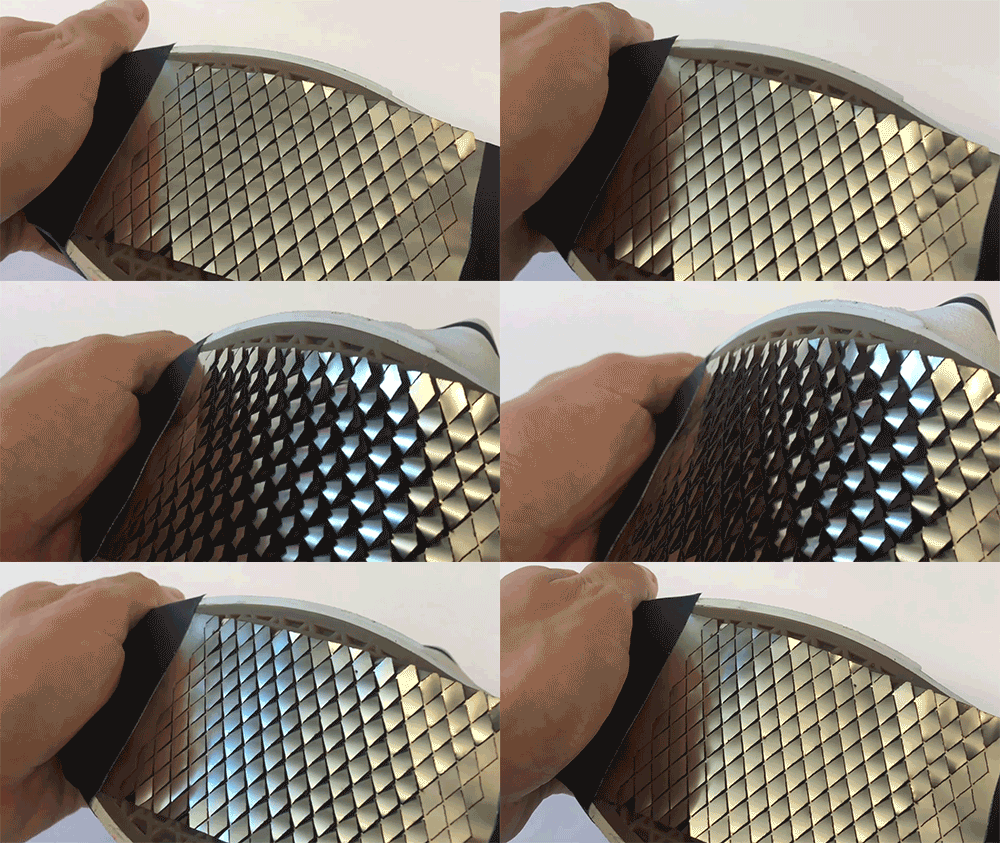
The researchers looked at kirigami, a variation of origami that involves both cutting paper and folding it, creating a particular coating. Lab studies show that when people with kirigami-coated shoes walked on an icy surface, they generated more friction than non-coated shoes. In short, adding this coating in shoes could help prevent dangerous falls on slippery surfaces. "We took up the challenge to come up with something that would significantly reduce the risk of falls on slippery surfaces. We developed a kirigami-based system that provides more friction with the surface," says researcher Gioavanni Traverso.
Kirigami
Kirigami is an art form in which intricate patterns are cut into sheets of paper then folded to create three-dimensional structures. Researchers have recently used this technique to develop new materials. One example are bandages that stick better to knees and other limbs and sensors that can be used to protect the 'skin' of soft robots and help them orientate in a room.
In this case, the team used this approach to create a pattern of spines in a sheet of plastic or metal. These sheets, which are attached to the sole of a shoe, remain flat when the wear is upright, but the spines come out while walking. "The novelty of this type of surface is that the shape changes from a 2D flat surface to a 3D geometry where spines come out. You can use these elements to control friction."
Different variants
The researchers created and tested different designs, sizes and compositions in both plastic and stainless steel soles. For each variant, they measured stiffness and the angle at which the spikes come out when the material is stretched. They also calculated the friction generated by each design and on different surfaces. They found that all designs enhanced friction, but the best result was achieved by the pattern of concave curves.
The sole was then tested under different shoes, such as trainers and winter boots, and had people walk on an icy surface with it. This allowed them to measure what the friction was. Because of the coatings, the shoe gave 20 to 35 per cent more friction with the surface. The researchers are now looking at the possibility of incorporating the sole into a shoe and making and selling it as a stand-alone version.











