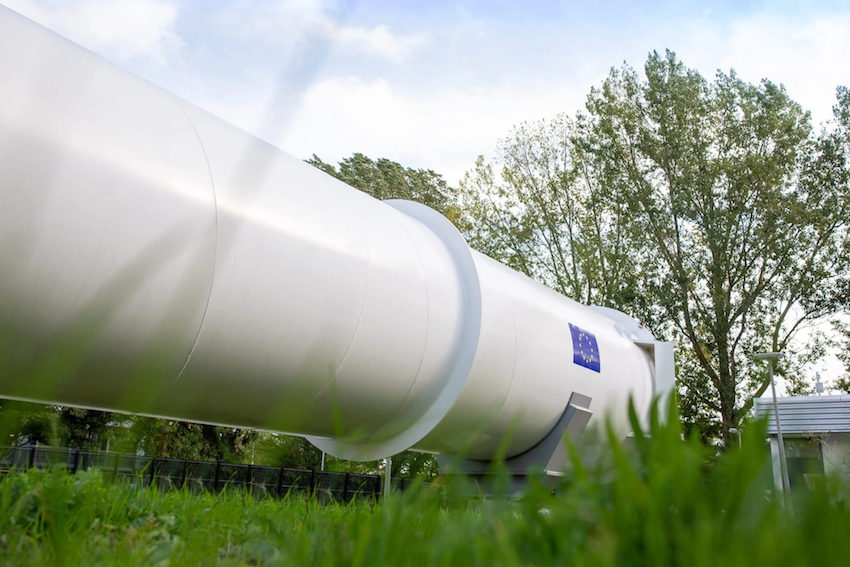

The Ministry of Infrastructure and Water Management (I&W) and the Ministry of Economic Affairs and Climate (EZK) are giving a €4.5 million grant to the Hyperloop Development Programme. This public-private partnership will investigate the potential of the hyperloop as a fast, emission-free means of transport. This will include the role the hyperloop can play in climate transition and potential economic growth. The province of Groningen is making $3 million available for a test facility.
What is the hyperloop?
The hyperloop is a concept for a means of transport conceived for Elon Musk, founder of SpaceX and Tesla, among others. The hyperloop is a train that travels through a vacuum tube. This vacuum creates low air resistance, allowing the vehicle to achieve high speeds with relatively little energy. Thanks to a top speed of around 1,200 kilometres per hour, a journey from Amsterdam to Paris using the hyperloop should take just 30 minutes.
The idea was presented by Musk in 2012. To accelerate the development of the idea, Musk set up the Hyperloop Pod Competition in 2015, challenging participants to build a hyperloop pod at half-scale. They could test this pod on a 1.6-kilometre-long test track, which was also built at half-scale. Three teams competed with their own design in January 2017. A Dutch student team from TU Delft operating under the name Delft Hyperloop won the competition.
ProRail and Delft University of Technology signed an agreement in September 2018 to convert an unused second tunnel tube of a railway tunnel in Delft into a test tube for the hyperloop. In late 2019, the realisation of a 3-kilometre-long test track a short distance from the city of Groningen was also announced. This centre should be ready by 2022.
Hyperloop Development Program
The Hyperloop Development Programme is a research and development (R&D) programme for the development of the hyperloop. The programme is designed as an inclusive ecosystem in which companies and institutes work together to accelerate the development of the hyperloop. The goal is to realise an efficient means of transporting both people and goods via vacuum tubes.
The programme, which will run for three years, aims, among other things, to demonstrate that the hyperloop is a safe, sustainable and commercially viable solution to transport challenges in both Europe and the rest of the world. It will also investigate the potential of the hyperloop as an industrial development project that can deliver new businesses, jobs and economic growth. Implications for the hyperloop's digitalisation and connectivity are also being researched.
"A global infrastructure project like the hyperloop can only be realised if public and private parties work together in complementary ways," said Jeroen in 't Veld, board chairman of the Hyperloop Development Programme.
'The Netherlands is a leader in hyperloop'
The Hyperloop Development Programme also points out that the Netherlands has now presented itself as a "natural leader" in the hyperloop field. For instance, an ecosystem with more than 20 relevant companies is now available. Crucial hyperloop technologies have also been developed and validated in the Netherlands. As an example, the programme cites switches for hyperloop routes.
The programme has a total budget of $30 million available. Industry partners are providing the lion's share of this investment with 22.5 million euros. The following industry partners are involved in the project: ADSE, Balance, Royal BAM Group, Delft Hyperloop, Dutch Railways, EuroTube, Hochschule Emden/Leer, Hardt, Institute of Global Innovation Economics and Logistics, Royal IHC, NEVOMO, POSCO, Recaro, Royal Schiphol Group, Schweizer Design Consulting, Tata Steel, TÜV Rheinland and Vattenfall.
Grant
The ministries of I&W and EZK are also jointly providing 4.5 million in subsidies. The province of Groningen is also pulling out the purse strings and making $3 million available for the realisation of a hyperloop test facility.
In October, Minister Cora van Nieuwenhuizen of Infrastructure and Water Management and State Secretary Mona Keijzer of Economic Affairs and Climate Policy already briefed the House of Representatives on the grants. It is expected that further information will be released in early 2021 regarding how to apply for subsidies and the role the government intends to play in developments relating to the Hyperloop. “It is important that, whilst we are experiencing the economic consequences of the coronavirus outbreak, the Netherlands continues to explore potential investments in this new technology, which could make a significant contribution to our future revenue model,” wrote Minister Van Nieuwenhuizen and State Secretary Keijzer in a letter to the House of Representatives.
Author: Wouter Hoeffnagel











