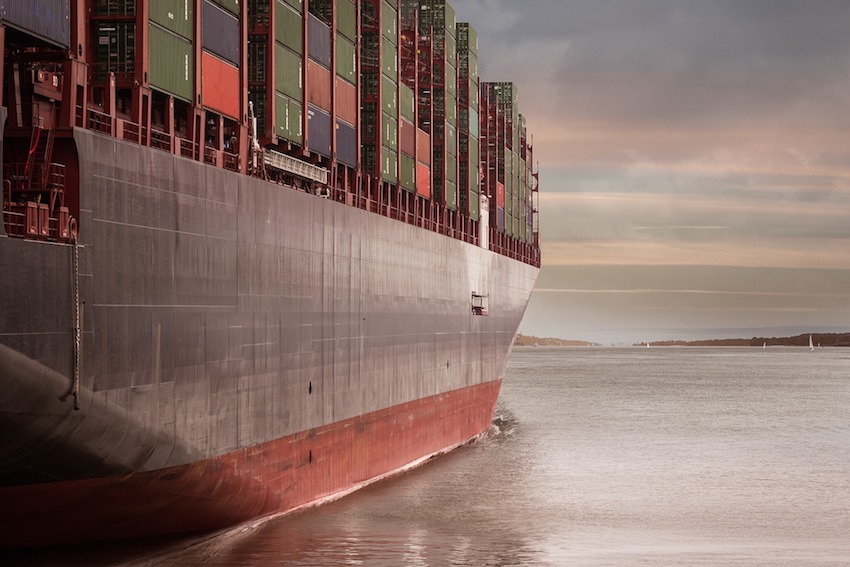

Danish container shipping company Maersk is betting on green methanol on a large scale. The company recently ordered eight dual fuel container ships, which can run on both traditional fuel oil and methanol. This makes Maersk's demand for methanol as much as almost twice its current production.
This reports Berit Hinnemann, senior innovation project manager at AP Moller Maersk to German DVZ. Maersk recently placed an order with Hyundai Heavy Industries for eight container ships with dual fuel configuration. Among other things, these can run on green methanol. Each ship consumes around 45,000 tonnes of methanol per year. Together, this makes the ships account for consumption of around 360,000 tonnes. However, the current annual production of green methanol worldwide comes to around 200,000 tonnes, Hinnemann reports.
Increase production capacity
It may well not stop at eight ships. Maersk has an option on a further four ships running on green methanol, which could be delivered in 2025. This would see demand from Maersk almost triple global production. Maersk hopes that due to its sizeable order and commitment to green methanol, production capacity will increase rapidly.
The purchase of the eight methanol-fuelled container ships is part of Maersk's 'decarbonisation strategy'. The ships will all accommodate some 16,000 TEU containers, each 6.10m long, 2.44m wide and 2.59m high. TEU stands for Twenty Foot Equivalent Unit.
The ordered ships replace existing container ships of the Danish shipping company. The shipping company is renewing ships with a total capacity of more than 150,000 TEU. As a result, Maersk expects to reduce its annual CO2 emissions by around one million tonnes. With the ships, Maersk claims to be the first in the market to offer fully CO2-neutral transport at scale on seas.
Demand from customers
Demand for this is high, according to Maersk. In a press release, the shipping company reports that about half of its 200 largest customers have or want to set ambitious targets for their supply chain. With its commitment to green methanol, the shipping company is responding to this. The company points out that Amazon, Disney, H&M Group, HP Inc, Levi Strauss & Co, Microsoft, Novo Nordisk, The Procter and Gamble Company, PUMA, Schneider Electric, Signify, Syngenta and Unilever, among others, have pledged to consciously opt for carbon-neutral sea transport solutions.
In addition to green methanol, the ships can also run on traditional fuel oil. This offers one solution as demand from Maersk for green methanol exceeds annual global production. The shipping company pledges to run the ships on CO2-neutral e-methanol or sustainable bio-methanol as soon as possible. However, the company does not expect to secure enough methanol immediately upon commissioning to realise this goal.
Maersk reports that this choice increases the purchase price by 10-15%. The fuel system was developed by Maersk in cooperation with MAN ES, Hyundai (Himsen) and Alfa Laval.
Also receiving attention in the Netherlands
In the Netherlands, too, attention is being paid to the use of green methanol. A consortium of thirty Dutch and international maritime companies and research institutions has mapped out the possibilities in the Green Maritime Methanol project. The parties concluded that sailing on methanol is technically and operationally feasible. However, there is scope for optimisation. The consortium argues that the time is ripe for pilot schemes involving a transition to sailing on methanol. An analysis of six ship designs shows that retrofitting existing vessels is more complicated and more expensive than building new ones.
More research is needed on safety and bunkering, according to the parties. More knowledge is also needed on engine performance and practical experience in applying methanol in operational conditions for different ship types.
Availability and pricing
Based on its research, the consortium points to uncertainties about the availability and pricing of renewable methanol. The parties involved call "flanking policies from the government" necessary for making the step towards implementation.
Ship owners Boskalis, the Royal Navy, Rijksrederij, DEME, Arklow Shipping,Van Oord, Wagenborg Shipping and industry organisation KVNR, shipyards Damen, Feadship and IHC were among those involved. As well as engine suppliers Pon Power, MTU, Wärtsilä and their trade association VIV, maritime suppliers Marine Service Noord and C-Job Naval Architects and classification societies Bureau Veritas and Lloyd's Register. The Ports of Rotterdam and Amsterdam, as well as methanol suppliers BioMCN, Helm Proman and industry association Methanol Institute mapped the impact on bunkering and fuel chains. Knowledge institutes TNO, TU Delft, NLDA, MARIN and Ghent University, supported by the Maritime Knowledge Centre, were also involved.
Author: Wouter Hoeffnagel











