To meet the challenges of the future, the manufacturing industry needs innovation. To build the future, you also need to work with the future generation, but students looking for a hands-on side job are still often overlooked. Mechatronics student Rik van den Reijen thinks this should change. He founded StuVal: a platform that matches tech companies' tangible innovation challenges with young talent.
When Rik, whilst studying Mechatronics at Avans University in Breda, went looking for a part-time job where he could develop his skills in his field of study, it proved virtually impossible. “One reason for this is that many companies are open from Monday to Friday, 9 am to 5 pm, and those aren’t ideal hours for a student,” says Rik. “I also heard stories from people around me that the opportunities to gain study-related work experience in the manufacturing industry whilst studying are very limited. As a student, you’re therefore left with no choice but to take a part-time job as, for example, a shelf-stacker. In my view, that’s a shame, because I believe that students, with their fresh perspective and skills, can be of great value to technical manufacturing companies; and, conversely, they can learn so much more and probably pay off some of their student debt. The way many organisations recruit staff no longer appeals to the younger generation, who are used to everything coming to them ‘on demand’. What’s more, with recruitment agencies, you often end up on a list and they only approach you after you’ve graduated. That’s something I want to change with StuVal.”
The platform
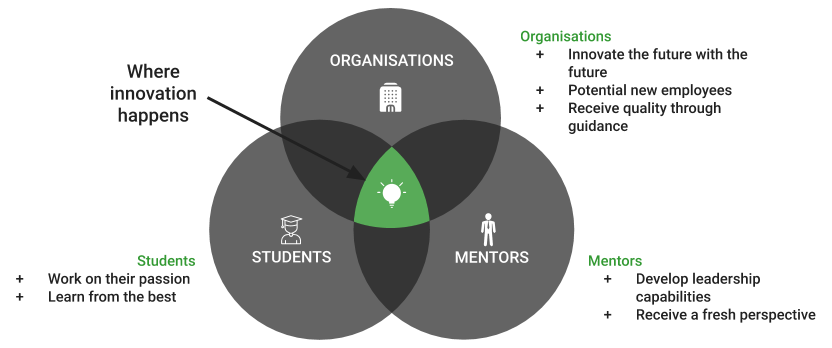
The basic idea of StuVal (a combination of Student and Value) is a connection and innovation platform where, based on interests and skills, students are matched with innovation issues from the manufacturing industry. This is done in a triangular form consisting of the relevant organisation, students and mentors. The company can use the students' knowledge and fresh ideas and vice versa they gain experience from mentors and get to know a potential employer. "StuVal can therefore be seen as an innovation and talent agency in one," says Rik, "through which we go from idea to market and from project to talent." Together with technical business administration students, he was already working on a cool product himself. "Under the guidance of a mentor, we developed a so-called hurdle runner for Mistras, an oil inspection company. The device is placed on a large oil wall and then the wheels clamp against the wall with magnets after which they can be hoisted up. The biggest challenge was to ensure that the robot manoeuvres around the tank flanges on its own. We were able to build it so that the wheels are dropped off independently from the wall and once the robot is around the flange, they are linked back to the wall. This is a very good example of how an idea can result in a unique solution for the market."
Challenges manufacturing industry
Rik has ambitious plans with StuVal. "I hope we can become the largest student-mentor driven innovation agency, with a learning community where students and professionals can learn from each other. Our goal is to have 200 products developed by 2040. I just see a lot of opportunities for the market. It's an easy way for companies to do long-term recruitment. No more ideas that sit on the shelf for years, and no more students that you suddenly pay heavily for if you want to recruit those individuals after graduation. In short, we make technical know-how accessible. By involving young talents in your product development during their studies, you also know what you can get from someone when they graduate. You build a relationship with each other and invest in human capital. And for students it is an absolute deepening of their studies and a way to get in touch with practice."
Rik, incidentally, looks beyond technical degree programmes. “At the moment, the focus is still on technical students, but to take a product from idea to market, more disciplines are needed. You build a good team with‘hackers, hustlers and hipsters’. So in future, we’d also like to involve students from commercial and creative degree programmes, such as entrepreneurship, retail management, communication and multimedia design. Our platform is designed so that students can sign up based on their interests and skills, and we match them with the right mentors and challenges from manufacturing companies. This is how we build successful teams and ideas. There are so many challenges currently facing the manufacturing industry; technological developments are advancing at breakneck speed, markets and business models are shifting, and there is an ever-increasing shortage of skilled labour. Students can contribute ideas in all sorts of areas, such as making your production line more sustainable, using new materials and modernising your current product. Innovation is, certainly in these times, more important than ever, and students have great ideas on this. By working together, we can only create a win-win situation!”











