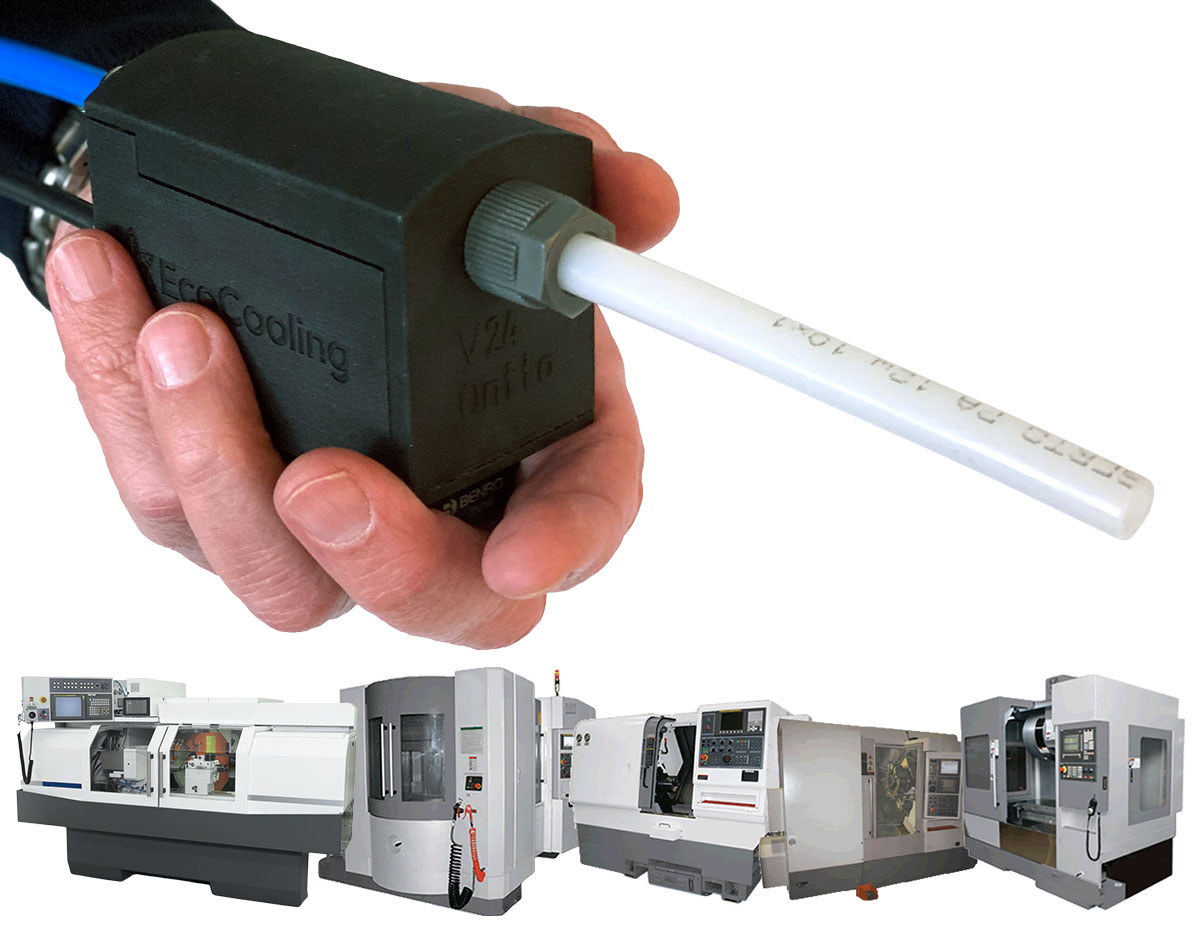

It is no longer necessary to use expensive metalworking fluids to cool and lubricate workpieces and cutting tools in the metalworking industry. EcoCooling uses ionised and cooled air. Is not hazardous to the environment brings none of the costs related to oil-based fluids.
EcoCooling is the result of long-term, interdisciplinary R&D from the same team that developed the technology behind Amazons ground-breaking range of front-lit Kindle devices. Now, the group comprising scientists, engineers and experienced business people from different disciplines has developed a dry, clean and environmentally friendly method for lubricating metal workpieces with ionised and cooled air without the need to use emulsions.
"Workshops want to get rid of fluids and many have tried to find a solution to the problem," said Leo Hatjasalo, co-founder and CEO of EcoCooling. "Now we have the answer to this demand, as EcoCooling can be used even on the hardest known metals such as chrome, titanium and tungsten carbide."
Large market
The global metalworking fluids market is estimated to be around $12bn this year. It is a steadily growing market, as global machine tool market estimates expect growth from $120 bln to $150 bln over a five-year period. Growth is being driven by the increased need for components in the aerospace, automotive and transport sectors.
"EcoCooling is based on the fact that ionised air enters the cutting zone and forms a dry lubricant that reduces the rubbing of cutting and the heat generated. at the same time, the time needed to form an oxide layer is reduced," Hatjasalo explains. "The process has been patented in all parts of the world. We are currently validating it to include all types of machine tools."
Hatjasalo stresses that EcoCooling is not only a way to reduce the cost of emulsions, but also a way to increase productivity through higher cutting speeds, reduced cutting tool wear and minimised maintenance costs.
"Since metal pieces are not contaminated by any liquid, they can be completely recycled without having to clean them," he says. "Another big advantage is that it eliminates toxic liquid waste and fumes. It also minimisesCO2 emissions since no oil is used."
The technology makes it possible to build smaller and cheaper metalworking machines, as the EcoCooling unit is of very compact size.
"The unit requires no maintenance and has proven to significantly extend the life of cutting tools," Hatjasalo says. "The system can be easily connected to older machine tools."
The big leap is yet to come.
In recent years, EcoCooling has succeeded in being tested internationally in several commercial trials in demanding environments. Now that the process has demonstrated excellent results, big savings and substantially reduced environmental impact, the goal is to create a versatile product range that covers all machine tools besides just turning machines.
"We also plan to integrate the system so that it can use different CNC machine tools and create optimal solutions for all machine tools and workshops," says Hatjasalo. "For that, we do need more funding that we can raise ourselves. Therefore, the next step is to find an industrial partner who can help us commercialise EcoCooling globally and increase how the technology can be used."











