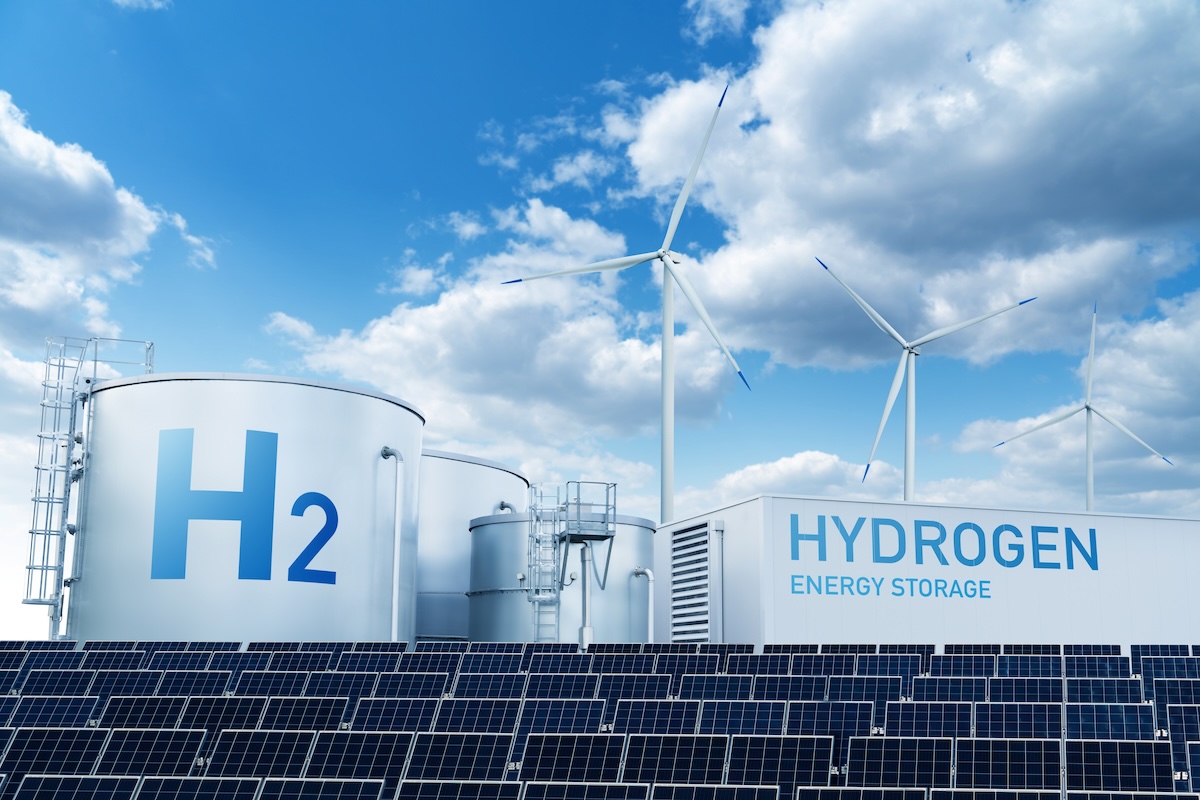

Underground hydrogen storage could play a vital role in ensuring the stability of the future energy system, which will rely mainly on wind and solar power. A European research project therefore aims to demonstrate that hydrogen can be stored safely, reliably and affordably in empty gas fields.
This is the project European research project 'EUH2STARS' (European Underground Hydrogen Storage Reference System). In this project, TNO, Energie Beheer Nederland (EBN) and Shell are working together with organisations from Austria, Spain and Hungary. The parties aim to demonstrate that hydrogen can be stored safely, reliably and affordably in empty gas fields.
The EUH2STARS research project will receive a European grant of €20 million. The project is led by RAG Austria and focuses, among other things, on both technical and societal aspects of underground hydrogen storage in empty gas fields.
Essential
According to stakeholders, the future energy system is largely dependent on wind and solar energy produced in the Netherlands and elsewhere in Europe. This means that energy production varies by day and season. These fluctuations need to be accommodated.
Bastiaan Jaarsma, underground hydrogen storage project leader at EBN, explains: "In addition to import and demand management, large-scale underground hydrogen storage will be needed to balance fluctuations in supply and demand. This makes hydrogen storage essential not only for system stability, but also for the industry's transition to sustainable energy carriers."
The Dutch government recently published the 'Energy Storage Roadmap', in which it also refers to large-scale underground hydrogen storage as an important and necessary technology. It should be scaled up in the Netherlands from 2030 onwards.
Salt caverns and empty gas fields
Hydrogen can be stored underground in salt caverns - cavities created by salt extraction - and in empty natural gas fields. Steps are currently being taken to develop four salt caverns for hydrogen storage in the north-east of the Netherlands.
However, once large-scale hydrogen production in the Netherlands and north-western Europe really takes off, the expected storage needs will be many times higher. As empty gas fields have a much higher storage capacity and are already connected to existing infrastructure, hydrogen storage in empty gas fields is seen as a promising complement to storage in salt caverns.
Cross-border
The EUH2STARS project, which runs until 2030, will make an important contribution to the further development of hydrogen storage in empty gas fields. "Within EUH2STARS, experience is being gained with hydrogen storage in an empty gas field, together with a large number of European parties led by RAG Austria," says Remco Groenenberg, scientific leader underground hydrogen storage at TNO.
"RAG recently completed a successful small-scale pilot with hydrogen storage in an empty gas field, and with EUH2STARS we are now taking an important next step towards commercial application. This project allows us to develop, exchange and share knowledge and experience across national borders together with experts from Austria, Spain and Hungary," Groenenberg said.
Safe, sustainable and timely development of hydrogen storage
"This will provide us with important insights in terms of technology, sustainability and social embedding, which we can use to support the Dutch government and the emerging hydrogen market in the safe, sustainable and timely development of hydrogen storage in empty gas fields in the Netherlands."
Several parties are involved in the EUH2STARS consortium. RAG Austria, Shell Global Solutions International, Energie Beheer Nederland, Hungarian Gas Storage and Trinity Energy Storage are focusing on hydrogen storage, while Axiom angewandte Prozesstechnik and Axiom Polska are contributing hydrogen processing knowledge. Austrian parties AGGM Austrian Gas Grid Management and LINZ specialise in transmission networks. Several research institutes are also involved, including Montanuniversität Leoben, TNO and Energieinstitut an der Johannes Kepler Universität Linz.
Author: Wouter Hoeffnagel











