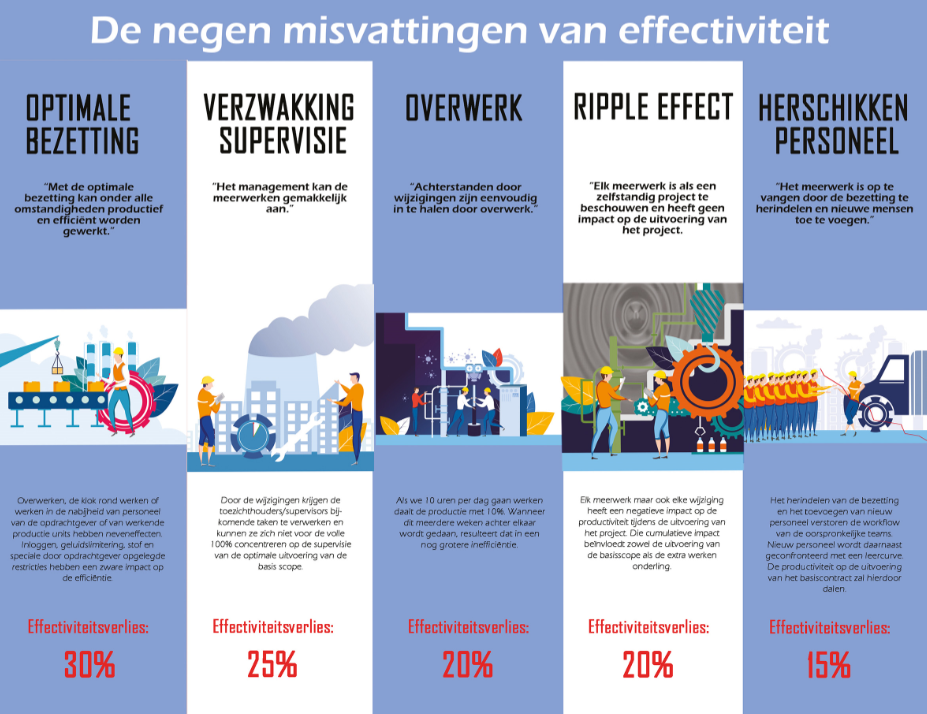

VOMI has published an infographic. It gives an at-a-glance view of the effectiveness of changes made during project implementation.
In practice, two out of three projects face delays and inefficiencies. Various causes underlie this. Consider, for instance, changes and/or additional work that adversely affect productivity. The direct cost of such a change can usually be calculated, but the disruption caused by one or more changes on project execution is difficult to quantify. In late 2019, the Optimisation Committee of VOMI, the trade association of service operators in the process industry, therefore started developing the VOMI Optimisation Model.
Nine misconceptions
Using nine misconceptions, the committee has outlined the effectiveness losses associated with various changes. It also provides substantiation regarding the (financial) impact of a change in the project/construction process, in other words a clear picture for the various stakeholders in the chain.
Handbook
The VOMI Optimisation Model is based on the handbook ‘Project Management in the Construction and MEP Sectors’. This handbook provides a detailed examination of project management and the factors that can disrupt or influence the scope, schedule and budget of projects. The most important of these are examined in detail in the handbook.
Closing
The infographic summarises the the nine main misconceptions about effectiveness. With these elements, all the 'ingredients' are in place to widely disseminate this knowledge, related to project management and optimisation.
Misconception 1 - Logistics
"Performing additional work does not cause significant disruptions in your logistics organisation" is the first misconception. In practice, changes do have a major impact on project logistics. It can even lead to a 50% loss in effectiveness. The contractor must ensure that materials and tools are present and scaffolding is in place. Prefab and transport need to be scheduled.
Misconception 2 - Accumulation of activities
"Shifting activities has no impact on productivity" is misconception two. As a project progresses, it gets busier on site. With the accumulation of activities, the site may become overcrowded which can lead to loss of effectiveness.
Misconception 3 - Learning curve
The statement "Surely, extra work can just be absorbed by adding new people" is not true. Changed circumstances, for instance due to additional work, require an adjustment period.
Misconception 4 - Access to the work site
"Additional work and more people have no impact on workplace accessibility" is the fourth misconception. More people on site means that smooth access to the site is hampered. This too can lead to lower effectiveness.
Misconception 5 - Optimal utilisation
The statement "With optimal staffing, productive and efficient work can be done under all conditions" is not true either. Conditions must also be right. For example, noise limiting, login or special restrictions imposed by the client also have an impact on efficiency.
Misconception 6 - Weakening supervision
Misconception 6 reads, "Management can easily handle the additional work". Supervisors faced with changes will have to deal with them. As a result, they cannot concentrate 100 per cent on supervision, leading to loss of effectiveness.
Misconception 7 - Overtime
"Backlogs due to changes are easily made up by overtime" is the seventh misconception. Working more decreases productivity so backlogs are not easily made up with overtime. Rather, it leads to even greater inefficiency.
Misconception 8 - Ripple effect
"Any additional work can be considered an independent project and has no impact on project execution," is misconception eight. Not only additional work but also changes negatively affect productivity during execution.
Misconception 9 - Rearranging staff
The last misconception is the assumption that "Additional work can be absorbed by reshuffling the workforce and adding new people." In reality, however, this leads to workflow disruption while adding new people comes with a learning curve, which will reduce productivity.
The VOMI Optimisation Model can be downloaded from VOMI website.
Source and image: VOMI











