
Fraunhofer researchers have developed a method to make biogenic building materials based on cyanobacteria. The bacteria multiply in a nutrient solution driven by photosynthesis. When aggregates and fillers such as sand, basalt or renewable raw materials are added, rock-like solid structures are created. Unlike traditional concrete production, this process does not emit carbon dioxide. Instead, the carbon dioxide is bound in the material itself.
The construction industry has a problem. Cement, the main component of concrete is bad for the climate. CO2 emissions from cement production are very high. Researchers at the Fraunhofer Institute for Ceramic Technologies and Systems IKTS and the Fraunhofer Institute for Electron Beam and Plasma Technology FEP have put their heads together. They are now introducing an environmentally friendly, biologically induced method to produce biogenic building materials based on cyanobacteria. This as part of the "BioCarboBeton" project. Not only does the process itself not emit any carbon. On the contrary, the climate-damaging gas is used for the process and then bound into the material.
Blue-green algae
At the heart of the new method are cyanobacteria, formerly known as blue-green algae. These bacterial cultures are capable of photosynthesis. When light, moisture and temperature interact, they form structures known as limestone stromatolites. These rocky biogenic structures have existed in nature for 3.5 billion years. This testifies to the resilience and durability of this biological process. As then, CO2 is captured from the atmosphere as part of the mineralisation process and then bound into the biogenic rock.
Technological method
Fraunhofer researchers have succeeded in mimicking this natural process with a technological method. Under the project leadership of initiator Dr Matthias Ahlhelm, who also came up with the idea, Fraunhofer IKTS develops materials and processes, selects potential fillers and binders and takes care of the shape and structure. Researchers at Fraunhofer FEP, led by Dr Ulla König, are establishing the methods for culturing the cyanobacteria, additional microbiological analysis and scaling up the biomass production to be achieved.
Structure
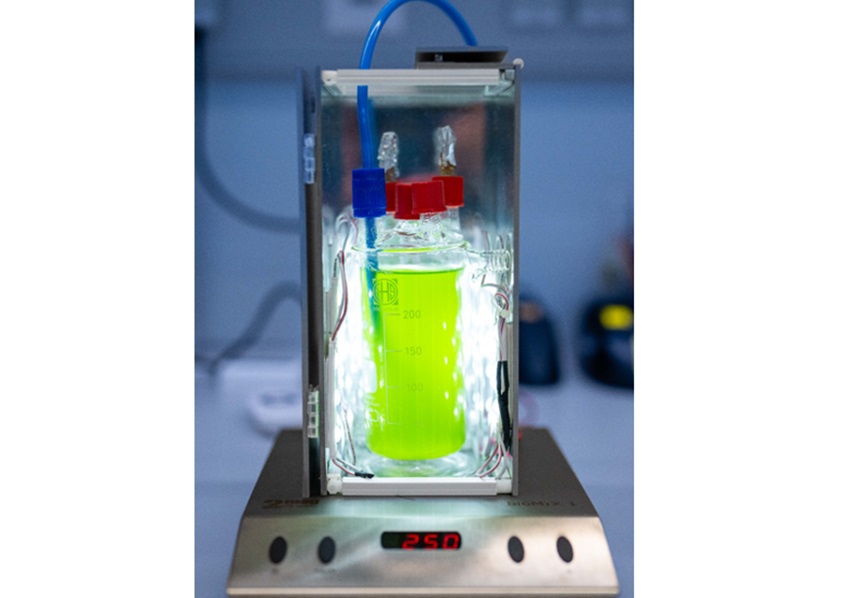
In the first step to produce biomass, light-sensitive cyanobacteria are grown in a nutrient solution. The intensity and colour of the light source used affect bacterial photosynthesis and metabolism. To ensure that the bacterial solution can undergo mineralisation to produce stromatolite-like structures, calcium sources such as calcium chloride are added. The researchers then create a mixture of hydrogels and various fillers, such as different types of sand, including marine or silica sand. Additional CO2 is added to increase the dissolved carbon dioxide content and aid the process.
Final stages of mineralisation
The bacterial mixture is stirred to the point of homogeneity. It is then given structure by transferring it into moulds, for example. The moulds should preferably be transparent so that the bacterial metabolic and photosynthetic processes can continue. Subsequent mineralisation leads to final solidification. The bacterial mixture can also be formed by spraying, foaming, extrusion or additive manufacturing. This gives it the shape in which the final stages of mineralisation take place.
Cyanobacteria
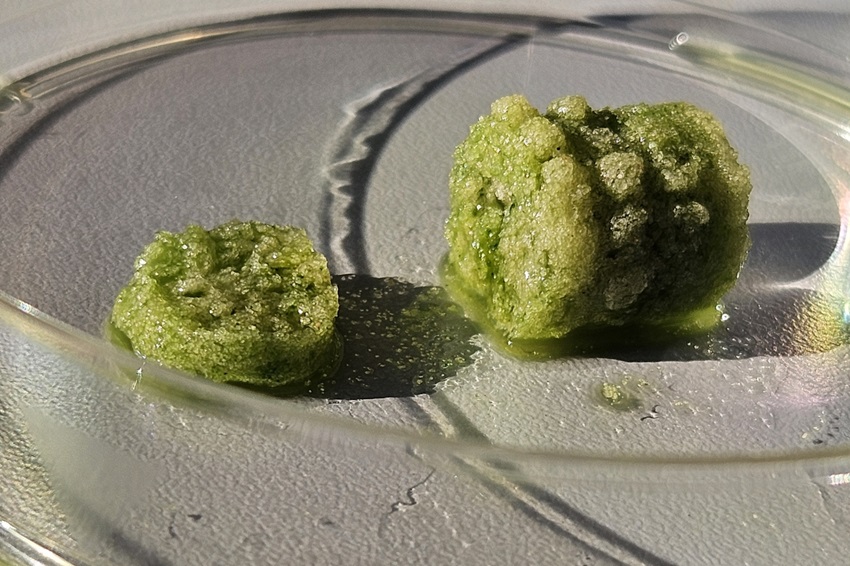
Alternatively, porous substrates can be made and then treated with cyanobacteria culture: "The developing solid structure is still porous during the process, so light enters and carbon dioxide fixation is driven by limestone mineralisation. We can stop the process by removing the light and moisture or changing the temperature," Ahlhelm explains. At that point, all the bacteria simply die off. The result is a solid product based on biogenic calcium carbonate and fillers. This can be used as brick, for example. The bio-based building materials made from cyanobacteria contain no toxic substances.
Circular process design
One of the goals of the BioCarboBeton project is to determine the possible material and mechanical properties of the biogenic materials to be produced and to scale up the processes. The researchers are already thinking about a circular process design. The carbon dioxide, for example, could come from industrial waste gases. The team is currently working with biogas. Basalt and mining waste could be used as calcium sources, but so could milk residues from dairies. And besides sand, construction waste or renewable sources could be used as filler.
Applications - from insulation to mortar
With targeted selection of fillers and management of process and mineralisation parameters, products can be made for a wide range of application scenarios. Potential applications include insulation material, brick, formwork filling and even mortar or stucco that cures or hardens after application.
Scaling up
Now that the team of researchers has established and tested the process at Fraunhofer IKTS and Fraunhofer FEP, they are working to scale up the volumes and determine the desired properties of the solid. The aim is to enable manufacturers to produce the eco-friendly bio-based building materials in the required volumes, quickly and cost-effectively.
Circular economy
Ahlhelm and König believe in the process: "Our method shows the huge potential that can be unlocked by biologisation technology. Overall, our BioCarboBeton project is an opportunity for a big step towards a circular economy in the construction industry and beyond."
Opening image: Fraunhofer FEP’s laboratory-scale photobioreactor for cultivating cyanobacteria under controlled light, temperature and gas conditions. Photo: Fraunhofer FEP
Read also: Digital construction: efficient and cost-effective